
Background
Code on Social Security (Gujarat) Rules, 2023 have been framed by the Government of Gujarat in exercise of the powers conferred under the Code on Social Security, 2020. These Rules operationalise and give procedural effect to the provisions of the Code within the State of Gujarat.
The Rules lay down detailed mechanisms for implementation, administration, and enforcement of social security benefits relating to employment injury, medical benefits, sickness, maternity, disablement, dependants’ benefits, gratuity, and other allied matters. They supplement the substantive provisions of the Code by prescribing conditions, forms, timelines, eligibility criteria, and compliance requirements for employers, employees, and authorities.
Applicability
These Rules apply to:
The Rules shall be read in conjunction with the Code on Social Security, 2020 and the Code on Social Security (Central) Rules, 2026.
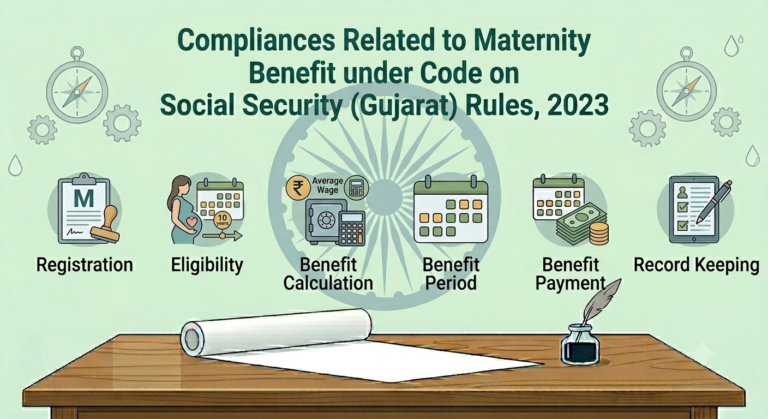
Compliance Requirements under the Rules in Accordance with the Cod.
The abstract of the provisions under Section 71 of Chapter VI of the Code and the rules framed thereunder, which is required to be exhibited under Section 71, shall be in Form XII and shall be displayed in the manner as directed by the Competent Authority.
Employers must not employ women, and women must not work, in any estalishment during the six weeks immediately following their delivery, miscarriage, or medical termination of pregnancy.
No pregnant woman shall be required to perform arduous work, tasks requiring long periods of standing, or any work likely to interfere wih her pregnancy or health during: (a) the month immediately before the six weeks preceding her expected date of delivery; or (b) any time within these six weeks if she does not take maternity leave under Section 62. ‘Work of an arduous nature’ means work that involves strenuous effort or is difficult and tiring in nature.
Employers must grant maternity benefit to eligible women employees for up to twenty-six weeks (not more than eight weeks before the expected date of delivery), at the average daily wage rate. Maternity benefit is calculated on the basis of the woman’s average daily wage for the three calendar months immediately preceding the date of absence, subject to the minimum wage under the Code on Wages, 2019. A woman is eligible only if she has worked in the establishment for at least eighty days in the twelve months preceding her expected delivery date. Women with two or more surviving children are entitled to twelve weeks (up to six weeks before confinement). Maternity benefit is paid in advance (for the pre-delivery period) on proof of pregnancy and within forty-eight hours of submitting proof of childbrth for the post-delivery portion.
The maximum period for which a woman is entitled to maternity benefit is twenty-six weeks, of which not more than eight weeks may precede the expected date of delivery. Women with two or more surviving children are entitled to a maximum of twelve weeks, of which not more than six weeks may precede the expected delivery date. Where a woman dies during the benefit period, maternity benefit is payable only up to the date of her death; where the child also survives, it is payable until the child’s death as well.
A woman who lgally adopts a child below three months of age or acts as a commissioning mother is entitled to maternity benefit for a period of twelve weeks from the date the child is handed over to her.
Where the nature of the work assigned to a woman permits her to work from home, the employer may allow her to do so after availing of her maternity benefit, on such terms and for such period as the employer and the woman mutually agree.
Every woman entitled to maternity benefit under Chapter VI of the Code shall continue to be so entitled, notwithstanding the application of Chapter IV (ESIC) to the establishment in which she is employed, until she becomes qualified to claim maternity benefit under Section 32 (ESIC provisions).
Proof of a woman’s pregnancy, childbirth, miscarriage, medical termination of pregnancy, tubectomy operation, or related illness must be provided by way of a certificate in Form X from: (1) a registered medical practitioner; (2) an Accredited Social Health Activist (ASHA); or (3) a qualified Auxiliary Nurse and Midwife (ANM). The fact of confinement ma additionally be proved by a certified extract from a birth register or a certificate signed by an ASHA, ANM, Gram Pradhan, Village Administrative Officer, or Authorised Officer of the Municipality. Miscarriage may be proved by a certificate from a qualified ANM. The death of a woman or child may be proved by a certificate in Form X from any of the prescribed authorities, or by a certified extract from a death register.
A woman entitled to maternity benefit must notify her employer using Form XI. A pregnant woman’s notice must state the date from which she will be absent, which cannot be earlier than eight weeks before her expected delivery. Any woman who was unable to give prior notice may do so as soon as practicable after delivery. Upon receipt of notice, the employer must permit the absence and pay maternity benefit. The employer must pay the pre-delivery portion in advance upon proof of pregnancy and the post-delivery portion within forty-eight hours of proof of childbirth. If a woman dies before receiving the benefit, the employer must pay the amount to her nominated person or, in the absence of nomination, her legal representative, and if there is any doubt, must deposit the aount with the Competent Authority within two months. Failure to give notice does not disentitle a woman from receiving benefits if she is otherwise eligible.
Every woman entitled to maternity benefit is also entitled to receive a medical bonus of ₹3,500 (or such higher amount as the Central Government may notify) from her employer, where the employer does not provide free pre-natal confinement and post-natal care. The medical bonus shall be paid along with the maternity benefit.
If a woman entitled to maternity benefit dies before receiving it — or in cases where the employer is liable under the second proviso to Section 60(3) — the employer must pay the full entitled amount to the person nominated by he woman in her notice, or to her legal representative if no nomination has been made. Such payment must be made within two months of the woman’s death.
After a miscarriage or medical termination of pregnancy, a woman is entitled, on production of prescribed proof (Form X), to six weeks’ leave with wages at the maternity benefit rate, immediately following the day of miscarriage or medical termination. Wages for this period must be paid within forty-eight hours of the woman submitting the prescribed certificate.
After undergoing a tubectomy operation, a woman is entitled, on production of prescribed proof (Form X), to two weeks’ leave with wages at the maternity benefit rate, immediately following the day of the tubectomy. Wages for this period must be paid within forty-eight hours of the woman submitting the prescribed certificate.
A womansuffering from illness arising out of pregnancy, delivery, premature birth, miscarriage, or medical termination of pregnancy is entitled, on production of prescribed proof (Form X), to up to one additional month’s leave with wages at the maternity benefit rate, in addition to her standard maternity entitlement. These wages must be paid within forty-eight hours of the woman submitting the prescribed certificate.
Every woman who returns to work after delivering a child is entitled to two nursing breas of fifteen minutes each during her daily work, in addition to her regular rest intervals, until the child is fifteen months old. Sufficient additional time is allowed for the journey to and from the crèche or the place where children are kept during duty hours.
Every establishment with fifty or more employees must provide a crèche for children below six years of age, within one kilometre of the establishment. Women are entitled to four dily visits to the crèche, including during rest breaks. The crèche may be operated as a standalone facility or shared with government bodies, municipalities, private entities, NGOs, or through pooled resources. The crèche must provide clean, sanitary, well-lit and ventilated accommodation in a safe, rain-proof building with a minimum floor area of ten square feet per child and a fenced play area. It must be managed by a woman with midwifery training and assisted by one female ayah for every ten children. Adequate cots, bedding, toys, feeding facilities for infants below fifteen months, bathroom and washing facilities, first aid, and nuritional provisions must be made available. The employer must inform every woman employee in writing and electronically at the time of initial appointment of all benefits available under this Chapter.
Every establishment to which Chapter VI applies must inform every woman employee in writing and electronically, at the time of her initial appointment, of every benefit available to her under this Chapter.
When a woman is absent from work under the provisions of Chapter VI, the employer cannot: discharge or dismiss her by reason of that absence; give her notice of discharge or disissal during that period; or alter her service conditions to her disadvantage. If a woman is discharged or dismissed during pregnancy, she remains entitled to maternity benefit or a medical bonus. However, if a woman is dismissed for gross misconduct, the employer may, by written order, deny these benefits. Acts constituting gross misconduct include: wilful destruction of employer’s goods or property; assault of a superior or co-employee at the workplace; criminal offences involving moral turpitude resulting in a court conviction; theft, fraud, or dishonesty in connection with the employer’s business; and wilful nonobservance of safety measures or interference with safety devices or fire-fighting equipment.
A woman entitled to maternity benefits shall not have any deductions made from her normal daily wages on account of: (a) the nature of work assigned to her during pregnancy under Section 59; or (b) nursing breaks taken by her as permitted under Section 66.
A woman who works for remuneration with any other employer during the period for which she is entitled to receive maternity benefit under the Code shall not be entitled to reeive maternity benefit for that period.
Penalty & Punishment
Disclaimer: The information contained in this Article is intended solely for personal non-commercial use of the user who accepts full responsibility of its use. The information in the article is general in nature and should not be considered to be legal, tax, accounting, consulting or any other professional advice. We make no representation or warranty of any kind, express or implied regarding the accuracy, adequacy, reliability or completeness of any information on our page/article.