
Background
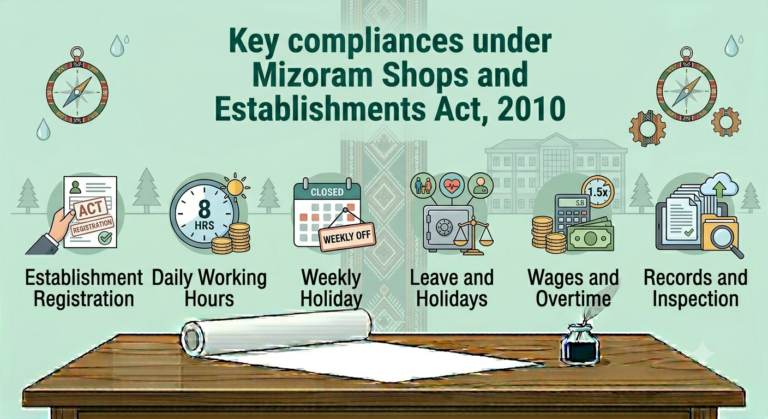
Mizoram Shops and Establishments Act, 2010 and the Mizoram Shops and Establishments Rules, 2011 form the core legislative framework governing the registration, working conditions, health, safety, and welfare of employees across shops, restaurants, hotels, and entertainment venues in Mizoram. This framework has been progressively modernized: first by the 2020 Amendment Act, which introduced vital protections for women workers (such as night-shift safety, crèches, and non-discrimination), and recently by the 2026 Amendment Act, which updated working hour limits and operational conditions.
In practice, this framework regulates the entire employment lifecycle—spanning establishment registration, mandatory appointment letters, daily working hours, rest intervals, overtime, and leave entitlements, through to dismissal protocols and child labor prohibitions. To ensure compliance, employers must strictly adhere to state health, ventilation, and fire safety standards while maintaining a meticulous administrative trail via the Visit Book and mandatory statutory registers (Forms G, H, J, K, O, P, Q, R, and S).
Applicability
Mizoram Shops and Establishments Act, 2010 and the Mizoram Shops and Establishments Rules, 2011 apply to all employers and employees in every shop, commercial establishment, residential hotel, restaurant, eating house, theatre, and place of public amusement or entertainment in the State of Mizoram. All employers are required to register their establishment with the Chief Inspector or authorised officer and comply with the conditions of registration, including renewal, display, and intimation of changes. Employers of establishments where women workers are employed are subject to additional obligations relating to non-discrimination, night-shift safety conditions, and crèche provision. Employers of establishments employing 30 or more women workers or 50 or more total workers must provide crèche facilities; those employing 100 or more workers must provide canteen facilities when so required by the State Government. Every employer is required to maintain prescribed registers and records, issue appointment letters, and produce documents on demand by the Inspector.
Compliance Requirement Under the act in Accordance with the Rules & Regulations:
Every employer must apply for registration in Form A (in duplicate with treasury challan) to the Chief Inspector or authorised officer within 30 days of commencing business or the Act/Rules becoming applicable. The fee is as per Schedule I. The Certificate of Registration in Form C is issued and is valid for 12 months. Existing establishments on the date of enforcement of the Rules had 60 days from such date; new establishments after enforcement must register within 30 days of the Act becoming applicable.
Every employer shall display the Certificate of Registration — or the Renewed Certificate of Registration, as the case may be — in a conspicuous place in the establishment at all times. Any notice or certificate required to be exhibited shall be displayed so that it is readily seen and can be read at ease by any person whom it concerns, and shall be replaced by a fresh one whenever it becomes defaced or ceases to be legible.
Where any change occurs in the ownership, management, or other particulars registered for the establishment, the employer shall notify the Chief Inspector or authorised officer in Form D — together with the original receipt of the requisite fees — within two months of such change. The Chief Inspector shall then amend the Register and the Certificate of Registration accordingly.
No employee shall be required or permitted to work for more than 10 hours in any day or 50 hours in any week. The total working hours including overtime shall not exceed 12 hours in any day, except on days of stock-taking and preparation of accounts. The total overtime hours shall not exceed 125 hours in any three consecutive months.
No young person — meaning a person who has completed fourteen years but has not completed eighteen years of age — shall be required or permitted to work for more than 5 hours in any day.
Where an employee works for more than 10 hours in a day or more than 50 hours in a week, the employee shall be entitled to overtime wages at twice the rate of normal wages for such overtime work.
On transfer of ownership of an establishment, the outgoing employer shall — within two months of such transfer — notify the Chief Inspector or authorised officer of the fact of transfer and surrender the Certificate of Registration or Renewed Certificate of Registration, along with a signed statement specifying the name and address of the transferee. The transferee (new employer) of the establishment so transferred shall apply for a new Certificate of Registration as provided in the Act and Rules.
The employer shall, within ten days of the winding-up of the business of the establishment, notify the Chief Inspector or authorised officer in Form E, accompanied by the Certificate of Registration. The Chief Inspector shall, on being satisfied about the correctness of the information, remove the name of the establishment from the Register and cancel the Certificate of Registration. Every case where an establishment is closed for a continuous period of three months or more shall be treated as a case of winding-up.
If the Certificate of Registration is lost, destroyed, or defaced, the employer shall forthwith report the matter and make an application in Form F, accompanied by the original receipt depositing the required fees per Schedule I. The Chief Inspector shall issue a duplicate certificate duly stamped with the words ‘DUPLICATE’ in red ink.
The period of work of an adult employee shall be fixed such that no employee works for more than four consecutive hours before being given a rest interval of at least one hour. No young person shall be required or permitted to work continuously for more than three hours before being given a rest interval of at least one hour.
The employer must fix employee work schedules so that the spread over — inclusive of rest intervals — does not exceed 12 hours in any day.
No woman worker shall be discriminated against in matters of recruitment, training, transfer, promotion, or wages. Every employer shall ensure that women workers are treated equally with men in all such matters within the establishment.
No woman shall be required or allowed to work in a shop or establishment except between 6:00 a.m. and 9:00 p.m. Employment between 9:00 p.m. and 6:00 a.m. shall be allowed only with the written consent of the woman, subject to the employer ensuring: workplace safety; separate toilets; protection from sexual harassment; adequate security; and safe transportation to and from the workplace. Employers shall maintain consent records and make them available for inspection.
Every establishment shall remain closed on, and every employee of such establishment shall be allowed as holiday for rest on, one day of every week.
Every employer of a shop shall submit Form J in duplicate to the Inspector within whose jurisdiction the shop is situated, specifying the day on which the shop shall remain entirely closed each week. The Inspector shall countersign the form on being satisfied about the correctness of the entries, retain one copy, and return the other copy to the employer for display in the shop.
Every employer of a commercial establishment or establishment for public entertainment or amusement shall submit Form K in duplicate to the Inspector, specifying one and a half continuous days in each week during which every employee shall be allowed holidays. The Inspector shall countersign and return one copy for display in the establishment.
The one and a half weekly holidays determined for employees shall be continuous in nature and shall not be altered more than once during a calendar year.
No deduction shall be made from the wages of any employee on account of the closure of the shop on the prescribed weekly closing day or any additional weekly closure period required under the Act. Employees shall be entitled to receive full wages for such weekly holidays.
Every employee in an establishment shall be entitled to three national holidays — Republic Day (26th January), Independence Day (15th August), and Gandhi Jayanti (2nd October) — and five festival holidays on such days as the Government of Mizoram may specify by notification, all with wages. Where an employee in a residential hotel, restaurant, eating house, theatre, or place of public amusement is required to work on any such holiday, a compensatory holiday with wages shall be allowed within thirty days. If the employee is required to work on the compensatory holiday, additional wages equal to the ordinary rate shall be paid.
Every employee in an establishment shall be entitled to: (a) privilege leave with wages for 15 days after every 12 months of continuous service, accumulating up to a maximum of 30 days; (b) casual leave with wages for 8 days in a calendar year; and (c) sick leave with wages for 12 days after every 12 months of continuous service, on production of a medical certificate. Applications for privilege leave shall be submitted in writing at least 7 days before the intended date; the employer shall dispose of the application within 3 days. Leave duly applied for shall not be refused, and all refused privilege leave shall accumulate without any ceiling.
If an employee entitled to leave is discharged before being allowed the leave, or quits employment after having been refused leave, the employer shall pay the full amount of wages payable for the period of leave to which the employee is entitled at the time of separation. For leave allowed under Section 15, wages shall be paid at the daily average of the employee’s normal wages for the days worked during the preceding month, excluding overtime earnings.
No employer shall remove or dismiss an employee who has rendered continuous service for not less than six months except for reasonable cause and unless the employee has been given one month’s prior written notice or paid one month’s wages in lieu of such notice. An employee is deemed to have completed six months of continuous service notwithstanding interruptions due to sickness, accident, or authorised leave not exceeding 45 days in aggregate; lock-out; legal strike; or intermittent involuntary unemployment not exceeding 15 days in aggregate.
No child shall be employed in any establishment except as permitted under the Child Labour (Prohibition and Regulation) Act, 1986. No young person shall be required or allowed to work — whether as an employee or otherwise — in any establishment before 6:00 a.m. or after 7:00 p.m.
Every employer shall make effective arrangements to provide and maintain at suitable and conveniently situated points a sufficient supply of wholesome drinking water for all persons employed in the shop or establishment.
Every employer shall provide sufficient latrines and urinals, separately for male and female employees, conveniently situated and accessible to all workers. Where space constraints make individual provision impracticable, several employers may join to provide common latrine and urinal facilities.
In every shop or establishment wherein 30 or more women workers or 50 or more total workers are ordinarily employed, a suitable room or rooms shall be provided and maintained as a crèche for the use of children of women workers. A group of shops or establishments may provide a common crèche within a radius of one kilometre, with the Chief Facilitator’s approval and subject to specified conditions.
Every employer shall provide at the place of work first-aid facilities as may be prescribed by the Government, to enable prompt response to injuries, accidents, or medical emergencies occurring at the establishment.
Where required by the State Government, the employer of a shop or establishment wherein not less than 100 workers are employed shall provide and maintain a canteen for the use of workers. A group of shops or establishments may provide a common canteen with the Chief Facilitator’s approval and subject to specified conditions.
Every employer shall maintain all prescribed registers and records on the premises of the establishment. These include: Form G — hours of work and rest intervals; Form H — overtime work and wages; Form P — lime-washing, colour-washing, painting or varnishing dates; Form R — register of employment signed by each employee; and Form S — leave register and leave card for each employee.
Every employer shall issue a letter of appointment in Form O to every employee before commencement of work, and shall furnish copies to the Chief Inspector by registered post with acknowledgment due and to the Inspector of the area. For persons already employed on the date the Rules come into force, the letter shall be issued within 30 days. For persons employed after the Rules come into force, the letter shall be issued before the person commences work. The appointment letter shall be effective from the actual date of employment.
Every establishment shall: (1) lime-wash or colour-wash all inside walls, ceilings, tops, passages, and staircases at least once a year (or earlier if required by the Inspector); and (2) paint or varnish all beams, rafters, doors, window frames, and other woodwork (except floors) once in two years. This requirement does not apply to rooms used only for storage of articles or to show-rooms, unless the Inspector so directs. The employer shall maintain a register in Form P recording the dates on which each such activity is carried out.
The employer shall maintain a register in Form P and enter the dates on which lime-washing, colour-washing, painting, or varnishing activities are carried out at the establishment, in compliance with the prescribed maintenance requirements under Rule 37.
All floors, passages, and staircases shall be swept, washed, and dried — where necessary with mixtures or detergents or deodorizers — at least once a day, to keep them adequately clean and free from slippery agents or substances giving offensive smell.
Where the floor of the premises of an establishment is liable to become wet in the course of any process, effective means of drainage shall be provided and maintained to prevent accumulation of water and ensure safe working conditions.
No rubbish, filth, or debris shall be allowed to accumulate or to remain on or near any premises of an establishment in such a position that effluvia can arise therefrom, causing unhygienic conditions for employees and visitors.
All drains carrying waste water, silage water, or sewage shall be constructed of impermeable material and shall be flushed regularly — at least twice daily — to prevent blockage and accumulation of hazardous matter.
In every establishment in which articles are stored with a view to their transport or sale, adequate washing facilities — including soap, towels, and nail brushes — shall be provided and maintained free for the use of employees.
No stationary internal combustion engine shall be operated in any establishment unless the exhaust is conducted into the open air. No other internal combustion engine shall be operated in any room unless effective measures have been taken to prevent accumulation of fumes that are likely to be injurious to the health of employees.
In every establishment in which dust, fumes, or other impurities of such nature and extent as are likely to be injurious or offensive to employees are given off, effective measures shall be taken to prevent their inhalation and accumulation. Where an exhaust appliance is required, it shall be applied as near as possible to the point of origin of the dust, fume, or impurity, and such point shall be enclosed as far as possible.
Every employer of an establishment where food, drink, or beverage is prepared and served shall ensure that all persons employed in connection with the business — including the employer — are free from any communicable disease. A certificate in Form Q to this effect shall be obtained from a competent medical officer not below the rank of Health Officer of Class I, and produced before the Inspector on demand.
In every establishment, proper arrangements shall be made for providing a sufficient supply of drinking water fit for human consumption to all employees. The water shall be stored in a hygienically sheltered place and kept clean and properly covered. As far as practicable, only filtered water shall be supplied for this purpose.
Every employer shall provide and maintain at convenient places a sufficient number of spittoons in a clean and hygienic condition with lime. The disinfectants in the spittoons shall be replaced daily.
Latrines and urinals shall be conveniently accessible and provided in sufficient numbers for the use of employees. Walls, ceilings, and partitions shall be made of glazed tiles or, where not, shall be white-washed or colour-washed once every month. All latrines and urinals shall be adequately lighted, ventilated, and maintained in a clean and sanitary condition at all times.
Every establishment shall: (a) be provided with adequate means of escape in case of fire; (b) ensure that all exit doors can be opened easily and immediately from inside while any person is within the room — no locking or fastening that prevents this is permitted; (c) provide fire buckets and/or chemical fire extinguishers in suitable numbers and at suitable locations based on the nature of work and size of the premises; and (d) in establishments dealing in or with inflammable substances, conspicuously display a warning notice that no person shall smoke or use a naked light in the immediate vicinity of such substances.
Every dangerous part of machinery shall be securely fenced by safeguards of substantial construction, kept in position while such parts are in motion or in use. In establishments where packing or any other process is carried on with the aid of electric power, suitable devices for cutting off power in emergencies from running machinery shall be provided and maintained. No employee wearing loose-fitting clothes shall be allowed or required to work near moving machinery or belts; tight-fitting clothes shall be provided free by the employer.
Every employer shall maintain a Visit Book on the premises, which shall be produced on demand by an Inspector. The Visit Book shall be a bound book of size 7 inches x 6 inches containing at least two hundred pages, each page numbered in duplicate with a vertically perforated straight line on the margin side. Every page shall contain: name and full address of the establishment; Registration Number; date; and time of visit. If the Visit Book is lost, destroyed, or defaced, the employer shall forthwith report in writing to the area Inspector and immediately replace it.
No employee shall work in any establishment, and no employer shall knowingly permit an employee to work in any establishment, on a day on which the employee is on leave or enjoying a holiday granted under the provisions of the Act and Rules.
In every workroom or hall of an establishment, windows and other forms of openings for ventilation shall be provided in sufficient numbers to admit a continued supply of fresh air, so as to keep the atmosphere inside such room or hall comfortable and free from dust, fumes, and other impurities.
Every employer shall maintain a Register of Employment in Form R. The register shall be kept up to date and all changes shall be recorded within three days from the date of occurrence. Each entry shall bear the signature of the employee concerned and shall be authenticated by the employer.
Every employer shall maintain a Register of Leave in Form S. Particulars of every leave application — whether granted or refused — shall be entered in the relevant portion of the register against the employee’s name immediately upon receipt of the application.
Every employer shall provide each employee with a Leave Card in the prescribed format containing leave records. The Leave Card shall remain the property of the employee and may be retained by the employer only for making entries therein and for a period not exceeding one week at a time. Where an employee loses the Leave Card, the employer shall issue a duplicate Leave Card upon payment of the prescribed fee, and update the card based on entries in the Leave Register.
Every employer shall maintain all prescribed registers and records regularly and legibly in English or Mizo. Records shall be serially page-marked, well bound, updated on the same day of occurrence, and authenticated by the employer, manager, or authorised person. Such records shall be preserved for at least three successive years.
Penalty & Consequences:
Section 24 of the Mizoram Shops and Establishments Act, 2010 — General Penalty
Whoever contravenes any provision of the Act or Rules shall be liable to a fine which may extend to ₹2,00,000. In case of a continuing contravention, an additional fine of up to ₹2,000 per day may be imposed for each day the default continues, subject to a maximum of ₹2,000 per worker employed. For a repeat offence — i.e., contravention of the same provision after a prior conviction — the offender shall be punishable with a fine of not less than ₹1,00,000 and up to ₹5,00,000.
Section 24B of the Mizoram Shops and Establishments Act, 2010 — Penalty for Obstruction
Whoever wilfully obstructs the Inspector in the exercise of powers conferred by or under the Act, or refuses or wilfully neglects to afford the Inspector any reasonable facility for making any entry, inspection, examination, supervision, search, or inquiry authorised under the Act, shall be punishable with a fine which may extend to ₹50,000.
Disclaimer: The information contained in this Article is intended solely for personal non-commercial use of the user who accepts full responsibility of its use. The information in the article is general in nature and should not be considered to be legal, tax, accounting, consulting or any other professional advice. We make no representation or warranty of any kind, express or implied regarding the accuracy, adequacy, reliability or completeness of any information on our page/article.