
Background
The RERC notified the RERC (Renewable Purchase Obligation) Regulations, 2023 under Section 86(1)(e) of the Electricity Act, 2003, prescribing renewable energy procurement targets for obligated entities in Rajasthan. The framework covered Wind RPO, Hydro Purchase Obligation (HPO), Other RPO and Energy Storage Obligation (ESO), with compliance monitored under the RERC REC and RPO Compliance Framework.
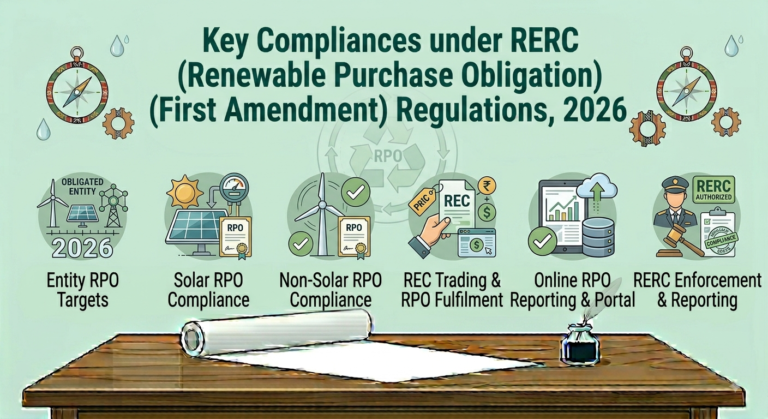
The First Amendment Regulations, 2026 revised the RPO targets for FY 2024-25 and FY 2025-26 and introduced, from FY 2026-27, a four-category framework comprising Wind RPO, Hydro RPO, DRE RPO and Other RE RPO. It also aligned Designated Consumers with the Central Government’s Renewable Consumption Obligation (RCO) framework and operationalised ESO requirements.
Applicability
The regulations primarily apply to:
Compliance Requirement Under the act in Accordance with the Rules & Regulations:
Distribution Licensees, including deemed licensees, must comply with the following Renewable Purchase Obligation (RPO) targets for the financial years specified: for FY 2024-25 — Wind RPO 2.46%, Hydro Purchase Obligation (HPO) 1.08%, Other RPO 26.37%, Total RPO 29.91%; and for FY 2025-26 — Wind RPO 3.36%, HPO 1.48%, Other RPO 28.17%, Total RPO 33.01%. Wind RPO must be met from energy generated by Wind Power Projects (WPPs) commissioned after 31st March 2022, along with eligible wind energy exceeding 7% from WPPs commissioned on or before 31st March 2022. HPO must be met from Hydro Power Projects (HPPs), including Pumped Storage Plants (PSPs) and Small Hydro Plants (SHPs), commissioned after 8th March 2019. Other RPO may be met from any other renewable or green energy source. From FY 2024-25 onwards, energy from all Hydro Power Projects counts towards overall RPO, while the HPO sub-obligation applies only to eligible post-8th March 2019 hydro projects. RPO is calculated on total electricity consumption; eligible free hydro power (excluding LADF contributions) may count towards HPO, and any HPO shortfall must be met through additional hydro power or Hydro RECs as per CERC norms. Shortfalls in Wind, HPO, and Other RPO categories may be adjusted using eligible surplus renewable energy as permitted. Imported hydro power does not qualify for HPO. For FY 2024-25 and FY 2025-26, RPO compliance is deemed met to the extent that a Designated Consumer demonstrates compliance with its Renewable Consumption Obligation (RCO) under the Energy Conservation Act, 2001, and no separate RPO penalty applies for such Designated Consumers for these years. Proceedings for prior financial years remain unaffected.
From FY 2026-27 onwards, Distribution Licensees, including deemed licensees, must comply with a revised four-category RPO framework with the following annual targets: FY 2026-27 — Wind 1.97%, Hydro 1.34%, Decentralised Renewable Energy (DRE) 2.70%, Other RE 29.94%, Total 35.95%; FY 2027-28 — Wind 2.45%, Hydro 1.42%, DRE 3.30%, Other RE 31.64%, Total 38.81%; FY 2028-29 — Wind 2.95%, Hydro 1.42%, DRE 3.90%, Other RE 33.09%, Total 41.36%; FY 2029-30 — Wind 3.48%, Hydro 1.33%, DRE 4.50%, Other RE 34.02%, Total 43.33%. Wind RPO must be met from WPPs commissioned after 31st March 2024; Hydro RPO from HPPs commissioned after 31st March 2024, including eligible free power and approved overseas hydro projects. DRE includes renewable energy projects of up to 10 MW capacity, including solar and other notified sources; where generation data is unavailable, DRE is computed at 4 kWh per kW per day. Other RE includes pre-1st April 2024 wind and hydro energy (including free power), biomass, and municipal solid waste co-firing. Wind, Hydro, and Other RE targets are fungible among themselves; the DRE target is non-fungible and must be met independently, though any DRE surplus may be applied against Other RE shortfall. Nuclear power is excluded from RPO computation. RPO is computed on electricity supplied to consumers, excluding open access supply procured from other sources and captive self-consumption.
Captive Power Plants (CPPs) and Open Access consumers with a contracted load or installed capacity of 1 MW and above must comply with the following Total RPO targets: FY 2024-25 — 29.91%; FY 2025-26 — 33.01%; FY 2026-27 — 35.95%; FY 2027-28 — 38.81%; FY 2028-29 — 41.36%; FY 2029-30 — 43.33%. For CPPs commissioned before 1st April 2016, the applicable RPO is at the level mandated by the Commission for FY 2015-16. For CPPs commissioned from 1st April 2016 onwards, the RPO level mandated for the year of commissioning applies. In the case of capacity augmentation, the augmented capacity carries the RPO applicable for the financial year in which the augmentation occurred. Surplus power generated by CPPs may be sold to Distribution Companies under prevailing arrangements or through power exchanges.
Distribution Licensees, including deemed licensees, must fulfil an Energy Storage Obligation (ESO) in addition to their RPO, calculated as a percentage of total electricity consumption for each financial year as follows: FY 2024-25 — 1.5%; FY 2025-26 — 2.0%; FY 2026-27 — 2.5%; FY 2027-28 — 3.0%; FY 2028-29 — 3.5%; FY 2029-30 — 4.0%. The ESO must be met through renewable energy stored in an Energy Storage System (ESS). The ESO is deemed fulfilled on an annual basis only where at least 85% of the total energy stored in the ESS during that year is procured from renewable energy sources. Energy stored from renewable energy sources that counts towards ESO fulfilment also counts towards the overall RPO to that extent. The ESO is applicable to all Distribution Licensees including deemed licensees for all financial years and is subject to periodic review by the Commission through a separate order, taking into account the commissioning and operation of Pumped Storage Plant (PSP) capacity, emerging commercially viable energy storage technologies, and changes in the cost of Battery Energy Storage Systems (BESS). Compliance with the ESO is verified by the State Agency under the RERC (Renewable Energy Certificate and Renewable Purchase Obligation Compliance Framework) Regulations, 2010, as amended.
Where an obligated entity changes its status between Non-Designated Consumer (subject to RERC RPO framework) and Designated Consumer (subject to the Renewable Consumption Obligation framework under the Energy Conservation Act, 2001) during a financial year, compliance is to be determined under the applicable framework for the respective period of the financial year during which each status was operative. The entity is required to notify the State Agency within 30 days of such change of status. Where any inconsistency arises between the RPO framework under these Regulations and the RCO notification issued by the Central Government under the Energy Conservation Act, 2001, the Central Government notification prevails.
Penalty & Consequences
The following penalty provisions apply across the compliance obligations covered in this blog.
Section 142 of the Electricity Act, 2003 (as amended by the Jan Vishwas (Amendment of Provisions) Act, 2026, with effect from 1st June 2026) — Penalty for Contravention of the Act, Rules, Regulations, or Directions
Any person who contravenes any provision of the Electricity Act, 2003, or any rule, regulation, or direction or order issued thereunder — including non-compliance with RPO, ESO, or notification obligations under the RERC RPO Regulations — shall be liable to: (a) a penalty of not less than ₹10,000 but which may extend to ₹5,00,000 for each contravention; and (b) in the case of a continuing failure, an additional penalty of not less than ₹1,000 but which may extend to ₹10,000 per day during the period of such failure. Proceedings under Section 142 may be initiated by the Commission suo motu or upon a complaint filed before the Appropriate Commission.
Section 146 of the Electricity Act, 2003 — Penalty for Failure to Comply with Orders or Directions
Whoever fails to comply with any order or direction given under the Electricity Act, 2003 within the time specified therein, or contravenes, attempts, or abets the contravention of any provision of the Act or any rule or regulation made thereunder, shall be punishable with a fine of not less than ₹10,000 but which may extend to ₹10,00,000 in respect of each offence. In the case of a continuing failure, an additional fine of not less than ₹1,000 but which may extend to ₹50,000 for every day during which the failure continues after conviction of the first offence shall also be imposed. Section 146 applies where a person knowingly fails to comply with directions issued under the Act.
Section 149 of the Electricity Act, 2003 — Offences by Companies
Where a company commits any contravention under the Electricity Act, 2003, the company itself is liable for the contravention. In addition, every person who, at the time the contravention was committed, was in charge of and responsible for the conduct of the business of the company — including the Managing Director, Director, Manager, and other key managerial persons — shall also be deemed guilty of and liable for the contravention, unless such person proves that the contravention was committed without their knowledge or that they exercised all due diligence to prevent the commission of such contravention.
Regulation 9 of the RERC (Renewable Energy Certificate and Renewable Purchase Obligation Compliance Framework) Regulations, 2010 — RPO Default Charge and Remedial Directions
On a finding of RPO default, the Rajasthan Electricity Regulatory Commission (RERC) may levy an RPO charge on the defaulting entity based on the quantum of the shortfall and the forbearance price of Renewable Energy Certificates (RECs) as determined by CERC. The amount so levied is to be deposited in a separate fund to be utilised for the purchase of RECs and for the development of renewable energy evacuation infrastructure. There is no fixed monetary penalty prescribed in these Regulations; enforcement operates primarily through: (i) direction to purchase additional RECs sufficient to make up the identified shortfall; and (ii) initiation of proceedings under Section 142 of the Electricity Act, 2003 for continued non-compliance. The Commission may, in cases of genuine difficulty, allow carry-forward of unfulfilled RPO obligations to subsequent years or grant a partial waiver, as considered appropriate.
Renewable Consumption Obligation (RCO) Framework — Designated Consumers under the Energy Conservation Act, 2001
For entities classified as Designated Consumers under the Energy Conservation Act, 2001, non-compliance with RPO for FY 2024-25 and FY 2025-26 is to be addressed exclusively under the RCO enforcement mechanism of the Energy Conservation Act rather than through parallel RPO proceedings by RERC. The Central Government’s notification under the Energy Conservation Act prevails over the RERC RPO framework in case of inconsistency, and no separate RPO penalty is imposed on Designated Consumers for these years to the extent their RCO compliance is established. From FY 2026-27 onwards, Designated Consumers transitioning back to Non-Designated Consumer status revert to RERC RPO compliance and penalty provisions.
Practical Enforcement Consequences of RPO or ESO Non-Compliance
Where an obligated entity — whether a Distribution Licensee, deemed licensee, CPP, or Open Access consumer — fails to meet its RPO or ESO targets, the RERC or the designated State Agency identifies the shortfall through the annual compliance verification process. The Commission may then direct the entity to purchase additional renewable power or equivalent RECs to make up the shortfall. If the entity continues to fail after such direction, RERC may initiate proceedings under Section 142 of the Electricity Act, 2003, which may result in monetary penalties as described above. For Designated Consumers, enforcement may instead proceed under the Energy Conservation Act and RCO framework. Penalty under the Electricity Act, 2003 is not automatic and is initiated either upon a complaint filed before the Appropriate Commission or where the Commission, acting suo motu, is satisfied that an obligated entity has contravened the provisions of the Act or the RPO Regulations.
Disclaimer: The information contained in this Article is intended solely for personal non-commercial use of the user who accepts full responsibility of its use. The information in the article is general in nature and should not be considered to be legal, tax, accounting, consulting or any other professional advice. We make no representation or warranty of any kind, express or implied regarding the accuracy, adequacy, reliability or completeness of any information on our page/article.