
Background
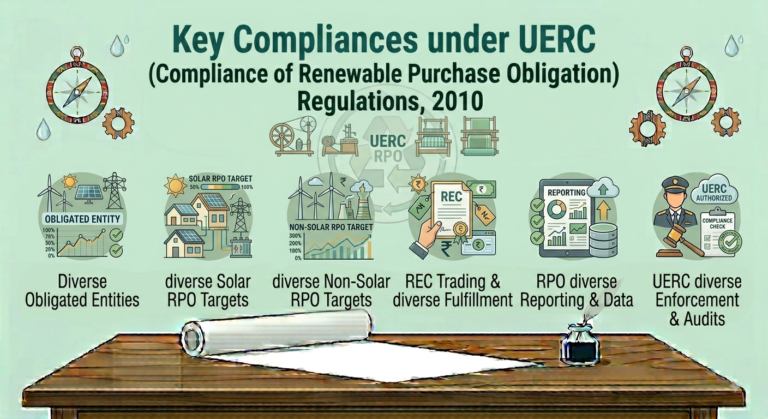
UERC (Compliance of Renewable Purchase Obligation) Regulations, 2010 establish the framework for ensuring compliance with Renewable Purchase Obligation (RPO) in Uttarakhand under Section 86(1)(e) of the Electricity Act, 2003. The Regulations require specified Obligated Entities to procure a prescribed percentage of their electricity consumption from renewable energy sources, including separate Solar and Non-Solar RPO requirements. They also recognise Renewable Energy Certificates (RECs) as a mechanism for meeting RPO, with Solar and Non-Solar RECs to be procured through approved Power Exchanges and deposited with the State Agency. The framework further provides for accreditation of eligible renewable energy generators participating in the REC mechanism and establishes an RPO Fund mechanism for addressing RPO shortfalls.
Applicability
Regulations apply primarily to Distribution Licensees, Captive Power Plants (CPPs) with a connected load or installed capacity of 1 MW and above, and Open Access consumers of equivalent capacity in Uttarakhand. Obligated Entities are required to meet the applicable annual RPO targets, submit their estimated renewable energy requirements, file periodic and annual compliance reports, and procure and deposit RECs where applicable. In case of an RPO shortfall, the entity may be directed to deposit the prescribed amount into the RPO Fund within the specified period. Renewable energy generating companies, including eligible CPPs and co-generation plants seeking to participate in the REC mechanism, are required to obtain accreditation from the State Agency and comply with the applicable accreditation and reporting requirements.
Compliance Requirement Under the act in Accordance with the Rules & Regulations:
Every Obligated Entity must purchase a minimum specified percentage of its total electricity requirement — expressed in kWh — from renewable energy sources during each financial year, as prescribed by the Commission under the UERC (Tariff and Other Terms of Supply of Electricity from Co-generation and Renewable Energy Sources) Regulations, 2010. A specified portion of the total RPO must be sourced exclusively from solar energy-based generation. The RPO obligation is inclusive of any renewable energy purchases already being made by the Obligated Entity under existing arrangements. Power purchases under Power Purchase Agreements for renewable energy already entered into by distribution licensees and consented to by the Commission shall continue until their present validity, even if the total purchases under such agreements exceed the prescribed percentage.
Renewable Energy Certificates (RECs) issued under the CERC (Terms and Conditions for Recognition and Issue of Renewable Energy Certificate for Renewable Energy Generation) Regulations, 2009 are valid instruments for the discharge of the mandatory RPO obligations under these Regulations. Where an Obligated Entity fulfils its RPO through the purchase of RECs rather than through direct procurement of renewable energy, the Solar RPO must be met exclusively through Solar RECs, and the Non-Solar RPO must be met exclusively through Non-Solar RECs. The two categories of RECs are not interchangeable for the purpose of RPO compliance.
Obligated Entities that purchase Renewable Energy Certificates through a Power Exchange must deposit such certificates with the State Agency in accordance with the procedure prescribed by the State Agency. The State Agency’s procedure is to be based on the procedure of the Central Agency and must be approved by the Commission. Compliance with the deposit procedure is a precondition for the RECs to be recognised towards fulfilment of the RPO.
Every Obligated Entity must submit to the State Agency — with a copy marked to the Commission — the estimated renewable energy purchase requirement for the ensuing financial year on or before 15th March of each year. The estimated quantum must be computed in accordance with the UERC (Tariff and Other Terms of Supply of Electricity from Co-generation and Renewable Energy Sources) Regulations, 2013. If the actual renewable energy requirement at the end of the financial year differs from the estimate submitted in March, the Renewable Purchase Obligation shall be revised accordingly to reflect the actual requirement.
Every Obligated Entity must submit a quarterly status report to the State Agency in respect of its compliance with the Renewable Purchase Obligation for each quarter of the financial year. The quarterly report must be submitted in accordance with the procedure framed by the State Agency for this purpose. These quarterly reports enable the State Agency and the Commission to monitor RPO compliance on an ongoing basis and identify shortfalls during the year.
Every Obligated Entity must submit a detailed annual compliance statement to the State Agency — under intimation to the Commission — within one month of the close of each financial year, in respect of the compliance of the Renewable Purchase Obligation for that year. The annual statement must provide a comprehensive account of renewable energy purchased directly, RECs procured, and the overall extent of RPO fulfilment for the year, and must be reconciled with the estimates submitted in March and the quarterly reports submitted during the year.
Where an Obligated Entity fails to meet its Renewable Purchase Obligation for any financial year and has not procured adequate RECs to cover the shortfall, the Commission may direct the Obligated Entity to deposit into the RPO Fund the amount determined by the Commission in respect of the shortfall. The Obligated Entity must deposit the directed amount within fifteen days of communication of the Commission’s direction. The RPO Fund is maintained for the purpose of promoting renewable energy development and facilitating RPO compliance within the State.
Every eligible renewable energy generating company — including eligible captive power plants and co-generation plants — that wishes to participate in the Renewable Energy Certificate mechanism must obtain accreditation from the State Agency before participating. The application for accreditation must be made to the State Agency in the prescribed manner, with all required project details including project location, metering details, injection point, and proposed mode of power sale. To be eligible for accreditation, the generating company must: have the required grid connectivity where applicable; not be a party to a Power Purchase Agreement that disqualifies the energy from RPO compliance by obligated entities; sell power only through permitted modes; maintain prescribed metering and accounting systems; comply with all captive use and transmission, wheeling, and banking conditions; and not supply REC-accredited power to obligated entities for the purpose of RPO compliance. The State Agency must grant or reject the accreditation application within thirty days. Accreditation, once granted, is valid for five years unless revoked earlier.
Every renewable energy generating company that has obtained accreditation under these Regulations must submit an annual status report to the State Agency in respect of the accreditation and all other matters connected with it. The State Agency, in coordination with the concerned transmission licensee and/or distribution licensee, monitors accredited projects, maintains accounts of the sale and purchase of RECs by generating companies and obligated entities, and undertakes other functions incidental to the monitoring of accredited projects. The annual status report from each generating company provides the State Agency with the information necessary for this monitoring function.
Penalty & Consequences
The following penalty provisions and enforcement consequences apply across the compliance obligations covered in this blog.
Regulation 7.1 — Deposit into RPO Fund on RPO Default
An Obligated Entity that fails to fulfil its Renewable Purchase Obligation and does not procure adequate Renewable Energy Certificates may be directed by the Commission to deposit the shortfall amount — as determined by the Commission — into the RPO Fund within fifteen days of communication of the Commission’s direction. This direction is the primary regulatory consequence for RPO non-compliance under the UERC framework, and the obligation to deposit arises immediately upon communication of the Commission’s direction.
Section 142 of the Electricity Act, 2003 (as amended by the Jan Vishwas (Amendment of Provisions) Act, 2026, with effect from 1st June 2026) — Penalty for Contravention of the Act, Rules, Regulations, or Directions
Any contravention of the provisions of the Electricity Act, 2003, or any rule, regulation, or direction or order issued thereunder — including contraventions — may attract a penalty of not less than ₹10,000 but which may extend to ₹5,00,000 for each contravention. In the case of a continuing failure, an additional penalty of not less than ₹1,000 but which may extend to ₹10,000 per day during the period of such continuing non-compliance shall also be imposed.
Section 146 of the Electricity Act, 2003 — Penalty for Failure to Comply with Orders or Directions
Whoever fails to comply with any order or direction given under the Electricity Act, 2003 within the time specified therein, or contravenes, attempts, or abets the contravention of any provision of the Act or any rule or regulation made thereunder, shall be punishable with a fine of not less than ₹10,000 but which may extend to ₹10,00,000 in respect of each offence. In the case of a continuing failure, an additional fine of not less than ₹1,000 but which may extend to ₹50,000 for every day during which the failure continues after conviction of the first such offence shall also be imposed.
Regulation 11.1 — Revocation of Accreditation
Accreditation granted to a renewable energy generating company — including eligible captive power plants and co-generation plants — may be revoked by the State Agency where: (a) the generating company breaches any of the terms and conditions of its accreditation that are expressly declared to render the accreditation liable to revocation; or (b) the generating company makes wilful and prolonged default, in the opinion of the State Agency, in doing anything required of it by or under these Regulations. Revocation of accreditation disqualifies the generating company from participating in the REC mechanism.
Disclaimer: The information contained in this Article is intended solely for personal non-commercial use of the user who accepts full responsibility of its use. The information in the article is general in nature and should not be considered to be legal, tax, accounting, consulting or any other professional advice. We make no representation or warranty of any kind, express or implied regarding the accuracy, adequacy, reliability or completeness of any information on our page/article.