
Background
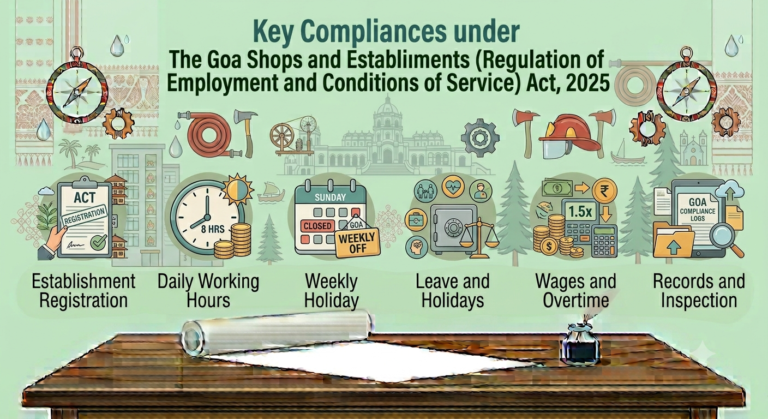
Goa Shops and Establishments (Regulation of Employment and Conditions of Service) Act, 2025 (“the Act”) is a new State legislation enacted by the Goa Legislature to modernise and consolidate the regulatory framework governing employment conditions in shops and commercial establishments in Goa. The Act replaces the earlier legislative framework with a unified statute covering registration and licensing through a fully online process, weekly rest entitlements, hours of work, spread-over limits, overtime, women’s and young persons’ protections, child employment prohibition, leave entitlements, health and safety measures, welfare facilities, records maintenance, appointment letters, identity cards, and annual returns. A significant feature of the Act is the two-tier registration framework: establishments with twenty or more workers must obtain formal online registration with a Labour Identification Number (LIN) issued within seven working days; establishments with fewer than twenty workers need only file an online intimation of commencement. The Act introduces a dedicated Facilitator-cum-Inspector as the primary regulatory authority, replacing the earlier Inspector-only model. The existing Goa, Daman and Diu Shops and Establishments Rules, 1975 continue to apply for procedural matters — including prescribed forms, fees, age verification, fire safety measures, and record maintenance — until replaced or amended under the new Act.
Applicability
Act and the 1975 Rules apply to all employers of shops and commercial establishments in Goa. Establishments employing twenty or more workers must obtain online registration and maintain a valid registration certificate with LIN, while those employing fewer than twenty workers must file an online commencement intimation. All employers — regardless of size — must comply with the Act’s substantive protections: weekly rest with compensatory holiday and double wages for rest-day work; daily and weekly working-hour limits for adult workers with a 30-minute break after every five hours; spread-over limits of twelve hours (fourteen for intermittent/urgent work); overtime at double rate not exceeding 144 hours per quarter; women’s working-hour restrictions with written consent and welfare safeguards for night work; young person restrictions (no work before 6:00 AM or after 7:00 PM; max seven hours per day or forty-two per week; no overtime); absolute prohibition on child employment; leave entitlements (nine days sick, six days casual, fifteen days earned per 240 days worked, earned leave accumulation up to 45 days); health, safety, drinking water, latrine, and fire prevention standards. Establishments with fifty or more workers must provide a crèche; those with one hundred or more workers must provide a canteen as required by the State Government. All employers must maintain Forms XX/XXI, XXII, XXIII registers; issue appointment letters in Form XXX; issue identity cards; and file annual returns in the prescribed form when notified.
Compliance Requirement Under the act in Accordance with the Rules & Regulations:
Every employer of an establishment employing twenty or more workers must apply online in Form II for registration with the Facilitator-cum-Inspector of the local area, within sixty days of commencing business. The application must be accompanied by the prescribed fee, a self-declaration, and self-certified documents as prescribed. On receipt of a complete application, the Facilitator-cum-Inspector must register the establishment and issue online a registration certificate along with a Labour Identification Number (LIN) within seven working days. The registration certificate must be produced whenever demanded by the Facilitator-cum-Inspector. A registration certificate is valid for the period requested by the applicant, subject to a maximum of five years.
Every employer of an establishment employing fewer than twenty workers must submit an online intimation of commencement of business within sixty days of commencing, in the prescribed form containing details of the name of the employer and manager, name of the establishment, nature of business, number of workers, and such other prescribed particulars. Where the establishment ceases business, the employer must intimate the closing within thirty days of closure. Where the number of workers at any time becomes twenty or more, full registration under Section 6 becomes mandatory and all provisions of the Act apply.
Where a registration certificate is lost, destroyed, or defaced, the employer must immediately inform the Inspector and apply in Form V with the prescribed fee of ₹10 for a duplicate certificate. The duplicate certificate issued shall be duly stamped ‘DUPLICATE’.
Every employer must digitally communicate to the Facilitator-cum-Inspector any change in the particulars contained in the registration application, within fifteen days of the change taking effect, in Form VI or digital mode. The communication must be accompanied by the prescribed fee, a self-declaration, and self-certified documents as prescribed. The Facilitator-cum-Inspector shall update the register of establishments accordingly and issue a fresh registration certificate online.
A registration certificate is non-transferable. On transfer of ownership of an establishment, the transferor must notify the Inspector, surrender the existing registration certificate, and submit the transferee’s details within thirty days of the transfer. The transferee must apply for a fresh registration certificate within thirty days of the transfer.
Where an establishment closes its business, the employer must inform the Facilitator-cum-Inspector within thirty days of closure in the prescribed form and manner. On receiving the information and being satisfied about its correctness, the Facilitator-cum-Inspector shall remove the establishment from the register and cancel the registration certificate. Where the Facilitator-cum-Inspector does not receive information but is otherwise satisfied that the establishment has closed, the Facilitator-cum-Inspector may take these steps on their own initiative.
Every employer must display a list of workers occupying confidential, managerial, or supervisory positions on the establishment’s website, or — where the establishment does not have a website — at a conspicuous place in the establishment. A copy of the list must also be sent to the Facilitators. This obligation ensures transparency about which workers are excluded from or treated differently under the Act’s working conditions provisions.
No adult worker shall be required or allowed to work in any establishment for more than ten hours in any one day or more than forty-eight hours in any one week. No adult worker shall be required to work continuously for more than five hours without a break of at least thirty minutes. Working hours or weekly holiday requirements may be relaxed in cases of urgent work with the prior written permission of the Facilitator-cum-Inspector.
The spread-over of a worker — being the total period from the start of work to the end of work on any day, inclusive of rest intervals — shall not exceed twelve hours in any day. For workers entrusted with intermittent or urgent work, the spread-over shall not exceed fourteen hours in any day.
Where a worker is required to work beyond eight hours in a day (excluding rest time) or beyond forty-eight hours in a week, the worker is entitled to overtime wages at twice the ordinary rate of wages. The total number of overtime hours shall not exceed one hundred and forty-four hours in any period of three months. Where a worker’s normal working day is up to ten hours (excluding rest), overtime at the double rate applies only when the worker works beyond forty-eight hours in a week.
Every establishment may remain open for business on all days in a week, subject to the condition that every worker must be allowed a weekly holiday of at least twenty-four consecutive hours of rest. Where a worker is denied the weekly holiday, a compensatory holiday in lieu thereof must be granted within two months of the scheduled weekly holiday. Where a worker is required to work on a rest day, the worker is entitled to wages at twice the ordinary rate for that day. No deduction shall be made from the wages of any worker on account of any day on which it has been a weekly holiday under this section.
No woman worker shall be required or allowed to work in any establishment outside the hours of 7:00 AM to 7:30 PM. A woman worker may be permitted to work between 7:30 PM and 7:00 AM subject to: the establishment providing shelter, restroom, ladies’ toilet, adequate protection and safety, and protection from sexual harassment; the provision of transportation from the establishment to her residence; and the woman worker’s written consent.
No employer shall employ or permit any child to work in any shop or establishment in any capacity whatsoever. The obligation to ensure that no child is engaged applies at all times during which the establishment is in operation.
No young person shall be required or permitted to work in any establishment before 6:00 AM or after 7:00 PM on any day.
No young person shall be required or permitted to work in any establishment for more than seven hours in any one day or more than forty-two hours in any one week. No overtime shall be permitted for young persons under any circumstances.
Every worker in a shop or establishment is entitled to: nine days of sick leave per calendar year; six days of casual leave per calendar year; and fifteen days of earned leave for every completed two hundred and forty days of work in a year. Earned leave may be accumulated up to a maximum of forty-five days. Where leave is refused, the worker is entitled to encashment of excess earned leave. Weekly paid holidays must be provided as required under the Act.
Every employer must take all prescribed measures relating to the health and safety of workers, including: maintaining cleanliness of the premises; adequate lighting and ventilation; lime-washing or colour-washing of all inside walls and ceilings of rooms; and fire prevention measures as prescribed. These obligations are continuous and must be maintained at all times during the operation of the establishment.
Every employer must provide and maintain prescribed first-aid facilities at the place of work. The prescribed first-aid box must contain: three small sterilised dressings; two medium-size sterilised dressings; two large-size sterilised dressings; two large-size sterilised burn dressings; two packets of sterilised cotton wool; one pair of dressing scissors; one bottle of iodine or mercurrichrome solution; one bottle of salvolatile solution with dose and mode of administration indicated; one bottle of potassium permanganate crystals; and an ointment or cream for burns.
Every employer must make effective arrangements to provide and maintain at suitable and conveniently situated points a sufficient supply of wholesome drinking water for all persons employed in the establishment. The area around drinking water distribution points must be kept clean and properly drained at all times.
Every employer must provide sufficient separate latrine and urinal facilities for male and female workers, conveniently situated for worker access and maintained as prescribed. Where constraints of space or other circumstances make it impractical for an establishment to provide independent facilities, several employers may provide common latrines and urinals, subject to such conditions as may be prescribed.
Every establishment in which fifty or more workers are employed must provide and maintain a suitable room or rooms as a crèche for the use of the children of such workers. A group of establishments within a radius of one kilometre may, with the approval of the Chief Facilitator and subject to specified conditions, provide a common crèche in lieu of individual crèche facilities.
Where the State Government requires it, every employer of an establishment in which one hundred or more workers are employed must provide and maintain a canteen for the use of workers. The canteen must be established and operated in accordance with such conditions and specifications as may be prescribed by the State Government.
Every employer must maintain a register of employment in Form XX, or in Form XXI where the opening and closing hours are uniform, and must display a notice of hours of work of employees in Form XXII. All registers and records may be maintained electronically or manually; hard copies, duly signed by the employer or their representative, must be produced on demand during inspection. All registers and records must be kept in the premises to which they relate and must be produced for inspection by the Chief Facilitator or Facilitator-cum-Inspector on demand. In addition, a register of wages in Form XXIII must be maintained for every establishment, containing the rate of wages payable to each employee, overtime wages paid, gross wages earned per wage period, total deductions made, wages actually paid, and the signature or thumb impression of the employee.
Every employer must furnish an annual return to the prescribed authority in the prescribed form and manner — including in electronic form. The prescribed form, due date, and designated authority are yet to be notified under the Rules. Employers should monitor the Goa Government Gazette for the notification of these operational details.
Every employer must issue an order of appointment in Form XXX to every worker before the worker joins service. For workers who were already in service on the date of commencement of the Act, the appointment letter must be issued within three months from the date of commencement.
Every employer must issue an identity card to every worker employed in the establishment. The identity card must contain details of the employer and establishment, the worker’s name and date of birth, date of joining, department, nature of work, designation, and the dated signature of the employer or manager. Workers must produce their identity card on demand by the Facilitator-cum-Inspector.
When required by the Inspector, the employer must produce an authentic school record or birth certificate confirming the age of any employee. Where such a document is unavailable, a Form VII age certificate issued by a Government Medical Health Officer must be furnished instead.
Every establishment other than a shop must provide adequate fire escape routes and must keep a sufficient number of water or sand buckets or chemical fire extinguishers at suitable locations throughout the premises. The smoking of cigarettes or beedis and the use of naked lights near or in the vicinity of any inflammable materials must be strictly prohibited.
Penalty & Consequences
Section 32 — General Penalty for Contravention of the Act or Rules
Whoever contravenes any provision of the Act or any rule made thereunder shall be punishable with a fine which may extend to ₹10,000. In the case of a continuing contravention, an additional fine which may extend to ₹500 for every day during which such contravention continues shall also be imposed. On subsequent conviction, the fine may extend to ₹20,000.
Section 33 — Enhanced Penalty where Contravention Causes Serious Bodily Injury or Death
Where an employer is held guilty of contravening any provision of the Act or the rules made thereunder and the contravention has resulted in an accident causing serious bodily injury or death of a worker, the employer shall, on conviction, be punishable with a fine of not less than ₹25,000, which may extend to ₹1,00,000. This enhanced penalty applies in addition to any other liability under law.
Rule 37 — Penalty for Contravention of Rules
Any person who contravenes any provision shall, on conviction, be punishable with a fine which may extend to ₹50. This rule-level penalty applies to violations relating to duplicate certificate applications, transfer-of-ownership procedures, age verification obligations, and fire safety and prevention measures under the Rules.
Disclaimer: The information contained in this Article is intended solely for personal non-commercial use of the user who accepts full responsibility of its use. The information in the article is general in nature and should not be considered to be legal, tax, accounting, consulting or any other professional advice. We make no representation or warranty of any kind, express or implied regarding the accuracy, adequacy, reliability or completeness of any information on our page/article.