
Background
Meghalaya Shops and Establishment Act, 2004 is the principal State legislation governing employment conditions in shops and commercial establishments in Meghalaya. The Act regulates registration and renewal, opening and closing hours, hours of work and overtime, weekly holidays, prohibition on child employment, women’s working hours, wage payment timelines, leave entitlements, termination notice, health and safety standards, fire precautions, and record-keeping obligations. The Meghalaya Shops and Establishment (Amendment) Act, 2025 introduced significant updates to the Act, including enhanced penalty provisions, the express obligation for establishments employing ten or more women to constitute an Internal Complaints Committee under the POSH Act, 2013, strengthened night-work protections for women requiring written consent and separate rest rooms, and revised compliance requirements. The Meghalaya Shops and Establishments Rules supplement the Act with prescribed forms, fees, and procedural requirements including Form B (registration), Form D (change of particulars), Form E (winding up), Form F (duplicate certificate), Form K (overtime register), and Form M (appointment letter).
Applicability
Act and Rules apply to all employers of shops and commercial establishments in Meghalaya employing five or more employees, who must obtain registration in Form B annually and renew it for each calendar year. All registered employers are subject to the Act’s operational obligations: compliance with Government orders on opening and closing hours; working-hour limits of forty-eight hours per week with a 30-minute rest interval after every five continuous hours; quarterly overtime cap of 144 hours with double-rate wages; weekly holiday of at least one and a half days for employees in commercial and entertainment establishments; absolute prohibition on employment of children under fourteen; night-work obligations for women employees requiring written consent and separate rest rooms; ICC constitution for establishments employing ten or more women; wage payment by the seventh day of each wage period and within two working days on discharge; paid leave entitlements (16 days privilege leave, 12 days medical leave, 12 days casual leave per year) plus 3 days religious leave and national/State-notified paid holidays; one month’s notice or wages in lieu for employees with six or more months of service; cleanliness, ventilation, lighting, and fire safety standards; maintenance of all prescribed registers including Form K (overtime) and display of prescribed notices; and issuance of Form M appointment letters to every employee.
Compliance Requirement Under the act in Accordance with the Rules & Regulations:
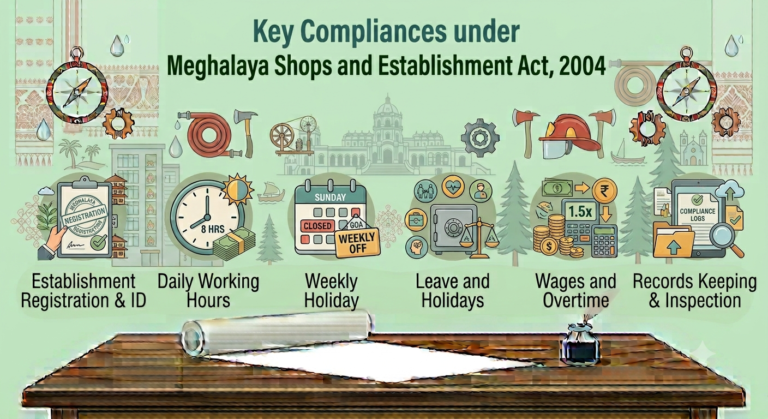
Every establishment employing five or more employees must register with the Labour Commissioner or such other officer as the Labour Commissioner may authorise, in Form B. The registration is valid for the calendar year in which it is granted and must be renewed for each subsequent calendar year. The application for registration or renewal must be submitted within the prescribed date, accompanied by the prescribed fee in the form of a treasury challan. No employer shall carry on business without a valid registration certificate or after the expiry of the last date for submission of a renewal application. The registration certificate must be produced whenever demanded by the inspecting authority.
Every registered employer must prominently display the Certificate of Registration — or the Renewal Certificate, as applicable — at a conspicuous place within the establishment at all times during which the establishment is in operation. The certificate must remain legibly displayed and must not be removed or defaced.
Where any change occurs in the particulars submitted at the time of registration under Rule 3, the employer must notify the Labour Commissioner or authorised officer in Form D within ten days of the change, accompanied by the original treasury challan evidencing payment of the prescribed fee. On receiving the notification and verifying its correctness, the authority shall update the register of establishments and, where required, amend the existing Registration Certificate or issue a fresh one.
Where an establishment is wound up, the employer must notify the Labour Commissioner or authorised officer in Form E within ten days of the winding up, and must simultaneously surrender the Registration Certificate. Closure of an establishment for three or more continuous months is deemed to constitute winding up for the purposes of this obligation. On verification of the closure, the authority shall remove the establishment from the register and cancel the Registration Certificate.
Where the Registration Certificate is lost, destroyed, or defaced, the employer must immediately report the matter to the Labour Commissioner or authorised officer and apply in Form F, accompanied by the original treasury challan evidencing payment of the prescribed fee. The authority shall issue a duplicate certificate marked ‘DUPLICATE’ in red upon receipt of the application and verification.
Opening and Closing Hours of Establishment (Section 4)
Every establishment registered under the Act may remain open for business on all days of the year, subject to compliance with any Government order or notice restricting the opening or closing hours of establishments issued from time to time by the State Government. Employers must monitor and comply with all such notifications without further specific notice.
No employee shall be required or permitted to work in any establishment for more than forty-eight hours in any one week. Every employer must provide paid weekly holidays as prescribed. Overtime is limited to one hundred and forty-four hours in any one quarter and must be compensated at twice the ordinary rate of wages. No employee shall be required to work continuously for more than five hours without a rest interval of at least thirty minutes.
Every employee in a commercial establishment or in an establishment for public entertainment or amusement must be allowed a holiday of at least one and a half days in each week. The employer must display Form H specifying the weekly holidays of employees. This entitlement must be honoured at all times and may not be set aside by agreement or custom.
No child — being a person who has not completed fourteen years of age — shall be employed in any establishment in Meghalaya in any capacity whatsoever. This prohibition applies at all times and the employer must ensure strict and continuous compliance.
Women employees may be required to work between 8:00 PM and 6:00 AM, subject to: (i) the employer providing separate rest rooms or resting areas for women employed during night shifts; and (ii) obtaining and maintaining written consent from each woman employee required to work beyond 8:00 PM. The written consent must be secured before the night shift and maintained in records. Where separate rest room facilities are not available, women may not be required to work during these hours.
Every employer employing ten or more women workers must constitute an Internal Complaints Committee (ICC) in accordance with the requirements of the Sexual Harassment of Women at Workplace (Prevention, Prohibition and Redressal) Act, 2013. The ICC must be operative for the establishment and must function as required under that Act. Establishments employing fewer than ten employees must refer any complaint of sexual harassment to the Local Committee of the concerned district.
Every employer must fix wage periods not exceeding one month and must pay wages in cash to all employees before the expiry of the seventh day from the last day of each wage period. On discharge of an employee, all wages earned must be paid within two working days of the date of discharge. No deduction from wages shall be made on account of closure of the establishment for a statutory holiday. The employer is personally responsible for ensuring payment of all wages required under the Act.
Every employer must pay overtime wages at twice the ordinary rate of wages — being the basic wages plus such allowances including the cash equivalent of the advantage of concessional meals and food grains, but excluding bonus — for every hour of work performed beyond the prescribed daily hours. Every employer in an establishment must maintain a register of overtime in Form K, recording all overtime worked and the corresponding wages paid.
After completion of twelve months of continuous service, every employee is entitled in the subsequent twelve-month period to: (a) sixteen days of privilege leave with full wages, which may be accumulated up to a maximum of thirty days; (b) twelve days of medical leave with wages for any sickness or accident; and (c) twelve days of casual leave with full wages on any reasonable ground. For the purpose of computing continuous service, interruptions caused by sickness, accident, or authorised leave (up to ninety days in aggregate), lockouts, non-illegal strikes, and voluntary unemployment (up to thirty days in aggregate) are excluded. On discharge, wages in lieu of all accrued privilege leave must be paid.
Every employee is entitled to leave of absence for up to three days in any one year for the purpose of attending religious ceremonies, performing religious functions, or carrying out duties enjoined by their religion. The employee selects the specific days for such leave and the employer must grant the entitlement.
Every employer must grant paid holidays to all employees on the following days each year: 26th January (Republic Day), 1st May (Labour Day), 15th August (Independence Day), and 2nd October (Gandhi Jayanti). In addition, any other days declared by the State Government by notification as paid holidays must also be granted. Employees must receive full wages for each such holiday.
No employee who has been in continuous service for not less than six months shall be discharged from service except for reasonable cause and without giving at least one month’s notice in writing or wages in lieu of such notice. The notice requirement is dispensed with only where the discharge is on grounds of misconduct supported by satisfactory evidence recorded at an inquiry held for the purpose.
Every employer must ensure the premises of the establishment are kept clean and free from effluvia arising from any drain, privy, or other nuisance, and must clean the premises at the times and by the methods prescribed. The premises must be adequately ventilated and sufficiently lighted during all working hours in accordance with the standards and methods prescribed.
Every employer must provide adequate fire exits and ensure that all exit doors remain unlocked at all times during working hours. Suitable fire extinguishers or water and sand buckets must be kept at appropriate locations throughout the premises. Notices prohibiting smoking and the use of open flames near inflammable materials must be displayed at all relevant points. These fire safety measures are a continuous obligation and must be maintained at all times.
Every employer must maintain all registers, records, and documents prescribed under the Act and the Rules at the premises of the establishment to which they relate. All prescribed notices must be displayed at the establishment at all times. All registers, records, notices, and documents must be kept up-to-date and must be produced immediately on demand by an Inspector.
Every employer must, on demand by an Inspector, immediately produce all registers, records, and notices required to be kept and maintained under the Act and the Rules for inspection. The documents must be kept at the establishment premises and must be accessible at all times.
Every employer must issue an appointment letter in Form M to every employee, effective from the employee’s actual date of commencement of employment. All new employees must receive the appointment letter before commencing work. Employees who were already in service when the Rules came into force must receive their appointment letters within thirty days of the Rules coming into force.
Penalty & Consequences
Section 3 of the Meghalaya Shops and Establishment Act, 2004 (as amended 2025) — Default in Registration or Renewal
Where an employer carries on business without a valid registration certificate or after the expiry of the last date for submission of a registration or renewal application, the employer is liable to pay: (a) a penalty equal to the prescribed registration or renewal fee; and (b) an additional penalty of ₹5 for every day of continued default after the expiry of the last date for submission of the application. No penalty is attracted where the employer has submitted a valid application for registration or renewal within the prescribed period.
Section 23 of the Meghalaya Shops and Establishment Act, 2004 (as amended by the Meghalaya Shops and Establishment (Amendment) Act, 2025) — General Penalty for Contravention of the Act or Rules
Whoever contravenes any provision of the Act or any rule made thereunder shall be liable to a penalty which may extend to ₹50,000. For a second or subsequent offence, the employer shall be liable to a penalty which may extend to ₹1,00,000.
Rule 47 of the Meghalaya Shops and Establishments Rules — Contravention of Rules
Whoever contravenes any provision of the Meghalaya Shops and Establishments Rules — including obligations relating to registration forms, change of particulars (Form D), winding-up notice (Form E), duplicate certificate (Form F), appointment letter (Form M), and overtime register (Form K) — shall, on conviction, be punishable with a fine which may extend to ₹5,000. Where the breach is a continuing one, an additional fine which may extend to ₹250 for every day after the first during which the breach continues shall also be imposed. Rules 34 and 36 carry separate penalties not covered by Rule 47.
Disclaimer: The information contained in this Article is intended solely for personal non-commercial use of the user who accepts full responsibility of its use. The information in the article is general in nature and should not be considered to be legal, tax, accounting, consulting or any other professional advice. We make no representation or warranty of any kind, express or implied regarding the accuracy, adequacy, reliability or completeness of any information on our page/article.