
Background
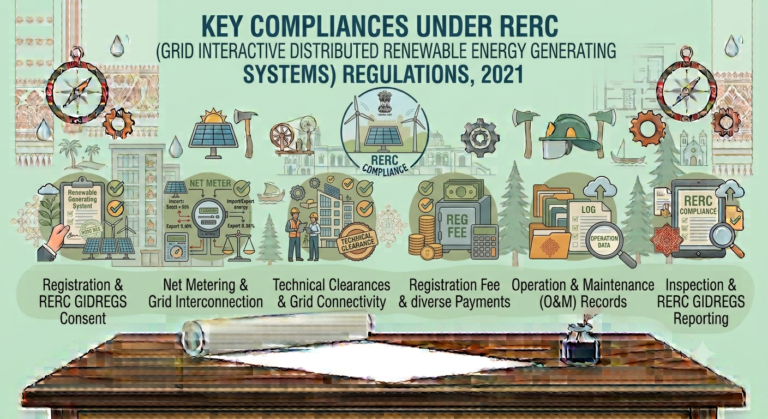
RERC (Grid Interactive Distributed Renewable Energy Generating Systems) Regulations, 2021 (“the DREGS Regulations”) were notified by the Rajasthan Electricity Regulatory Commission (RERC) to establish a comprehensive framework for grid-connected rooftop and distributed renewable energy generating systems commissioned on or after 1st July 2021 in Rajasthan. The DREGS Regulations supersede the RERC (Connectivity and Net Metering for Rooftop and Small Solar Grid Interactive Systems) Regulations, 2015 for all new installations, while the 2015 Regulations continue to govern systems commissioned under Net Metering agreements up to 30th June 2021 until expiry of their Connection Agreements. The DREGS Regulations introduced four distinct energy settlement arrangements: Net Billing (for grid-side connected systems, with surplus energy credited at the applicable tariff); Net Metering (for consumer-side connected systems, with domestic consumers receiving payment for net surplus); Group Net Metering (GNM, for a single consumer spreading generation across multiple connections); and Virtual Net Metering (VNM, for multiple consumers sharing energy from a common source). The DREGS Regulations have been amended three times: the First Amendment Regulations, 2023 introduced peak AC capacity limits for Net Billing and Net Metering systems and revised the RESCO charge framework; the Second Amendment Regulations, 2024 introduced the deemed-acceptance provision for domestic 10 kW and below installations and revised the LoA and commissioning timelines; and the Third Amendment Regulations, 2025 introduced the GNM and VNM framework in full detail, introduced BESS technical standards, revised energy settlement rates for domestic Net Metering consumers, and added the domestic rooftop solar fee waiver provisions.
Applicability
DREGS Regulations apply to all Eligible Consumers in Rajasthan — being electricity consumers permitted to install and operate a grid-connected RE generating system — who commission systems on or after 1st July 2021. All eligible consumers must comply with the applicable arrangement (Net Billing, Net Metering, GNM, or VNM) for their category and contracted capacity; clear pending electricity arrears before applying; follow the prescribed application process including Annexure II form and specified fees; install systems within 180 days of the Letter of Approval; execute a Connection Agreement before commencing generation; ensure all technical, safety, and equipment standards per CEA Regulations and RERC Supply Code are met; provide and maintain anti-islanding protection, automatic synchronisation, and harmonic filtering; bear the costs of RE Generation Meter, Check Meter, and meter maintenance; observe the prohibition on third-party sale; comply with zero-injection requirements for behind-meter systems; and intimate the Distribution Licensee for behind-meter installations using Annexure V. RESCO entities operating under the framework must execute direct payment agreements with consumers (no tripartite arrangements) and comply with all Regulation 10, 11, and 15 charge and exemption provisions. The State Load Despatch Centre and Distribution Licensees have corresponding obligations — including processing applications, issuing Letters of Approval, installing meters, signing Connection Agreements — which run parallel to the consumer obligations described in this blog.
Compliance Requirement Under the act in Accordance with the Rules & Regulations:
An Eligible Consumer must install the Renewable Energy (RE) generating system within permissible technical limits, within the consumer’s premises, and interconnect at the consumer’s existing interconnection point to operate safely in parallel with the Distribution Licensee’s network. These Regulations apply to all Grid Interactive Distributed RE generating systems commissioned on or after 1st July 2021. Rooftop and Small Solar Grid Interactive Systems commissioned under Net Metering agreements up to 30th June 2021 continue under Net Metering until expiry of the Connection Agreement as per the RERC (Connectivity and Net Metering for Rooftop and Small Solar Grid Interactive Systems) Regulations, 2015. Consumers under existing Net Metering may shift to Net Billing only after termination of the existing Net Metering Connection Agreement; similarly, they may opt for Group Net Metering (GNM) or Virtual Net Metering (VNM) only after termination of the existing Agreement. A prosumer under Net Billing is not eligible for VNM or GNM under these Regulations.
Consumers having pending arrears with the Distribution Licensee are not eligible for Net Billing, Net Metering, Group Net Metering, or Virtual Net Metering under these Regulations. Where a dispute exists between the Distribution Licensee and the consumer relating to any electricity charge, the consumer shall be allowed to proceed with the relevant arrangement upon deposit of the disputed amount with the Distribution Licensee in accordance with Section 56 of the Electricity Act, 2003, pending resolution of the dispute.
RESCO-based RE generating systems are permitted under Net Metering, GNM, VNM, or Net Billing arrangements. Eligible Consumers may lease or rent rooftop space, land, or water bodies to a RESCO for this purpose. The RESCO must execute a direct payment agreement with the consumer; no tripartite agreement involving the Distribution Licensee is permitted. Any dispute between the consumer and the RESCO arising from their contractual obligations is to be settled mutually; the Commission and the Distribution Licensee are not parties to such disputes, and the Distribution Licensee shall not disconnect the consumer on grounds arising from such a dispute. All other provisions of these Regulations applicable to RE generating systems apply equally to RESCO-owned systems.
The maximum capacity of the RE generating system to be installed at any Eligible Consumer’s premises shall not exceed 100% of the Sanctioned Load or Contract Demand of the consumer, in conformity with the provisions of the RERC (Electricity Supply Code and Connected Matters) Regulations, 2021, and subsequent amendments thereto.
The RE generating system capacity at an Eligible Consumer’s premises must be more than 1 kW and up to 1 MW under Net Billing, Net Metering, Group Net Metering, or Virtual Net Metering, subject to the conditions in Regulation 7.2. Where the Eligible Consumer intends to install an RE generating system exceeding 1 MW, the terms and conditions of that arrangement are governed by the RERC (Terms and Conditions for Tariff Determination from Renewable Energy Sources) Regulations, 2020, and subsequent amendments.
HT consumers (connected at 11 kV and above) may install and connect an RE generating system at their LT Bus Bar System. In such cases, the RE Generation Meter or Net Meter must be installed on the HT side of the consumer’s transformer.
An Eligible Consumer may install, enhance the capacity of, or upgrade RE generating systems at different locations within the same premises, after following due procedure and intimating the concerned Distribution Licensee. The total capacity of all such systems within the same premises must not exceed the capacity limits specified in the Regulations.
Open access is allowed to Eligible Consumers or prosumers under Group Net Metering and Virtual Net Metering connections only for the purpose of wheeling energy to the beneficiary consumers or connections of the same consumer. Third-party sale is not allowed under Net Metering, Group Net Metering, Virtual Net Metering, or Net Billing arrangements, except for the RESCO model as permitted under these Regulations. Charges and losses are levied on beneficiary consumers under VNM or GNM as specified in Regulation 15.
An Eligible Consumer proposing to install an RE generating system must apply in the form at Annexure II — notified by the Distribution Licensee on its website — before installation, accompanied by the applicable fee: LT Single Phase ₹200, LT Three Phase ₹500, HT 11 kV ₹1,000, HT 33 kV ₹2,000, EHT 132 kV and above ₹5,000. The consumer must compulsorily provide their email address and mobile number with the application.
The Distribution Licensee must acknowledge and register the application on receipt, process it in order of receipt, and provide status tracking through a unique registration number via web portal, mobile app, SMS, or other suitable mode. Technical feasibility must be completed within 15 days; if not completed within this period, the proposal is deemed technically feasible. RE generating systems up to 10 kW for domestic category consumers under Net Metering, VNM, or GNM — if complete in all respects — are deemed accepted without technical feasibility study or enhancement of sanctioned load; this deemed feasibility does not apply to non-domestic consumers. For existing consumers under VNM or GNM, feasibility must be completed within 15 days; for new consumers seeking fresh connectivity, within 30 days, after which feasibility is deemed. Connectivity must be granted within 30 days of technical or deemed feasibility. If technically feasible, the Distribution Licensee must issue the Letter of Approval (LoA) within 30 days of acknowledgement of the application.
Where deficiencies are found during the technical feasibility study — regarding RE generating system capacity or available transformer loading — the Distribution Licensee must inform the applicant by email, SMS, or post within twenty working days of acknowledgement. The applicant must rectify the deficiencies within fifteen days of receiving the intimation and inform the Distribution Licensee of the resolution by email or post.
After installing the RE generating system, the consumer must submit the installation certificate to the Distribution Licensee. Receipt of the installation certificate triggers the Distribution Licensee’s obligation to sign the Connection Agreement, install the meter, and commission the system within 15 days.
The consumer has the option to purchase the requisite meter for the RE generating system. Such a meter, once purchased by the consumer, must be tested and installed by the Distribution Licensee.
The Eligible Consumer must install the RE generating system within 180 days of receiving the Letter of Approval, in accordance with prescribed standards. Failure to install within 180 days results in the automatic cancellation of the Letter of Approval.
The Eligible Consumer and the Distribution Licensee must enter into a Connection Agreement — in the form at Annexure IV-A for Net Billing or Annexure IV-B for Net Metering, GNM, or VNM — after approval of connectivity and before the start of actual generation from the RE generating system. The Connection Agreement must be executed before the system commences generation.
Upon termination of the Connection Agreement, the Eligible Consumer must immediately and forthwith disconnect the RE generating system from the Distribution Licensee’s network.
The RE generating system and all allied equipment must conform to: (a) the Central Electricity Authority (Technical Standards for Connectivity of the Distributed Generation Resources) Regulations, 2013; (b) the CEA (Installation and Operation of Meters) Regulations, 2006; (c) the CEA (Measures relating to Safety and Electric Supply) Regulations, 2010; and (d) the RERC (Electricity Supply Code and Connected Matters) Regulations, 2021, and subsequent amendments.
The consumer must get the RE system equipment installed at their premises by the supplier’s representative to confirm satisfactory working. The equipment must be pre-tested by the supplier and a test certificate for the equipment must be provided to the consumer. Additionally, tests as per applicable standards must be conducted to ensure the quality of power generated from the RE generating system.
The voltage levels at which the RE generating system is connected with the grid must be as per the RERC (Electricity Supply Code and Connected Matters) Regulations, 2021, as amended from time to time, subject to the capacity and technical requirements of Regulation 7.
The consumer who installs the RE generating system is solely responsible for the safe operation, maintenance, and rectification of defects of the system up to the Interconnection Point. Beyond the Interconnection Point — including the metering arrangement — responsibility rests with the Distribution Licensee. The Distribution Licensee may, however, call upon the consumer to rectify a defect within a reasonable time.
The Eligible Consumer is solely responsible for any incident — fatal, non-fatal, departmental, or non-departmental — that may occur due to back-feeding from the RE generating system when the grid supply is off. The Distribution Licensee reserves the right to disconnect the consumer’s installation at any time in such emergencies to prevent incident or damage to persons and property.
The Eligible Consumer may install the RE generating system with or without storage. Any alternate source of supply — including battery power, diesel generator, or backup power — must be restricted to the consumer’s network. The consumer must take adequate safety measures to ensure that battery, DG, or backup power does not extend to the Distribution Licensee’s LT grid on failure of the Licensee’s grid supply.
Tests as per EN 50160 and as per the Distribution Licensee’s standards must be carried out to ensure the quality of power generated from the RE generating system before and during grid-parallel operation.
The RE generating system must be capable of detecting an unintended islanding condition and must have anti-islanding protection — tested in accordance with IEC 62116 — to prevent unfavourable conditions including failure of supply arising from such islanding.
Every RE generating system must be equipped with an automatic synchronisation device. A system using an inverter is not required to have a separate synchronising device if the same functionality is inherently built into the inverter.
Where the Distribution Licensee determines it necessary for maintenance and safety purposes, it may require the consumer to provide a manually operated isolating switch between the RE generating system and the electricity system. Where such a requirement is imposed, the switch must: (a) allow visible verification that electrical separation has been accomplished; (b) include clear indications of open and closed positions; (c) be accessible quickly and conveniently at any time — twenty-four hours a day — by Licensee’s personnel without requiring clearance from the consumer; (d) be capable of being locked in the open position; and (e) not be rated for load-break nor have overcurrent protection features.
Prior to the first synchronisation of the RE generating system with the electricity system, the applicant and the Distribution Licensee must agree on the protection features and control diagrams for the installation.
The inverter must have the features to filter out harmonics and other distortions before injecting energy into the Distribution Licensee’s system. Technical standards, power quality standards, and inverter standards must comply with Annexure VI of these Regulations — including IEEE 519, which requires Total Harmonic Distortion (THD) to be less than 5% — or any other standards specified by the CEA from time to time.
A consumer installing an RE generating system behind their meter — not under Net Billing or Net Metering — must intimate the Distribution Licensee prior to installation in Form Annexure V and ensure all CEA safeguarding measures are in place. This prior intimation obligation applies to all behind-meter installations.
The maximum permissible capacity of an RE generating system installed behind the consumer’s meter is limited to 100% of the consumer’s Contract Demand as specified in these Regulations.
The peak AC capacity (inverter capacity on the AC side) of an RE generating station installed behind the consumer’s meter must not exceed the contracted AC capacity permissible under Regulation 10.14.2. Where the peak AC capacity exceeds the permissible contracted capacity in any time block, the corresponding excess generation in that 15-minute or 30-minute block (as applicable) is treated as deemed drawal from the DISCOM. There is no restriction on the installed DC capacity.
The consumer must ensure that no energy is injected into the grid from an RE generating system installed behind the consumer’s meter. Any energy so injected is considered inadvertent injection, will not be paid for or settled by the Distribution Licensee, and will attract a penalty as per applicable Regulations in force.
Consumers who have connected Solar Rooftop PV systems behind their meter and have not opted for Net Metering under the RERC (Connectivity and Net Metering for Rooftop and Small Solar Grid Interactive Systems) Regulations, 2015, must intimate the Distribution Licensee in the prescribed Model Form within three months from the notification of these Regulations. Failure to intimate within the specified period may result in additional liabilities being levied at the rate of fixed charges applicable as per the tariff order for the relevant consumer category.
The technical standards and power quality standards for Battery Energy Storage Systems (BESS) installed as part of an RE generating system under these Regulations must comply with Annexure VII of these Regulations, or any other standards as may be specified by the Central Electricity Authority (CEA) or the Ministry of Power (MoP) from time to time.
All meters installed at the RE generating system must comply with the CEA (Installation and Operation of Meters) Regulations, 2006, and subsequent amendments thereto.
All meters must have an Advanced Metering Infrastructure (AMI) facility with an RS-485 (or higher) communication port, or any other advanced communication facility, to enable data download and remote reading.
Under the Net Billing arrangement, the RE generating system must be connected on the Distribution Licensee side of the consumer’s meter.
The Net Metering arrangement must include a single-phase or three-phase Net Meter (as required) located at the point of interconnection as ascertained by the Distribution Licensee. Under the Net Metering arrangement, the RE generating system must be connected on the consumer side of the consumer meter.
The Eligible Consumer must install, at their own cost, an RE Generation Meter conforming to applicable CEA Regulations at the Interconnection Point of the RE generating system, to measure the total energy generated from such system.
The Distribution Licensee is responsible for the testing, installation, and maintenance of metering equipment and its adherence to applicable standards. However, the consumer must bear all costs associated with such testing, installation, and maintenance of the metering equipment.
All meters must be installed in a location that enables easy access to the Distribution Licensee for meter reading purposes.
All meters installed must be jointly inspected and sealed on behalf of both the consumer and the Distribution Licensee, and must be tested or checked only in the presence of representatives of both parties, or as per the Supply Code specified by the Commission. The Eligible Consumer must follow the metering specifications and provisions for placement of meters as developed by the Distribution Licensee from time to time and as per the Supply Code.
The consumer must install, at their own cost, a Check Meter of appropriate class for the RE Generation Meter. The Check Meter is used for billing and commercial settlement in the absence of readings from the RE Generation Meter on account of defective, failed, or burnt condition.
In the event of a defective, failed, or burnt meter, the consumer must report the failure to the Distribution Licensee in the format specified by the Distribution Licensee. The Distribution Licensee must replace the meter as specified in the Supply Code.
Under the Net Billing arrangement, any billing credit remaining at the end of the Settlement Period must be paid by the Distribution Licensee to the Eligible Consumer by 15th May of the next financial year. The consumer must monitor and, if necessary, follow up to ensure this annual settlement is effected.
Under the Net Billing arrangement, the peak AC capacity (inverter AC side capacity) of the RE generating station must not exceed the contracted AC capacity. Where the peak AC capacity exceeds the contracted AC capacity in any 15-minute or 30-minute time block (as applicable), the corresponding excess generation in that block lapses. There is no restriction on installed DC capacity.
For domestic consumers where electricity exported exceeds electricity imported during any billing period, the excess energy must be purchased by the Distribution Licensee at the weighted average tariff of large-scale solar projects of 5 MW and above, discovered through competitive bidding in the previous financial year and adopted by the Commission, plus 25%. Where no bidding was conducted in the previous financial year, the latest discovered tariff plus 25% applies. The purchase amount is credited in the succeeding billing cycle. For non-domestic consumers (including existing Net Metering installations), any net surplus at the end of the billing period lapses without payment. For consumers under Central or State Government schemes such as PM KUSUM, the energy quantum and purchase rate are as per the Commission’s applicable Order. Recognised Government educational institutions with Net Metering may opt for Net Billing for any two months in a financial year with prior intimation to the Distribution Licensee.
Where electricity imported by the Eligible Consumer during any billing period exceeds electricity exported, the Distribution Licensee must raise a bill for net electricity consumption after adjusting the credited units. For Net Metering consumers, the net imported energy (total consumption from all sources minus allowable solar generation) drawn from the grid must be billed according to the applicable slab corresponding to total consumption from all sources. This billing methodology also applies to consumers under existing Net Metering installations governed by the RERC (Connectivity and Net Metering for Rooftop and Small Solar Grid Interactive Systems) Regulations, 2015.
Under the Net Metering arrangement, unadjusted net credited units for domestic category consumers at the end of each financial year must be purchased by the Distribution Licensee at the rate specified in Regulation 12.6.1(a) and credited to the consumer’s account within the first month of the following financial year. Domestic consumers should monitor that this annual settlement is effected.
Under the Net Metering arrangement, the peak AC capacity (inverter AC side capacity) of the RE generating station must not exceed the contracted AC capacity. Where the peak AC capacity exceeds the contracted AC capacity in any 15-minute or 30-minute time block (as applicable), the corresponding excess generation in that block lapses. There is no restriction on installed DC capacity.
Eligible Consumers of all categories may install RE generating systems under Group Net Metering (GNM) or Virtual Net Metering (VNM), subject to permissible technical limits and safe parallel operation with the Distribution Licensee’s network. GNM and VNM may be implemented through a RESCO or Utility-Led Aggregator-owned system; landowners may lease space on mutually agreed terms, with no DISCOM role in RESCO commercial arrangements. Total capacity must not exceed 100% of cumulative sanctioned load or contract demand of all participating connections, and individual limits as specified. System capacity must be more than 1 kW and up to 1 MW; systems above 1 MW are governed by applicable RE Tariff or Green Energy Open Access Regulations. Consumers with 100 kW to 1 MW contract demand may opt for GNM, VNM, or Green Energy Open Access. GNM capacity is also subject to Distribution Transformer capacity limits. HT consumers (11 kV and above) may connect at LT busbars with the Net Meter on the HT side of the transformer. Capacity enhancement requires due procedure and DISCOM intimation. Applicants must follow Regulation 8 for the application process, execute the Connection Agreement under Regulation 9, and comply with technical standards under Regulation 10 and metering requirements under Regulation 11.
Under the Group Net Metering arrangement, excess energy exported at the RE system connection is adjusted against consumption at other participating service connections in the monthly bill, as per the consumer’s priority list starting with the RE system connection. The priority list may be revised once at the beginning of each financial year with two months’ advance notice. Any surplus energy remaining after adjustment against all participating connections is purchased by the Distribution Licensee as per Regulation 12.6.1(a). For Time-of-Day (ToD) consumers, energy injected first offsets imports in the corresponding time block at the RE-generating connection; remaining excess is adjusted against other connections as off-peak energy, settled from the lowest to highest ToD tariff. On disconnection of the RE-generating connection, remaining units or credits are paid by the Distribution Licensee at the end of the financial year after adjustment of pending dues. Where imported units exceed exported and allocated units, net consumption is billed as per Regulation 12.6.1(b).
Under the Virtual Net Metering arrangement, energy generated by the RE system is credited to each participating consumer’s monthly bill in the agreed ratio of procurement specified in the Agreement or MoU executed on stamp paper and submitted to the Distribution Licensee. Credit shares may be changed once at the beginning of each financial year by submitting a fresh Agreement or MoU with two months’ advance notice. Commercial arrangements among participating consumers are mutually agreed; excess energy beyond any consumer’s import is purchased by the DISCOM as per Regulation 12.6.1(a). For ToD consumers, generation first offsets the corresponding time-block drawal per each consumer’s allocation ratio; surplus is treated as off-peak energy and settled from the lowest to highest ToD tariff. On disconnection of a participating consumer, remaining credits are paid at financial year-end after adjustment of pending dues as per Regulation 12.6.1(a). Where imports exceed exported or allocated units, net consumption is billed as per Regulation 12.6.1(b).
The quantum of electricity generated from an RE generating system under Net Billing, Net Metering, Group Net Metering, or Virtual Net Metering by an Eligible Consumer qualifies towards compliance of the Renewable Purchase Obligation (RPO) of the Distribution Licensee in whose area of supply the Eligible Consumer is located. Such quantum qualifies towards RPO compliance under Net Metering, GNM, or VNM arrangements only where the Eligible Consumer is not itself defined as an obligated entity under the applicable RPO framework.
Electricity generated from a self-owned RE generating system under the Net Metering arrangement, installed on Eligible Consumer premises, is exempted from banking charges, wheeling charges, cross-subsidy surcharge, and additional surcharge.
Electricity generated from a RESCO-owned RE generating system under the Net Metering arrangement, installed on Eligible Consumer premises, is exempted from banking charges and wheeling charges. Cross-subsidy surcharge and additional surcharge are applicable for such RESCO-owned Net Metering systems — except in the case of LT domestic category consumers, for whom these charges apply at 50% of the rates applicable to open access consumers. Where cross-subsidy surcharge and additional surcharge have not been determined for a consumer category, a combined surcharge of ₹1.25/kWh applies until revised by the Commission. No cross-subsidy surcharge or additional surcharge is applicable for RESCO-owned RE generating systems under Net Metering set up for domestic category consumers, State Government buildings, local bodies, and public undertakings of the State Government.
Electricity generated from a self-owned or RESCO-owned RE generating system under the Net Billing arrangement, installed on Eligible Consumer premises, is exempted from banking charges, wheeling charges, cross-subsidy surcharge, and additional surcharge.
Electricity generated from an RE generating system under Group Net Metering or Virtual Net Metering for domestic category consumers is exempted from all applicable charges — including banking charges, transmission charges, transmission losses, wheeling charges, wheeling losses, cross-subsidy surcharge, and additional surcharge.
For non-domestic category consumers, electricity generated from a self-owned RE generating system under VNM or GNM installed on Eligible Consumer premises is exempted from banking charges, transmission charges, transmission losses, cross-subsidy surcharge, additional surcharge, and wheeling losses. Where the generating plant is installed at a location other than the consumer’s premises, wheeling charges and losses are applicable at the rate for the applicable voltage level; where such rate is not determined, 11 kV wheeling charges apply until determined.
For RESCO-owned RE generating systems under VNM or GNM for non-domestic consumers, electricity generated is exempted from banking charges, transmission charges, transmission losses, wheeling losses, and (where installed on consumer premises) wheeling charges. Where the generating plant is at another location, wheeling charges and losses apply at the applicable voltage level; 11 kV rates apply where not determined. Cross-subsidy surcharge and additional surcharge are applicable at 50% of the rate for open access consumers; where not determined for a consumer category, ₹1.25/kWh applies until revised. For Government connections under VNM or GNM — whether self-owned or RESCO-owned — cross-subsidy surcharge and additional surcharge do not apply.
VNM or GNM connections — including RESCO-owned systems — that include Battery Energy Storage Systems (BESS) are eligible for a tiered waiver of wheeling charges: BESS up to 5% of solar capacity attracts a 75% waiver of applicable wheeling charges. For BESS capacity beyond 5% of solar capacity, an additional 1% waiver applies for each additional 1% of BESS capacity, up to 30% of solar capacity. BESS capacity exceeding 30% of solar capacity attracts a 100% waiver of wheeling charges.
Application fee, security deposit, and meter testing charges are waived for domestic consumers installing rooftop solar under Net Metering, VNM, or GNM, until the State Government’s target of five lakh rooftop solar installations (or any other specified target) is achieved. The requirement to execute a Connection Agreement for domestic category consumers installing plants under Net Metering is also waived until this target is achieved.
The Commission may prescribe Parallel Operation Charges for Net Metering, GNM, and VNM consumers, covering balancing, banking, and wheeling costs after adjusting for RPO benefits, avoided distribution losses, and other benefits, based on a justified petition from the Distribution Licensee. No Parallel Operation Charges apply to Net Billing consumers. Parallel Operation Charges on RE generating systems installed behind the consumer’s meter are also applicable apart from charges under Regulation 10.14.5.
Penalty & Consequences
Section 142 of the Electricity Act, 2003 (as amended by the Jan Vishwas (Amendment of Provisions) Act, 2026, with effect from 1st June 2026) — Penalty for Contravention
Any contravention of any provision of the Electricity Act, 2003, or any rule, regulation, or direction or order issued thereunder — including non-compliance with the RERC (Grid Interactive Distributed Renewable Energy Generating Systems) Regulations, 2021 and its amendments — may attract: (a) a penalty of not less than ₹10,000 but which may extend to ₹5,00,000 for each contravention; and (b) in the case of a continuing failure, an additional penalty of not less than ₹1,000 but which may extend to ₹10,000 per day during the period of such continuing non-compliance.
Regulation 10.14.4 — Penalty for Inadvertent Energy Injection into Grid from Behind-Meter RE System
Any energy injected into the grid from an RE generating system installed behind the consumer’s meter (not under Net Billing or Net Metering) is considered inadvertent injection. Such injection will not be compensated or settled by the Distribution Licensee. A penalty shall be levied on the quantum of inadvertent injection as per the applicable Regulations in force at the time of such injection.
Regulation 10.14.6 — Additional Fixed Charges for Failure to Intimate Existing Behind-Meter Solar Systems
Where a consumer who has connected a Solar Rooftop PV system behind the consumer’s meter — without opting for Net Metering under the RERC Connectivity and Net Metering Regulations, 2015 — fails to intimate the Distribution Licensee within three months from the notification of the DREGS Regulations, additional liabilities may be levied at the rate of fixed charges applicable under the tariff order for the relevant consumer category, for each month of delay.
Regulation 8.14 — Automatic Cancellation of Letter of Approval on Failure to Install within 180 Days
Where the Eligible Consumer fails to install the RE generating system within 180 days of receiving the Letter of Approval, the approval is automatically cancelled without further notice. The consumer must apply afresh for a Letter of Approval and pay the applicable fees.
Disclaimer: The information contained in this Article is intended solely for personal non-commercial use of the user who accepts full responsibility of its use. The information in the article is general in nature and should not be considered to be legal, tax, accounting, consulting or any other professional advice. We make no representation or warranty of any kind, express or implied regarding the accuracy, adequacy, reliability or completeness of any information on our page/article.