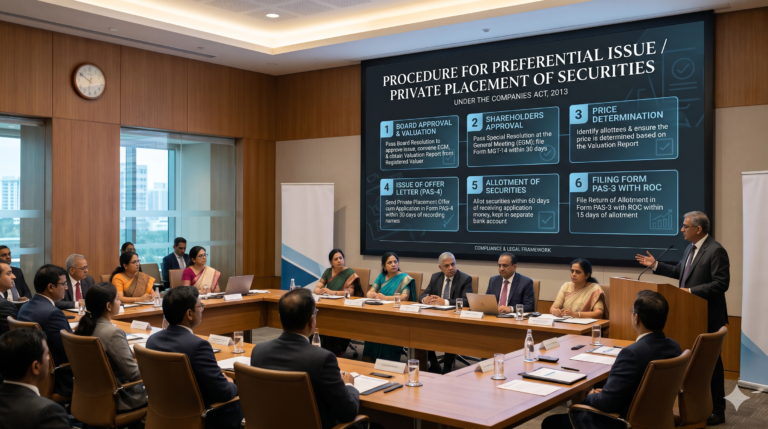
A preferential issue or private placement is the quickest way for a company to raise fresh capital from a select group of investors, without going to the public. Because the securities are offered only to chosen persons, the law controls who can be offered, how the price is fixed, how the money is received and how soon the securities must be allotted.
This article walks through the complete issue cycle, from the preparatory checks to the filing of the return of allotment and listing of the securities, with the timeline for each step.
Governing law: Sections 42, 62(1)(c), 117 and 179(3) of the Companies Act, 2013; Rule 14 of the Companies (Prospectus and Allotment of Securities) Rules, 2014; Rule 13 of the Companies (Share Capital and Debentures) Rules, 2014; SS-1 and SS-2; Regulations 28, 29, 30, 42 and 44 of the SEBI (LODR) Regulations, 2015 Applies to: All Companies (additional steps for Listed Company) Approval: Special resolution of members Key ROC forms: e-Form MGT-14 and e-Form PAS-3; offer letter in Form PAS-4 and record of offers in Form PAS-5 |
Check | Requirement |
Articles of Association | The Articles are required to permit the issue, and the authorised capital is required to be sufficient. |
Identified persons | The offer can be made only to persons identified by the Board, and in a financial year to not more than 200 persons in aggregate, excluding qualified institutional buyers and employees under ESOP. |
Valuation | The issue price is required to be determined on the basis of a valuation report of a registered valuer. |
Dematerialisation | Unlisted public companies are required to ensure that the entire holding of promoters, directors and KMP is in demat form before the issue. Private companies (other than small companies) are required to have dematerialised their securities; the extended deadline was 30 June 2025. |
An offer to persons other than the identified persons, or beyond the 200-person limit, is treated as an offer to the public and attracts the full requirements of a public issue.
Prior intimation, mentioning the date of the meeting, is required where the Board is to consider fund raising by issue of securities. The 2 working days exclude the date of intimation and the date of the meeting.
The decision on fund raising is required to be disclosed within 30 minutes of the conclusion of the meeting and hosted on the company’s website at the same time. Companies with listed non-convertible securities also make disclosures under Regulation 51.
The Board resolution for issue of securities is required to be filed in e-Form MGT-14. Private companies are exempt from filing resolutions passed under Section 179(3).
Draft minutes are required to be circulated within 15 days, signed within 30 days of the meeting, and a signed copy circulated to all directors within 15 days of signing.
The special resolution, along with the explanatory statement, is required to be filed in e-Form MGT-14. The offer letter can be issued only after this filing.
An application for in-principle approval is required to be made to the stock exchanges, with the valuation report, resolutions, shareholding pattern and other prescribed documents.
The return of allotment is required to be filed in e-Form PAS-3, with the list of allottees and the prescribed attachments.
Filing / Disclosure | Authority | Due Date | Applies to |
e-Form MGT-14 (Board resolution) | Registrar of Companies | Within 30 days of Board Meeting | Public Companies |
e-Form MGT-14 (special resolution) | Registrar of Companies | Within 30 days of general meeting | All Companies |
Outcome of Board Meetings | Stock Exchanges | Within 30 minutes of conclusion | Listed Company |
Voting results | Stock Exchanges | Within 2 working days of general meeting | Listed Company |
In-principle approval | Stock Exchanges | Before allotment | Listed Company |
e-Form PAS-3 | Registrar of Companies | Within 15 days of allotment | All Companies |
Listing and trading approval | Stock Exchanges | After allotment and credit of securities | Listed Company |
Default | Provision | Penalty |
Offer or acceptance of money in contravention of Section 42 | Section 42(10) | Up to the amount raised or ₹2 crore, whichever is lower, on the company, its promoters and directors; money to be refunded within 30 days of the order |
Delay in filing PAS-3 | Section 42(9) | ₹1,000 per day on the company, its promoters and directors, maximum ₹25 lakh |
Failure to refund money within 15 days after the 60-day period | Section 42(6) | Interest at 12% p.a. from the 60th day; money treated as a deposit |
Failure to give notice of Board Meeting | Section 173(4) | ₹25,000 on every officer whose duty it was to give notice |
Non-filing or late filing of MGT-14 | Section 117(2) | ₹10,000 on company and every officer in default, plus ₹100 per day (maximum ₹2 lakh for company, ₹50,000 for officers) |
Default in minutes / Secretarial Standards | Section 118(11) | ₹25,000 on company and ₹5,000 on every officer in default, per meeting |
Delay in prior intimation | Regulation 29, SEBI SOP Circular | ₹10,000 per instance per item |
Contravention where no specific penalty is provided | Section 450 | ₹10,000 on company and every officer in default, plus ₹1,000 per day of continuing default (maximum ₹2 lakh for company, ₹50,000 for officers) |
BM = Board Meeting approving the issue; GM = General Meeting; R = Receipt of application money; AL = Date of allotment
Timeline | Action | Applies to |
BM − 30 days | Articles, identified persons and offer limits verified; valuation report obtained | All Companies |
BM − 7 days | Notice, agenda and notes to directors | All Companies |
BM − 2 working days | Prior intimation to stock exchanges | Listed Company |
BM | Board approves the issue and the notice of general meeting | All Companies |
BM + 30 minutes | Outcome to stock exchanges and website | Listed Company |
BM + 30 days | Board minutes signed; MGT-14 filed | All Companies / Public Companies |
GM − 21 clear days | Notice of general meeting and newspaper advertisement | All Companies / Listed Company |
GM | Special resolution passed | All Companies |
GM + 30 days | MGT-14 filed for special resolution; GM minutes signed | All Companies |
After MGT-14 | PAS-4 issued; separate bank account opened; money received (R) | All Companies |
Before AL | In-principle approval of stock exchanges | Listed Company |
R + 60 days | Allotment made (AL); otherwise refund within the next 15 days | All Companies |
AL + 15 days | PAS-3 filed | All Companies |
After AL | Securities credited; registers updated; listing and trading approval | All Companies / Listed Company |
Disclaimer: The information contained in this Article is intended solely for personal non-commercial use of the user who accepts full responsibility of its use. The information in the article is general in nature and should not be considered to be legal, tax, accounting, consulting or any other professional advice. We make no representation or warranty of any kind, express or implied regarding the accuracy, adequacy, reliability or completeness of any information on our page/article.