
Background
Code on Social Security (Gujarat) Rules, 2023 have been framed by the Government of Gujarat in exercise of the powers conferred under the Code on Social Security, 2020. These Rules operationalise and give procedural effect to the provisions of the Code within the State of Gujarat.
The Rules lay down detailed mechanisms for implementation, administration, and enforcement of social security benefits relating to employment injury, medical benefits, sickness, maternity, disablement, dependants’ benefits, gratuity, and other allied matters. They supplement the substantive provisions of the Code by prescribing conditions, forms, timelines, eligibility criteria, and compliance requirements for employers, employees, and authorities.
Applicability
These Rules apply to:
The Rules shall be read in conjunction with the Code on Social Security, 2020 and the Code on Social Security (Central) Rules, 2026.
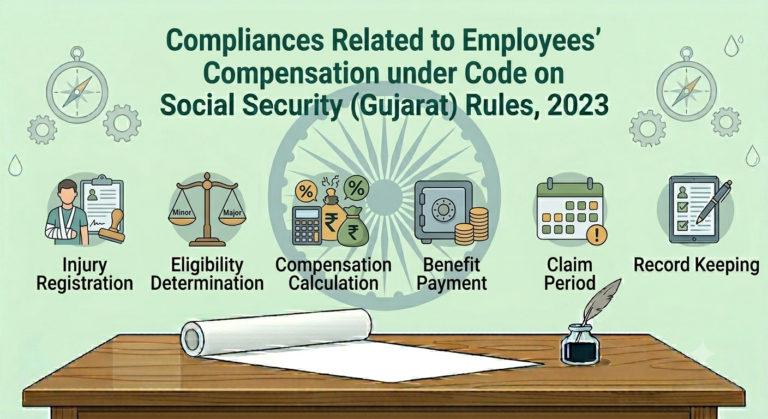
Compliance Requirements under the Rules in Accordance with the Code.
A review application for half-monthly compensation under Section 79 may be filed without a medical certificate: (a) by the employer, where the employee’s wages have increased; (b) by the employee, where wages have decreased or the employer has stopped payments without valid reason; and (c) by either party, where the compensation was determined through fraud, undue influence, or clear error.
The Government may require certain employers to maintain a Form XV notice-book at their work premises, accessible at all reasonable times to any injured employee or their bona fide representative. The notice-book records notices of accidents and occupational diseases contracted by employees in the course of employment.
An employer who becomes aware of an acident may, at any time (even before any claim is filed), submit to the Competent Authority a memorandum detailing the results of their investigation. The memorandum must be supported by an affidavit sworn by the employer themselves or a knowledgeable subordinate. Once the required fee is paid, the Competent Authority must record the memorandum.
Where an accident on an employer’s premises results in death or serious bodily injury and notice is required by law, the responsible person must send a Form XVI report detailing the circumstances to the competent authority within seven days of the event.
Every employer is liable to compensate employees for personal injury caused by accident arising out of and in the course of employment, or for occupational diseases contracted as listed in the Third Schedule. The employer is not liable where: (a) the injury results in disablement of less than three days; or (b) the injury does not result in death or permanent total disablement and is directly caused by the employee being under the influence of alcohol or drugs, the employee’s willful disobedience of explicit safety orders, or the employee’s intentional removal or disregard of a safety device. An accident or occupational disease is nonetheless deemed work-related if the accident would have arisen even without the employee’s contravention an the act was done for the purposes of the employer’s trade or business.
If an employee engaged in an occupation listed in the Second Schedule contracts an occupational disease listed in the Third Schedule after at least six months of continuous service in that occupation, the disease is treated as an injury by accident presumed to have arisen out of and in the course of employment, unless proven otherwise. The employer is liable for compensation accordingly.
For employees not covered under ESIC, an accident occurring while the employee is commuting to or from their place of work is deemed to have happened in the course of employment, if there is a clear nexus between the circumstances, time, and location of the accident and the nature of the employee’s job.
Where a worker or a family ember of a worker residing in employer-provided accommodation in a plantation suffers death or injury due to a collapse of the house or premises, and the collapse is not attributable solely to the fault of the occupants or to a natural disaster, the employer is liable to provide compensation. For purposes of this section, ‘worker’ means a person employed in a plantation for hire or reward — directly or through any agency — to perform skilled, unskilled, manual, or clerical work, and includes persons employed on contract for more than sixty days a year, but excludes medical officers, persons in managerial or administrative roles, and persons temporarily employed for construction or maintenance wor.
Compensation payable is determined as follows: where death results from the injury, fifty percent of the deceased employee’s monthly wages multiplied by the relevant factor, or an amount notified by the Central Government, whichever is higher; where the injury results in permanent total disablement, sixty percent of monthly wages multiplied by the relevant factor or the notified amount, whichever is higher; for permanent partial disablement from a scheduled injury, a percentage of the permanent total disablement compensation based on the loss of earning capacity listed in Part II of the Fourth Schedule; for permanent partial disablement from an unscheduled injury, a percentage of the permanent total disablement compensation proportionate to the assessed permanent loss of earning capacity; for temporary disablement (total or partial), a half-monthly payment equal to twenty-five percent of monthly wages under Section 76(4). The employer must also reimburse medical expenses for treatment of employment injuries, and upon the death of an employee, must deposit ₹15,000 with the competent authority for funeral expenses of the eldest dependent or the person who actually incurred such expenses.
Compensation must be paid when due. Where an employer disputes liability, provisional payments must nonetheless be made in respect of any admitted liability. Payments are made to the employee directly or to the competent authority, without prejudice to the employee’s right to claim further amounts. Monthly wages for the purpose of computing compensation are calculated as per Section 78 of the Code on Social Security, 2020.
Where an employee dies from a work-related injury, the employer must deposit funeral expenses of ₹15,000 (or a higher amount as prescribed) and body transport charges with the competent authority within forty-eight hours of the death. Transport costs are determined on the basis of actual cost to the place chosen for the last rites. If no deposit is made within forty-eight hours, the competent authority may make such payments and recover them from the employer.
Compensation in respect of a deceased employee, or any lump-sum compensation payable to a woman or a person under a legal disability, must be deposited with the competent authority and may not be paid directly by the employer. Any such direct payment shall not be deemed a valid payment of compensation. Advances of up to three months’ wages may be paid by the employer directly to a dependent of a deceased employee; such advance is deducted by the competent authority from the compensation and refunded to the employer. Any other sum of not less than ₹5,000 payable as compensation may also be deposited with the competent authority on behalf of the person entitled.
An employee who reports an accident or receives half-monthly payment must submit, within three days, to a free medical examination by the employer’s medical practitioner, subject to Rules 16–21. Where the employer’s facilities are not available at the workplace, the employer may send a medical practitioner to the employee’s residence or offer examination at the employer’s premises or a nearby location. No examination shall be required between 6 p.m. and 9 a.m. without the employee’s consent, or where travel would be unduly burdensome.
Where an employer engages a contractor to carry out work that is ordinarily part of the employer’s trade or business, the employer is liable to compensate any employee engaged on that project as if they were directly employed. Compensation is computed based on the wages the employee would have received if directly employed by the employer. The employer is entitled to be indemnified by the contractor or any other person from whom the employee could have recovered compensation. If the contractor is also an employer, they may seek indemnity from a sub-contractor. This provision does not prevent an employee from claiming directly from the contractor, and it does not apply where the accident occurs outside the employer’s premises or areas under their control.
If an employer has an insurance contract covering liability to employees and subsequently becomes insolvent, enters into a composition or scheme of arrangement with creditors, or (in the case of a company) commences winding-up proceedings, the employer’s rights against the insurer in respect of that liability are transferred to the employee. Upon this transfer, the insurer assumes the same rights, remedies, and liabilities as the employer, but the insurer’s liability to the employee shall not exceed what is contractually covered under the policy.
A Memorandum of Agreement for registration or recording of a compensation settlement under Section 89 of the Code on Social Security, 2020 must be filed by the employer before the Competent Authority in Form XVII, XVIII, or XIX as applicable, under Rule 25 of the Gujarat Social Security Rules, 2023.
Penalty & Punishment
Disclaimer: The information contained in this Article is intended solely for personal non-commercial use of the user who accepts full responsibility of its use. The information in the article is general in nature and should not be considered to be legal, tax, accounting, consulting or any other professional advice. We make no representation or warranty of any kind, express or implied regarding the accuracy, adequacy, reliability or completeness of any information on our page/article.