
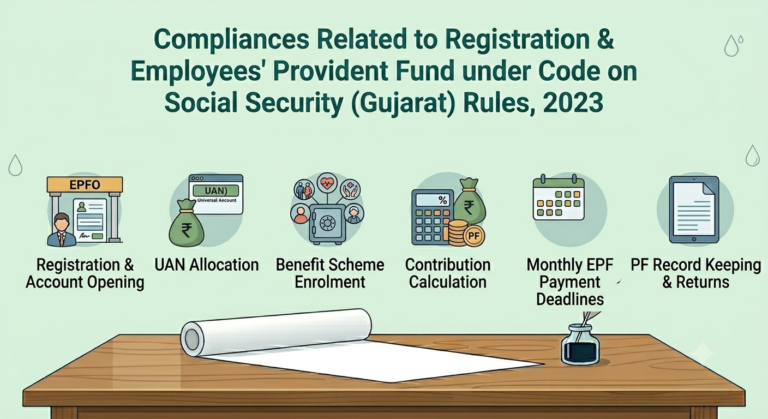
Compliances Related to Registration & Employees’ Provident Fund under Code on Social Security (Gujarat) Rules, 2023
Background
Code on Social Security (Gujarat) Rules, 2023 have been framed by the Government of Gujarat in exercise of the powers conferred under the Code on Social Security, 2020. These Rules operationalise and give procedural effect to the provisions of the Code within the State of Gujarat.
The Rules lay down detailed mechanisms for implementation, administration, and enforcement of social security benefits relating to employment injury, medical benefits, sickness, maternity, disablement, dependants’ benefits, gratuity, and other allied matters. They supplement the substantive provisions of the Code by prescribing conditions, forms, timelines, eligibility criteria, and compliance requirements for employers, employees, and authorities.
Applicability
Code on Social Security (Gujarat) Rules, 2023 apply to the whole of the State of Gujarat and shall be applicable to all establishments, employers, employees, and beneficiaries to whom the Code on Social Security, 2020 applies, insofar as matters fall within the State’s rule-making jurisdiction.
These Rules apply to:
Compliance Requirement Under the act in Accordance with the Rules & Regulations:
An employer of an establishment covered under Chapter III or IV (pursuant to Section 1(5) or 1(7)) may apply online to the Central Provident Fund Commissioner or Director General to exempt the establishment from such provisions, provided the employer and a majority of employees agree in writing. The Commissioner or Director General must decide the application within sixty days; if no decision is communicated within that period, approval is deemed granted. No such application is permitted if coverage occurred under Section 1(4), or within five years of coverage becoming applicable. All pending returns and dues must be cleared with self-certification before applying.
Every employer seeking registration of an establishment not already registered must apply electronically in Form I of the Occupational Safety, Health and Working Conditions (Central) Rules, 2026, on the Shram Suvidha Portal, furnishing establishment details and uploading prescribed documents. The Certificate of Registration in Form III must be issued electronically within seven days of submission of a complete application. If the certificate is not issued within this period, registration is deemed granted and Form III is auto-generated.
An employer of an establishment already registered under any other Central labour law in force must update the registration particulars in Form I on the Shram Suvidha Portal within six months from the date on which these Rules come into force.
Employers to whom this Code applies who are in the processof closing their establishments must apply for cancellation of registration via the Shram Suvidha Portal, furnishing complete establishment details and the status of all contributions and other dues payable under the Code. An application for cancellation can be made after the employer has ensured all dues are settled.
The employer must quote the Registration Number of the establishment on all documents prepared or submitted in connection with the Code, Scheme, Rules, or Regulations, and in all correspondence with the concerned offices.
Any change in the particulars furnished in Form I on the Shram Suvidha Portal must be updated by the employer within thirty days of sch change.
A copy of the Certificate of Registration must be displayed at conspicuous places at the premises where work is being carried ou.
Contributions payable by the employer to the Provident Fund shall be ten percent of wages payable to each employee (twelve percent for such lass of establishments as the Central Government may specify). Employees may contribute ten percent or more, but the employer is not obligated to match additional employee contributions beyond the statutory rate. PF contributions are applicable for all employees, whether employed directly or through a contractor. The employer may recover, from a contractor, both the employer’s and employee’s contributions in respect of employees engaged through that contractor, either by deduction from amounts payable to the contractor or as a debt.
The Central Government may establish a Pension Fund for the Pension Scheme. Employers must contribute up to 8.33% of wages (or such rate as notified), including contributions for exempted establishments. The Central Government may additionally credit sums to the fund as specified by law.
Employers must contribute up to one percent of employees’ wages to the Deposit-Linked Insurance Fund. An additional amount up to 0.25% of their contribution may be required for administrative expenses, as determined by the Central Government. The employer may recover, from the contractor, the employer’s contribution and any administrative charges in respect of employees engaged through that contractor, either by deduction or as a debt.
The Central Government may authorise an employer having one hundred or more employees to maintain a Provident Fund account independently, upon application and with the written consent of a majority of employees. This authorisation is subject to prescribed conditions and is not available where the employer has defaulted on PF contributions or committed an offence under this Code in the past three years. An employer so authorised must maintain the PF account, submit returns, deposit contributions, facilitate inspections, pay administrative charges, and abide by all terms and conditions as specified in the PF Scheme.
The Insured Person or the Corporation may file a second appeal to the Employees’ Insurance Court by presenting an application within ninety days of receiving the order of the Medical Board or, as the case may be, the Medical Appeal Tribunal. An appeal filed beyond ninety days may still be entertained at the Court’s discretion if sufficient cause is shown for the delay.
The employer must supply, free of cost, copies of Forms IX, X, XI, and XII — as appended to the Code on Social Security Central Rules, 2020 — to every woman employed by him, upon her request.
Penalty & Punishment
Disclaimer: The information contained in this Article is intended solely for personal non-commercial use of the user who accepts full responsibility of its use. The information in the article is general in nature and should not be considered to be legal, tax, accounting, consulting or any other professional advice. We make no representation or warranty of any kind, express or implied regarding the accuracy, adequacy, reliability or completeness of any information on our page/article.