
Background
Code on Social Security (Gujarat) Rules, 2023 have been framed by the Government of Gujarat in exercise of the powers conferred under the Code on Social Security, 2020. These Rules operationalise and give procedural effect to the provisions of the Code within the State of Gujarat.
The Rules lay down detailed mechanisms for implementation, administration, and enforcement of social security benefits relating to employment injury, medical benefits, sickness, maternity, disablement, dependants’ benefits, gratuity, and other allied matters. They supplement the substantive provisions of the Code by prescribing conditions, forms, timelines, eligibility criteria, and compliance requirements for employers, employees, and authorities.
Applicability
These Rules apply to the following as per Chapter VII of the code:
The Rules shall be read in conjunction with the Code on Social Security, 2020 and the Code on Social Security (Central) Rules, 2026.
Compliance Requirements under the Rules in Accordance with the Code.
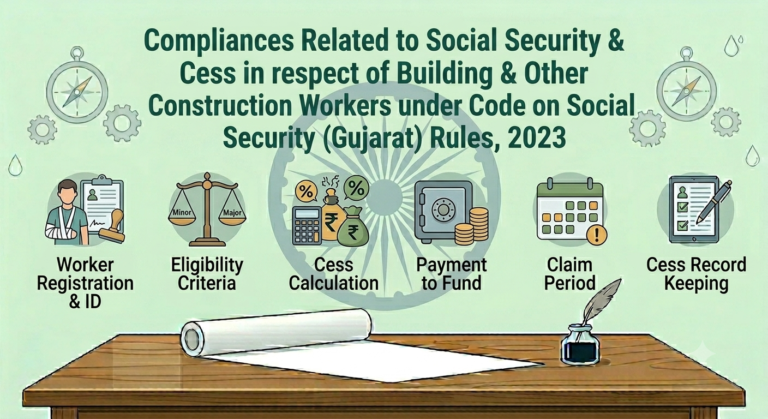
Every employer engaged in building or other construction work must pay a cess ranging from one to two percent of the total construction cost, to fund social security and welfare benefits for construction workers. The cess must be paid in advance, before the commencement of work, on the basis of a self-assessment certified by a Chartered Engineer, at the time of plan approval. For the purpose of self-assessment, the cost of construction is to be calculated at the uniform rate or rates of construction specified by the respective State’s Public Works Department or the Central PWD, or as per the return or document submitted to RERA, applicable for the year in which work commences. The self-assessment must be submitted in Form XV.
Every employer engaged in building or other construction work must furnish information in Form XV to the Assessing Officer within sixty days of commencement of work or commencement of cess payment, whichever is earlier.
Any change or modification in the information furnished in Form XV must be communicated to the Assessing Officer in the same form, incorporating details of the modification, immediately and not later than thirty days from the date on which the change or modification takes effect.
The employer must, within sixty days of completing each building or construction work (or within such periods notified by the Central Government), self-assess the cess payable on the total cost of construction, deduct any advance cess already deposited, pay the balance, and file the prescribed return under Section 123(d). If the assessing authority finds a discrepancy between the self-assessed and actual amount payable, it may conduct inquiries and issue an assessment order specifying the correct cess and the due date for payment. Employers must maintain supporting documentation including cost statements, invoices, approvals, bills of quantities, and contracts for verification.
Where there is any stoppage or reduction in building or construction work, the employer must inform the Assessing Officer in Form XVII within sixty days of such stoppage or reduction. Where advance cess has been paid and work is subsequently reduced, the employer may request a refund of excess cess by filing Form XVII with full details of the change.
Upon completion of each building or other construction work, the employer must submit a return in Form XVIII to the Assessing Officer within sixty days of the completion of each project.
The employer must submit a reply with supporting documentary evidence to the Assessing Officer within thirty days of receiving a cess assessment notice issued on grounds of undervaluation, miscalculation of construction cost, or short payment of cess. The employer may also seek a personal hearing before the Assessing Officer to substantiate their position.
An employer aggrieved by an assessment order under Rule 41(4) or penalty order under Rule 43 may file an appeal in Form XIX within ninety days of receiving the order, before the Appellate Authority notified by the State Government.
Building workers aged between eighteen and sixty who have worked at least ninety days in the preceding twelve months are eligible to register as beneficiaries with the Building Workers’ Welfare Board, through an authorised officer and the procedures prescribed by the Central Government. Employers or contractors must register eligible building workers on the State or Central Government portal within thirty days of their becoming eligible, linking the registration with Aadhaar and a Universal Account Number (UAN) or other unique identifier.
Where a building worker has been a registered beneficiary of the Welfare Board for at least three consecutive years immediately before attaining sixty years of age, the Central Government may formulate and notify schemes for the continued social security benefit of such workers.
Cess under Section 100(1) must be paid electronically (with read receipt) either in advance or before work commences. House owners constructing for personal use where the construction cost exceeds ₹50 lakh must pay the cess at the time of plan approval. Builders and developers must pay the cess electronically at the time of submitting plans for approval.
Penalty & Punishment
Disclaimer: The information contained in this Article is intended solely for personal non-commercial use of the user who accepts full responsibility of its use. The information in the article is general in nature and should not be considered to be legal, tax, accounting, consulting or any other professional advice. We make no representation or warranty of any kind, express or implied regarding the accuracy, adequacy, reliability or completeness of any information on our page/article.