
Background
Code on Social Security (Gujarat) Rules, 2023 have been framed by the Government of Gujarat in exercise of the powers conferred under the Code on Social Security, 2020. These Rules operationalise and give procedural effect to the provisions of the Code within the State of Gujarat.
The Rules lay down detailed mechanisms for implementation, administration, and enforcement of social security benefits relating to employment injury, medical benefits, sickness, maternity, disablement, dependants’ benefits, gratuity, and other allied matters. They supplement the substantive provisions of the Code by prescribing conditions, forms, timelines, eligibility criteria, and compliance requirements for employers, employees, and authorities.
Applicability
These Rules apply to:
1) Establishment employing ten or more persons other than a seasonal factory
2) Establishment carrying hazardous/notified life threatening activities with 1 or more employees
3) Est. being a plantation & opts for ESIC
The Rules shall be read in conjunction with the Code on Social Security, 2020 and the Code on Social Security (Central) Rules, 2026
Compliance Requirements under the Rules in Accordance with the Cod.
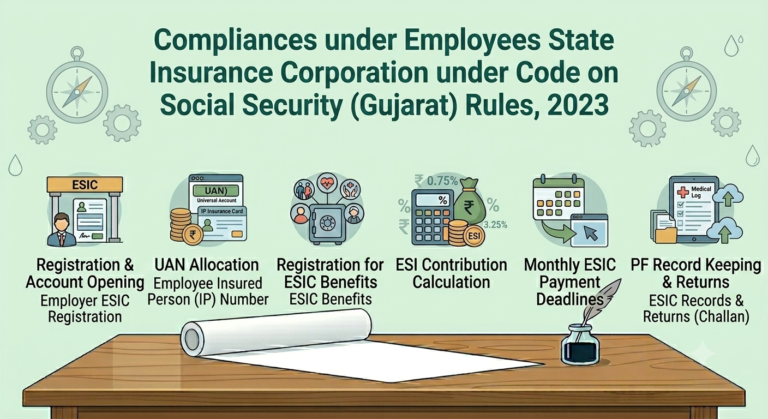
Every employer must register each new worker on the portal before or on the date of joining, using the worker’s Aadhaar number if the worker is not already registered. An insurance number is auto-generated and remains valid for thirty days pending full profile update. Workers already registered under ESIC are added via their existing insurance number and joining date. The employer is responsible for updating all worker and dependent details; an Aadhaar-linked identity card is issued to the employee and dependents. A registration number becomes invalid if employee details are not updated through the Declaration Form within thirty days, or if the Aadhaar number provided is returned as unauthenticated.
The employer must pay both the employer’s contribution and the employee’s contribution in respect of every employee, whether directly employed or engaged through a contractor.
Insured persons and their dependents are entitled to a comprehensive range of ESIC benefits, including: (a) sickness benefit — periodic cash payments during certified sickness, payable at seventy percent of the standard benefit rate for up to ninety-one days in two consecutive benefit periods, subject to a minimum contribution of seventy-eight days; (b) maternity benefit — periodic payments to women during confinement, miscarriage, or pregnancy-related illness as certified by an authorised authority; (c) disablement benefit — periodic payments for employment-related disablement; (d) dependants’ benefit — periodic payments to dependants of an insured person who dies from an employment injury; (e) medical benefit — outpatient and inpatient care as povided by ESIC institutions; and (f) funeral expenses — a payment of up to ₹20,000 claimable within three months of the insured’s death. Sickness benefit is not payable for the first two days of illness unless the sickness follows a previous spell within fifteen days.
Sickness benefit may be extended beyond the standard entitlement if the insured person is diagnosed with a disease specified in the Regulations framed under the Code, has completed four contribution periods before diagnosis, has paid contributions for at least one hundred and fifty-six days within those periods, and was eligible for sickness benefit in at least one of those periods. Extended sickness benefit is granted only where the person has exhausted the standard sickness benefit or is ineligible for it. The extended benefit may be granted for a maximum period of seven hundred and thirty days in total (including the standard sickness benefit) and is paid at eighty percent of the standard benefit rate.
An insured woman is eligible for maternity benefit for confinement if contributions were payable for at least seventy days in the immediately preceding two contribution periods. Eligible women receive maternity benefit at the standard daily rate for up to twenty-six weeks, with up to eight weeks permitted before the expected date of confinement; women with two or more surviving children are entitled to twelve weeks (up to six weeks before confinement). For miscarriage or medical termination, six weeks’ benefit is payable; for pregnancy-related sickness, an additional month may be granted. An insured woman or the insured person in respect of his wife shall receive ₹7,500 per confinement as a medical bonus where ESIC medical facilities are unavailable at the place of confinement, limited to two confinements. Where a woman dies during or after delivery, benefits continue for the entire entitled period or until the child’s death, payable to her nominee or legal representative. An insured woman who gives up a child for adoption or acts as a commissioning mother is entitled to twelve weeks’ maternity benefit from the date the child is handed over.
An insured person may claim temporary disablement benefit for disablement lasting at least three days (excluding the accident day). For permanent disablement, whether total or partial, periodical payments are available for the assessed period or for life. The daily rate of disablement benefit is ninety percent of the standard benefit rate in the relevant contribution period, rounded up to the next rupee. If the injury occurs before the first benefit period: where the injury is sustained after the expiry of the first wage period, the rate is ninety percent of average daily wages in that period; where the injury occurs before the expiry of the first wage period, the rate is ninety percent of wages actually earned or earnable on the date of the acciden.
Disablement benefit is payable to the insured person as follows: for temporary disablement, at the full rate; for permanent total disablement, at the full rate; for permanent partial disablement from an injury specified in Part II of the Fourth Schedule, at the percentage of the full rate corresponding to the loss of earning capacity listed in that Schedule; and for permanent partial disablement from an injury not specified in the Fourth Schedule, at a rate proportionate to the assessed permanent loss of earning capacity. Where more than one injury is caused by the same accident, the rates are aggregated but shall not in any case exceed the full rate.
Where an insured person dies from an employment injury leaving a widow, legitimate or adopted children, or a widowed mother, dependants’ benefit is distributed as follows: each widow receives three-fifths of the full rate until remarriage (shared equally where there are multiple widows); each legitimate or adopted son receives two-fifths of the full rate until age twenty-five; each legitimate or adopted unmarried daughter receives two-fifths of the full rate; and a widowed mother receives two-fifths of the full rate for life. Where an infirm child is wholly dependent on the insured’s earnings, benefit continues for the duration of the infirmity. The daily dependants’ benefit rate is ninety percent of the standard benefit rate. Where the aggregate of all dependants’ benefits exceeds the full rate, each share is proportionately reduced so the total does not exceed the full disablement rate. The minimum total monthly payment to all eligible dependants shall be as notified by ESIC.
Where the deceased insured person does not leave a widow, legitimate or adopted child, or widowed mother, dependants’ benefit is distributed to other dependants as follows: a widower receives three-fifths of the full rate for life; a parent other than a widowed mother or grandparent receives two-fifths of the full rate (shared equally if multiple). Other male dependants receive benefit until age eighteen; female dependants until age eighteen or marriage (whichever is earlier), or until age eighteen or remarriage in the case of widowed dependants. Each such dependant receives two-tenths of the full rate. If the aggregate exceeds the full rate, shares are proportionately reduced. The minimum monthly dependants’ benefit shall be as notifid by ESIC.
An accident arising in the course of an employee’s employment shall be presumed, in the absence of evidence to the contrary, to have arisen out of that employment.
If an employee is injured while taking action to rescue or protect persons or property during an emergency at their workplace, the accident is deemed to have occurred in the course of and arising out of their employment.
Accidents occurring while an employee is commuting to or from their place of work are deemed to arise in the course of employment where a clear nexus between the accident circumstances, time, and location and the employee’s employment is established. This includes accidents during travel in vehicles operated by or on behalf of the employer or provided pursuant to arrangements with the employer, provided the vehicle is not operating as part of an ordinary public transport service. Accidents are additionally deemed work-related even where the employee is acting in contravention of law or employer’s orders, provided the accident would have occurred regardless and the act was connected to the employer’s trade or busines.
Accidents during employment are deemed work-related even where the employee was acting against applicable law or the employer’s instructions, as long as the accident would have occurred regardless of the contravention and the action was connected to the employer’s trade or business.
If an employee contracts an occupational disease listed in Part A, Part B (after six months’ exposure), or Part C (as specified by the relevant regulations) of the Third Schedule to the Code, the contraction of such disease shall be deemed to be an ’employment injury’, unless proven otherwise. No benefit is payable, however, in respect of any disease unless the disease is directly attributable to a specific injury by accident arising out of and in the course of employment.
An insured person or their family member requiring medical treatment is entitled to medical benefit, which may include outpatient or inpatient care at a hospital, clinic, dispensary, or other ESIC institution, or home visits. Medical benefit is available during contribution periods and benefit periods during which sickness or maternity benefits are paid or payable. Disablement benefit recipients receive medical benefit; after permanent disablement, medical benefit continues only for employment-related injuries. Newly insured employees receive three months of medical benefit, extended if employed for three months. With seventy-eight days of contributions, benefits continue until the next benefit period. Medical benefit resumes immediately upon re-employment and re-registration. No reimbursement of private medical expnses is permitted unless expressly specified.
No insured employee shall receive sickness or temporary disablement benefit for any day on which they work, are on paid leave, are on holiday, or are on strike. A benefit recipient must remain at the designated treatment facility, follow medical directions, and not leave without the permission of the medical officer or act in a manner detrimental to recovery. An insured person is not entitled to receive simultaneously: sickness and maternity benefit; sickness and temporary disablement benefit; or maternity and temporary disablement benefit. Where entitlement to more than one benefit arises for the same period, the person must choose which to receive. If the recipient dies while entitled to a cash benefit, the amount accrued until the date of death is paid to their nominee or legal heir.
An appeal under Section 49 must be filed in triplicate in Form II containing court details, particulars of the parties, cause of action, jurisdiction, and relief sought. It must be verified in the manner of a civil pleading and accompanied by supporting documents. Such an appeal must be filed within three years and proceedings follow the Civil Procedure Code, 1908.
Penalty & Punishment
Disclaimer: The information contained in this Article is intended solely for personal non-commercial use of the user who accepts full responsibility of its use. The information in the article is general in nature and should not be considered to be legal, tax, accounting, consulting or any other professional advice. We make no representation or warranty of any kind, express or implied regarding the accuracy, adequacy, reliability or completeness of any information on our page/article.