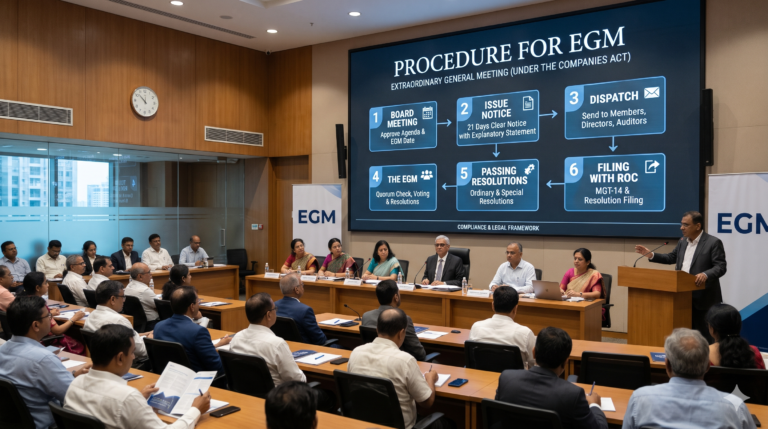
Any general meeting of members other than the Annual General Meeting is an Extra-Ordinary General Meeting. Companies call an EGM when shareholder approval is needed on business that cannot wait for the next AGM, such as an increase in authorised capital, alteration of the Memorandum or Articles, issue of shares, or the appointment of a director.
This article walks through the complete EGM cycle, from the Board decision to call the meeting to filing of resolutions with the Registrar, with the timeline for each step.
Governing law: Sections 100, 101, 102, 103, 108, 114, 117 and 118 of the Companies Act, 2013; Rules 17, 18 and 20 of the Companies (Management and Administration) Rules, 2014; Secretarial Standard-2 (SS-2); Regulations 30, 42 and 44 of the SEBI (LODR) Regulations, 2015 Applies to: All Companies (additional steps for Listed Company) Notice period: 21 clear days (shorter notice with consent of members holding at least 95% of voting capital) Key ROC form: e-Form MGT-14 (for special resolutions and other resolutions covered by Section 117) |
Called by | When | Timeline |
Board of Directors | On its own, whenever it considers fit | Notice of at least 21 clear days |
Board, on requisition of members | Members holding at least one-tenth of the paid-up capital carrying voting rights (or one-tenth of total voting power, where there is no share capital) deposit a requisition | Board to call within 21 days of requisition; meeting to be held within 45 days of requisition |
Requisitionists themselves | Where the Board fails to call the meeting within 21 days of requisition | Meeting to be held within 3 months of the date of requisition |
National Company Law Tribunal | Where it is impracticable to call or hold the meeting otherwise | As directed by the Tribunal (Section 98) |
An EGM may be held at any place in India. A meeting called on requisition is required to be held at the registered office or at another place in the same city, town or village, during business hours (9 a.m. to 6 p.m.) on a day that is not a National Holiday. A wholly owned subsidiary of a company incorporated outside India may hold its EGM outside India, and specified IFSC companies may do so with the consent of all members.
(Applicable to All Companies)
Section 173 of the Companies Act, 2013 read with SS-1
(Applicable to All Companies)
Sections 101 and 102 of the Companies Act, 2013 read with Rule 18 of the Companies (Management and Administration) Rules, 2014 and SS-2
(Applicable in case of Listed Company)
Regulation 30 read with Para A, Part A of Schedule III of the SEBI (LODR) Regulations, 2015
The notice of the general meeting is required to be submitted to the stock exchanges and hosted on the company’s website simultaneously.
(Applicable to Listed Companies and Companies having 1,000 or more members)
Section 108 of the Companies Act, 2013 read with Rule 20(4)(v) of the Companies (Management and Administration) Rules, 2014; Regulation 30 of the SEBI (LODR) Regulations, 2015
(Applicable to Listed Companies and Companies having 1,000 or more members)
Section 108 of the Companies Act, 2013 read with Rule 20 of the Companies (Management and Administration) Rules, 2014
(Applicable in case of Listed Company)
Regulation 42 of the SEBI (LODR) Regulations, 2015
Where a record date is fixed for a corporate action connected with the business of the EGM (such as a bonus or rights issue), prior notice is required to be given to the stock exchanges at least 3 working days in advance, excluding the date of intimation and the record date, stating the purpose of the record date. The intimation is also required to be hosted on the company’s website.
As clarified by the stock exchanges in February 2025, there is also required to be a gap of at least 3 working days between the date of Board or shareholder approval and the record date, excluding both dates.
(Applicable to All Companies)
Sections 100, 103 and 108 of the Companies Act, 2013 read with SS-2 and Rule 20 of the Companies (Management and Administration) Rules, 2014
(Applicable in case of Listed Company)
Regulations 30 and 44(3) of the SEBI (LODR) Regulations, 2015 read with Rule 20(4) of the Companies (Management and Administration) Rules, 2014
(Applicable to All Companies)
Section 118 of the Companies Act, 2013 read with Paragraph 17 of SS-2
Minutes are required to be entered in the Minutes Book and signed by the Chairman within 30 days of the conclusion of the meeting.
(Applicable to All Companies)
Section 117 of the Companies Act, 2013
Special resolutions, and the other resolutions listed in Section 117(3) (such as resolutions requiring a special majority or those altering the Articles), are required to be filed in e-Form MGT-14 with a certified copy of the resolution, the notice and the explanatory statement, and, where applicable, the members’ consent to shorter notice. Ordinary resolutions generally do not require MGT-14 unless specifically covered.
Filing / Disclosure | Authority | Due Date | Applies to |
Notice of EGM | Stock Exchanges and website | Within 12 hours of dispatch | Listed Company |
Newspaper advertisement | Stock Exchanges and website | Within 24 hours of publication | Listed Company |
Summary of proceedings | Stock Exchanges | Within 12 hours of conclusion | Listed Company |
Voting results and scrutiniser’s report | Stock Exchanges and website | Within 2 working days of conclusion | Listed Company |
e-Form MGT-14 | Registrar of Companies | Within 30 days of passing resolution | All Companies (where applicable) |
Default | Provision | Penalty |
Failure of Board to call EGM on valid requisition | Section 100(5) | Reasonable expenses of requisitionists recoverable from the company and retained out of fees or remuneration of defaulting directors |
Defects in notice or holding of meeting | Section 450 | ₹10,000 on company and every officer in default, plus ₹1,000 per day of continuing default (maximum ₹2 lakh for company, ₹50,000 for officers) |
Failure to disclose interest in explanatory statement | Section 102(5) | ₹50,000 or five times the benefit accruing to the defaulting promoter, director, manager or KMP, whichever is higher |
Non-filing or late filing of MGT-14 | Section 117(2) | ₹10,000 on company and every officer in default, plus ₹100 per day (maximum ₹2 lakh for company, ₹50,000 for officers) |
Default in minutes / SS-2 | Section 118(11) | ₹25,000 on company and ₹5,000 on every officer in default, per meeting |
Delay in submission of voting results | Regulation 44(3), SEBI SOP Circular | ₹10,000 per instance |
Delay in disclosures under the SEBI (LODR) Regulations | Section 15A(b), SEBI Act, 1992 | ₹1 lakh, up to ₹1 lakh per day of default (maximum ₹1 crore) |
Day 0 = Date of EGM
Timeline | Action | Applies to |
Before dispatch | Board approves notice and fixes EGM date | All Companies |
Day 0 − 21 clear days | Notice dispatched; placed on website | All Companies |
Dispatch + 12 hours | Notice submitted to stock exchanges | Listed Company |
Day 0 − 21 days | Newspaper advertisement published | Listed / 1,000+ members |
Day 0 − 7 days (earliest) | Cut-off date for voting eligibility | Listed / 1,000+ members |
Day 0 − 1 day, 5:00 p.m. | Remote e-voting closes | Listed / 1,000+ members |
Day 0 | EGM held | All Companies |
Day 0 + 12 hours | Proceedings to stock exchanges | Listed Company |
Day 0 + 2 working days | Voting results and scrutiniser’s report | Listed Company |
Day 0 + 30 days | Minutes signed; MGT-14 filed | All Companies |
Disclaimer: The information contained in this Article is intended solely for personal non-commercial use of the user who accepts full responsibility of its use. The information in the article is general in nature and should not be considered to be legal, tax, accounting, consulting or any other professional advice. We make no representation or warranty of any kind, express or implied regarding the accuracy, adequacy, reliability or completeness of any information on our page/article.