
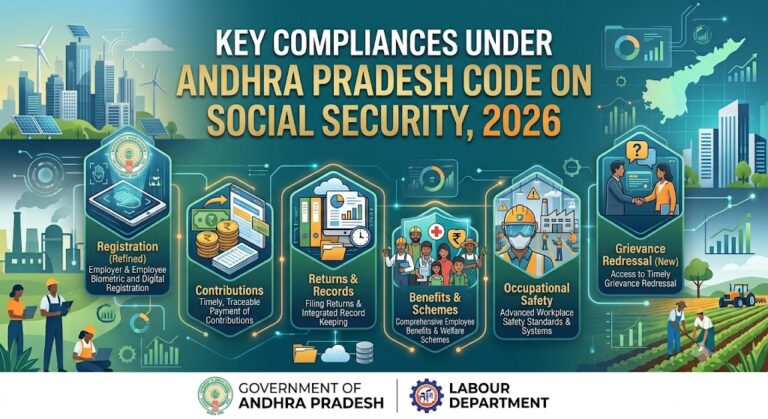
Background
Code on Social Security, 2020 was enacted by Parliament to amend and consolidate the laws relating to social security with the objective of extending social security to all employees and workers, whether in the organised, unorganised or any other sector. It subsumes and replaces nine earlier central labour enactments dealing with employees’ provident fund, employees’ state insurance, maternity benefit, gratuity, cess on building and other construction workers, and related welfare schemes, bringing them under a single unified framework. The Andhra Pradesh Government has framed the Code on Social Security (Andhra Pradesh) Rules, 2026 to operationalise the Code within the State, prescribing the forms, registers, timelines and procedures that establishments must follow for registration, contribution payment, record-keeping and reporting.
Core regulatory mechanism introduced by the Code is a single registration for an establishment covering multiple welfare obligations, supported by electronic filing of returns, unified annual reporting in Form-XIII, and digital reporting of employment vacancies to Career Centres. Chapter IV extends Employees’ State Insurance coverage, Chapter III governs Employees’ Provident Fund contributions, Chapter VIII introduces a welfare cess on building and other construction work, and Chapter IX extends social security contributions to aggregators engaged with gig and platform workers, reflecting the Code’s recognition of new and unorganised forms of employment. Recent amendments, given effect through the Andhra Pradesh Rules of 2026 and the Social Security (Central) Rules, 2026, have updated the prescribed forms, contribution rates and procedural timelines that establishments operating in Andhra Pradesh must now follow.
Applicability
The compliance obligations under the Code apply broadly across factories, mines, oilfields, plantations, ports and railway companies, as well as shops or establishments employing ten or more employees, all of which must register the establishment, maintain prescribed registers and file periodic returns; establishments in which ten or more persons are employed (other than a seasonal factory), and certain hazardous or life-threatening occupations regardless of employee count, must additionally extend Employees’ State Insurance coverage, while establishments employing twenty or more employees must remit Employees’ Provident Fund contributions for eligible employees. Employers carrying on building or other construction work must pay and self-assess the building and construction workers’ welfare cess, aggregators engaging gig and platform workers in the unorganised sector must pay social security contributions on their turnover, and public sector establishments together with private sector establishments ordinarily employing 50 or more employees must report vacancies, selection results and employment information to the designated Career Centres. Establishments meeting the prescribed benefit standards may additionally apply for exemption from EPF or ESI provisions under Section 143 of the Code.
Key Requirement Under Andhra Pradesh Code on Social Security, 2026
Every employer seeking registration for an establishment that is not already registered shall apply electronically in Form-I of the Occupational Safety, Health and Working Conditions (Andhra Pradesh) Rules, 2026, on the Designated Portal of the State Labour Department, furnishing details of the establishment and uploading documents relating to registration, including proof of identity and address of the employer. The applicant is responsible for the veracity of all information submitted. The certificate of registration is issued electronically within seven days of submission of a complete application, failing which deemed registration and auto-generation of the certificate occurs.
The employer shall display a copy of the certificate of registration at conspicuous places in all premises where work is carried out.
The employer shall quote the registration number on all documents prepared or submitted by him in connection with the Code, the schemes, the rules or the regulations, as the case may be, and in all correspondence with the offices concerned.
Any change in the particulars furnished in the Form submitted on the specified State Labour Portal shall be updated by the employer within thirty days of such change.
The employer of an establishment to which the provisions of the Code apply, and whose business activities are in the process of closure, may apply for cancellation of registration in the specified form online on the Designated State Labour Department Web Portal, after clearing all dues and furnishing all returns, and after giving complete details and the status of the contribution and other dues payable under the Code.
The employer must pay ESI contributions, comprising a 3.25% employer share and a 0.75% employee share of wages, to the ESI Corporation on a monthly basis within the prescribed period, for all eligible employees. This obligation applies to every establishment in which ten or more persons are employed, other than a seasonal factory, provided that Chapter IV also applies to an establishment carrying on hazardous or life-threatening occupations notified by the Central Government even where a single employee is employed, that an employer of a plantation may opt into Chapter IV where the benefits offered are better than those the employer already provides, and that contributions become payable from the date on which ESI benefits are notified as extended to the employees of the establishment.
The employer shall deposit both the employer’s and the employee’s EPF contributions for every eligible employee, including employees engaged through contractors, after deducting only the employee’s share from wages, within the prescribed time. This obligation is applicable to every establishment in which twenty or more employees are employed.
Employers carrying on building or other construction work must pay welfare cess under Chapter VIII at a rate not less than 1% and not exceeding 2% of the cost of construction, as notified by the Central Government, with the payment timeline and modalities as notified by the Andhra Pradesh Government. The cost of land and any compensation paid or payable under Chapter VII does not form part of the cost of construction, and the cess may be collected through deduction at source, advance collection, or other modes specified under the Code.
Within 60 days of completion of each building or other construction work, or such other period as notified by the Central Government, the employer shall determine the cess payable based on the cost of construction, adjust any advance cess already paid, and pay the balance Building and Other Construction Workers’ Welfare Cess.
After payment of the self-assessed cess, the employer shall file the return under Section 123(d) within 60 days of completion of each building or other construction work, or such other period as notified by the Central Government.
An aggregator shall pay social security contribution, at the rate notified by the Central Government, to fund social security schemes for gig workers and platform workers. The contribution shall be not less than 1% and not more than 2% of the aggregator’s annual turnover, and shall not exceed 5% of the amount paid or payable by the aggregator to gig workers and platform workers. Annual turnover excludes taxes, levies and cess payable to the Central Government, and the contribution obligation commences from the date notified by the Central Government.
The employer shall maintain the Register of Employees in Form-I of the Code on Wages (Andhra Pradesh) Rules, 2026, electronically or otherwise. The register shall be complete, up-to-date, and preserved for five calendar years from the date of the last entry.
The employer shall maintain the Register of Wages, Overtime, Advances, Fines and Deductions in Form-IV of the Code on Wages (Andhra Pradesh) Rules, 2026, electronically or otherwise. The register shall be complete, up-to-date, and preserved for five calendar years from the date of the last entry.
The employer shall maintain the Attendance-cum-Muster Roll in Form-IX of the Code on Wages (Andhra Pradesh) Rules, 2026, electronically or otherwise. The register shall be complete, up-to-date, and preserved for five calendar years from the date of the last entry.
The employer shall maintain the Register of Women Employees in Form-XX, electronically or otherwise. The register shall be complete, up-to-date, and preserved for five calendar years from the date of the last entry.
Every employer shall issue wage slips, electronically or otherwise, to employees under clause (c) of Section 123, at least 24 hours before payment of wages, in Form-V of the Code on Wages (Andhra Pradesh) Rules, 2026.
The employer shall conspicuously display a notice at or near the main entrance of the establishment, in bold letters in English, Hindi and a language understood by the majority of the employees, specifying the name and designation of the officer authorised by the employer to receive, on his behalf, notices under the Code or the rules made thereunder.
The employer shall not reduce the wages or the total quantum of employment benefits of an employee, whether directly or indirectly, solely on account of the employer’s liability to pay any contribution or charges under the Code or any scheme framed thereunder.
An employer aggrieved by an order of the Authorised Officer under Section 125 relating to Chapter IV may file an appeal within 60 days from the date of the order. The appeal shall be accompanied by a deposit of 25% of the contribution ordered, or the contribution as per the employer’s own calculation, whichever is higher. Where the appeal succeeds, the Corporation shall refund the deposit along with the interest specified in the regulations.
The officer authorised by the State Government for compounding of offences under Section 138(1) shall electronically issue a compounding notice in Form-XIV for offences that are compoundable under Section 138. The employer so noticed shall apply electronically in Part III of Form-XIV to the officer, and deposit the entire compounding amount by electronic transfer or otherwise, within fifteen days of receipt of the notice.
Vacancies required to be reported to the Regional Career Centre shall be reported in Form-XV, through writing, official email or digital mode, at least 15 days before the last date for receipt of applications for appointment, interview or test.
Technical and scientific vacancies notified by the Central Government, vacancies to be circulated outside the State or Union Territory, and vacancies requiring State, Inter-State or All India recruitment shall be reported in Form-XV to the Central Career Centre at least 40 days before the last date for receipt of applications for appointment, interview or test.
The employer shall furnish information relating to the result of selection to the concerned Career Centre, against vacancies previously reported, within thirty days from the date of selection.
The employer must submit the Employment Information Return in Form-XVII to the Regional Career Centre within 30 days of 31st March, that is, by 30th April each year. This requirement applies to all public sector establishments and to private sector establishments ordinarily employing 50 or more employees, or such other number as may be notified by the Central Government; covered employers are required to report vacancies, report selection results, maintain employment records and furnish the Employment Information Return. The requirement to report vacancies to Career Centres does not, however, apply to vacancies in agriculture and horticulture establishments in the private sector (other than plantations); vacancies in domestic service; vacancies connected with the staff of Parliament or any State Legislature; employment of less than 90 days; classes or categories of establishments or employments notified by the Central Government; non-Government establishments employing less than 20 employees (or such other number as may be notified); vacancies proposed to be filled through promotion, absorption of surplus staff, or through independent recruitment agencies such as the UPSC, SSC or State Public Service Commissions (unless otherwise directed by the Central Government); and vacancies carrying a monthly remuneration below the amount notified by the appropriate Government (unless otherwise directed by the Central Government).
An establishment seeking exemption from EPF/ESI provisions under Section 143 must apply electronically to the competent authority. To be eligible for such exemption, the establishment must, prior to grant of exemption, demonstrate that its employees are in receipt of benefits substantially similar or superior to the benefits granted under the schemes framed under Chapter III, or the benefits available under Chapter IV, as the case may be, of the Code
Penalty & Consequences
The following penalty provisions apply across the compliance obligations covered in this blog.
Section 104 of the Code on Social Security, 2020: Penalty for Non-Payment of Assessed Cess
Where the amount of cess payable by an employer under Section 103 is not paid within the date specified in the order of assessment, the prescribed authority may, after making such inquiry as it deems fit, impose on the employer a penalty not exceeding the amount of the cess, provided the employer is first given a reasonable opportunity of being heard.
Section 133(a) of the Code on Social Security, 2020: Failure to Pay Contribution
Where an employer fails to pay any contribution which he is liable to pay under the Code, or the rules, regulations or schemes made thereunder, he is punishable with imprisonment for a term of up to three years, but not less than one year, together with a fine of one lakh rupees, where the failure relates to the employee’s contribution that was deducted from the employee’s wages; and, in any other case, with imprisonment for a term of not less than two months, extendable up to six months, together with a fine of fifty thousand rupees.
Section 133(l) of the Code on Social Security, 2020: Failure to Pay Cess for Building Workers
Any person who fails to pay the cess for building workers which he is liable to pay under the Code is punishable with imprisonment for a term of up to six months, or with a fine of up to fifty thousand rupees, or with both.
Section 133(m) of the Code on Social Security, 2020: General Penalty for Contravention
Any person guilty of any contravention of, or non-compliance with, any requirement of the Code, or the rules, regulations or schemes made or framed thereunder, for which no special penalty is otherwise provided, is punishable with a fine of up to fifty thousand rupees.
Section 133(p) of the Code on Social Security, 2020: Default in Complying with Exemption Conditions
Any person who fails or defaults in complying with any condition subject to which an exemption under Section 143 was granted is punishable with a fine of up to fifty thousand rupees.
Section 134 of the Code on Social Security, 2020: Enhanced Penalty for Repeat Offences
Where a person already convicted by a court of an offence punishable under the Code commits the same offence again, he is punishable, for the second or every subsequent such offence, with imprisonment for a term of up to two years together with a fine of two lakh rupees. Where such second or subsequent offence relates to the employer’s failure to pay any contribution, charges, cess, maternity benefit, gratuity or compensation due under the Code, the punishment is imprisonment for a term of not less than two years and up to three years, together with a fine of three lakh rupees.
Section 138(1) of the Code on Social Security, 2020: Compounding of Offences
A first-time offence under Chapter IV that is punishable with fine only, or with imprisonment for a term of not more than one year together with fine, may be compounded by an authorised officer on payment of a compounding amount equal to half of the maximum fine provided for the offence, in the case of an offence punishable with fine only, or three-fourths of the maximum fine provided for the offence, in the case of an offence punishable with imprisonment of up to one year together with fine. Failure to deposit the compounding amount within the specified time results in the institution of prosecution.
Disclaimer: The information contained in this Article is intended solely for personal non-commercial use of the user who accepts full responsibility of its use. The information in the article is general in nature and should not be considered to be legal, tax, accounting, consulting or any other professional advice. We make no representation or warranty of any kind, express or implied regarding the accuracy, adequacy, reliability or completeness of any information on our page/article.