
Background
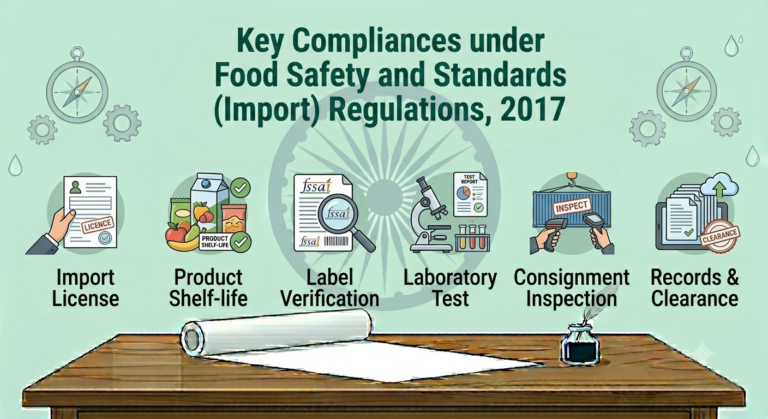
Food Safety and Standards (Import) Regulations, 2017 have been notified by the Food Safety and Standards Authority of India (FSSAI) under the Food Safety and Standards Act, 2006. These Regulations establish the comprehensive regulatory framework governing the import of food articles into India, prescribing the conditions, procedures, documentation, inspection, sampling, testing, clearance, and enforcement mechanisms applicable to all food importers and imported food consignments entering the country through any port of entry.
Regulations were subsequently amended by the Food Safety and Standards (Import) First Amendment Regulations, 2022 and further modified by the Jan Vishwas (Amendment of Provisions) Act, 2023. The framework covers: mandatory dual licensing (FSSAI import licence and DGFT Importer Exporter Code); linkage of IEC status with FSSAI import licence validity; Integrated Declaration Form filing at ports; minimum shelf life compliance; packaging, labelling, and storage conditions; specialised import categories (personal use, exhibition, R&D, export, re-export, and sports events) with prescribed declaration forms (Forms 7 through 13A); risk-based profiling by FSSAI; food recall plan obligations; No Objection Certificate validity and customs clearance timelines; disposal of rejected consignments; and registration of foreign food manufacturing facilities through Form 16 renewal.
Applicability
Food Safety and Standards (Import) Regulations, 2017 apply to all food importers and persons engaged in importing any article of food into India, including commercial importers (required to hold a valid FSSAI import licence and DGFT IEC); Custom House Agents authorised to act on behalf of importers at ports; persons importing food for personal use (subject to Form 7 declaration); exhibitors importing food for trade fairs and exhibitions (Form 10, with bills of material and display requirements); entities importing food for 100% export or re-export (Form 8); importers bringing food for research and development (Form 9, with valid FSSAI licence); importers of food for sports events (Form 11); importers of frozen/chilled food requiring provisional NOC (Form 12); importers of food with shelf life less than 7 days (Form 13); importers of pre-packaged retail food (Form 13A); and foreign food manufacturing facilities registered with FSSAI for export to India (Form 16 renewal). The Regulations also apply to custodians of food consignments held in customs warehouses, who are responsible for storage conditions and disposal of rejected consignments.
Compliance Requirement Under the act in Accordance with the Rules & Regulations:
No person shall import any article of food into India without first obtaining an import licence from the Central Licensing Authority in accordance with the provisions of the Food Safety and Standards (Licensing and Registration of Food Businesses) Regulations, 2011. The import licence must be obtained before any food article is brought into the country and must remain valid throughout the period of import operations.
Apart from obtaining a mandatory import licence from FSSAI, food importers shall also register with the Directorate General of Foreign Trade (DGFT) and obtain a valid Importer Exporter Code (IEC) before importing any article of food into India. Both the FSSAI import licence and the IEC must be in force concurrently at all times during food import operations.
In the event of any suspension, revocation, or cancellation of the Importer Exporter Code issued by DGFT, the food importer must inform the Central Licensing Authority and the Authorised Officer within three working days of such event. Upon suspension, revocation, or cancellation of the IEC, the FSSAI import licence issued under the Food Safety and Standards (Licensing and Registration of Food Businesses) Regulations, 2011 shall be deemed to have been simultaneously cancelled.
A food importer whose FSSAI import licence was cancelled due to suspension, revocation, or cancellation of its IEC may apply for re-issuance of the import licence once the IEC suspension is withdrawn or the IEC is restored, set aside, or freshly issued by DGFT. The Licensing Authority may re-issue the licence with the same licence number within seven days of receipt of the application.
The food importer or their authorised Custom House Agent (CHA) shall file an Integrated Declaration Form — as specified by the Customs authorities — on arrival of every food consignment at the port of entry. Additionally, the food importer or their authorised representative shall remain personally present at the customs area at the appointed time to facilitate visual inspection, assist in drawing of samples, participate in import clearance proceedings, witness sealing of samples by the Authorised Officer, and affix counter-signatures on sealed samples.
Customs shall not clear any article of food unless it has a valid remaining shelf life of not less than sixty percent of the total shelf life or three months before expiry — whichever is less — at the time of import. Food importers must ensure that all food consignments dispatched for import to India meet this minimum shelf life requirement at the port of entry.
Food importers must ensure that all imported food is transported and stored under proper temperature and hygiene conditions; packaged and labelled in accordance with the Food Safety and Standards (Labelling and Display) Regulations and other applicable FSSAI standards; packed in a manner that allows easy access to the Authorised Officer for inspection and sampling of each item in a consignment or multi-food container; and accompanied by a proper stuffing list for each consignment to facilitate clearance and verification. Food not packed and labelled in accordance with the prescribed standards shall not be permitted to be imported.
Where imported packaged food has rectifiable labelling deficiencies, the Authorised Officer may — during the scrutiny stage or after visual inspection — direct the food importer or their authorised agent to carry out permissible labelling rectifications within a specified time in the customs area, without altering or masking the original label information in any manner. Permissible rectifications include affixing a non-detachable sticker near the principal display panel containing the importer’s name and address, FSSAI logo and licence number, vegetarian or non-vegetarian logo, product category, and other required information not present in the original label.
Any person bringing or carrying imported articles of food for personal consumption — where the value does not exceed the amount permitted by Customs from time to time — shall submit a declaration in Form 7 to the Authorised Officer at the port of entry. The exemption from general import regulations applicable to such personal-use food articles is conditioned upon timely submission of this declaration.
Where imported food is intended for use in producing products for 100% export by the importer, its sister concern, or its wholly-owned subsidiary, or where imported food is to be re-exported, the importer shall declare in Form 8 to the Customs Department at the time of filing the Bill of Entry that the imported article of food is meant for captive use for 100% export or re-export, and that no part thereof shall be supplied for domestic consumption. This facility is not available to trading entities that do not import such items for their captive use, due to traceability concerns.
Where imported food is intended solely for research and development purposes, the importer shall submit a declaration in Form 9 stating that the food will not be sold, distributed, used for test marketing, or released into the domestic market under any circumstances. For such imports, the importer must also possess a valid FSSAI licence.
An exhibitor importing food articles for exhibition purposes must meet applicable Customs requirements and submit a declaration in Form 10 stating that the imported food shall be used only for exhibition purposes and not for sale. All food products for exhibition shall carry an additional non-detachable label or sticker clearly stating ‘For Exhibition Purpose Only’ and ‘Not for Sale’. Where food is permitted for tasting at the exhibition, the importer must submit a registration certificate, licence, or food safety certificate from the country of origin; a placard stating ‘For Tasting Only’ shall be prominently displayed at the exhibition site; and unconsumed portions of opened food items used for tasting shall be destroyed after the exhibition.
The exhibitor importing food for trade fair or exhibition purposes shall maintain detailed bills of material covering: (i) all food items imported for exhibition; (ii) food items consumed for tasting purposes or destroyed; and (iii) food items intended for re-export to the country of origin after the conclusion of the exhibition, fair, or event. These records must be produced on demand by the Authorised Officer.
The importer must ensure that the quantity of food imported for captive use or specific consumption — whether by sportspersons, exhibitors, or any other special category — does not exceed the bona fide requirement for the duration of the stay or event, whichever is earlier. Any unconsumed quantity must be re-exported to the country of origin, with prior intimation to the Authorised Officer before such re-export.
Where food is imported for exclusive consumption by sportspersons of a foreign country participating in a sports event in India — as may be permitted by the Food Authority — the importer shall submit a declaration in Form 11 for clearance of the imported food consignment.
Imported articles of food shall be stored in accordance with the storage conditions specified for each food category in the customs warehouse before clearance. No consignment of food articles shall be stored in a manner that allows one type of food to come into contact with another type of food. Failure to comply with prescribed storage conditions may result in the Authorised Officer refusing to grant a No Objection Certificate for import clearance of the consignment.
Where a temperature-controlled storage facility is not available at the customs warehouse, the Authorised Officer shall obtain a No Objection Certificate from the Customs Department to treat the importer’s warehouse as a bonded area. For this purpose, the importer shall submit a declaration in Form 12. After receiving the NOC, the importer shall be allowed to move the food consignment to a well-equipped storage facility.
For food imported in sealed bulk containers where breaking the seal would affect the food’s aseptic or hygroscopic conditions, the importer must ensure that the manufacturer provides two sealed representative samples from the same batch, along with a declaration confirming that the bulk consignment matches the submitted samples. Where such sealed representative samples or the manufacturer’s declaration are not provided, the Authorised Officer is empowered to break open the seal and collect a sample for laboratory analysis. The Authorised Officer may also collect a sample from the sealed container where the provided representative samples appear doubtful.
For food articles with a shelf life of less than seven days, the importer must submit a declaration in Form 13, enabling the Authorised Officer to draw a sample and issue a provisional NOC without waiting for the laboratory report. Final clearance shall depend on the laboratory test results confirming that the product conforms to the applicable FSSAI standards. On receipt of the laboratory analysis report, the Authorised Officer shall communicate to Customs and issue the NOC if the product conforms.
For imported pre-packaged food articles, the importer shall submit a declaration in Form 13A, upon which the Authorised Officer may issue a provisional NOC to allow the food consignment to be moved to a well-equipped storage facility. The importer shall sell such pre-packaged food articles only after the Authorised Officer issues the final NOC. In case of non-conformance of the sample, the Authorised Officer shall immediately inform the importer or Custom Broker to initiate a recall of the consignment and submit a compliance report as per the Food Safety and Standards (Food Recall Procedure) Regulations, 2017.
The importer must ensure that the labels affixed on sealed samples of imported food contain: the sample code; date and place of collection; quantity; product name and category (as per the Food Safety and Standards (Food Product Standards and Food Additives) Regulations, 2011); preservative details if any; and signatures of the importer or authorised agent and the sender, with the official seal for identification and traceability purposes.
For food consignments that were exported from India and subsequently rejected by foreign countries and are being re-imported, the importer must submit official rejection documents of the exporting (foreign) country. Such re-imported consignments shall be subject to all provisions of the FSSAI Import Regulations, except that packaging and labelling shall be in accordance with the requirements of the exporting country rather than India’s domestic labelling standards.
FSSAI may assess the risk associated with food imports into India by profiling the importer, custom house agent, manufacturer of the imported product, the imported product, country of origin, source country, port of entry, history of compliance, and such other parameters as it deems fit. For the purpose of such risk assessment, the food importer shall submit a certificate of sanitary export from authorised agencies in the exporting country, as may be required by FSSAI.
Every food importer must prepare, submit to FSSAI, and maintain a Food Recall Plan as per the Food Safety and Standards (Food Recall Procedure) Regulations, 2017. The recall plan shall specify the details of the contingency plan for ensuring traceability of food consignments in the event of any safety risk, including product identification, withdrawal procedures, and communication protocols. Failure to submit or maintain a recall plan may result in suspension or cancellation of the importer’s licence.
A No Objection Certificate (NOC) for food import is valid for 30 days from the date of its issue by the Authorised Officer, within which period the food importer must take effective steps to get the food consignment released from the customs area. Food not cleared within the NOC validity period shall be deemed to be uncleared and may be subject to further action. The Food Authority may review and revise the validity period for different food articles from time to time.
On receipt of a Non-Conformance Report (NCR) from the Authorised Officer, the custodian or importer shall dispose of the rejected consignment in accordance with the Customs Act, 1962. Disposal is permitted only after the expiry of the review period specified in the NCR. Storage costs during the review period shall be borne by the importer. The Authorised Officer shall return the remaining part of the sample to the importer within ten days of issuance of the NOC. If the importer fails to collect the remaining sample, the Authorised Officer shall dispose of it in the manner specified by the Food Authority.
Foreign food manufacturing facilities falling under notified categories and desirous of exporting food articles to India shall register with FSSAI before commencing exports. FSSAI shall register eligible foreign food manufacturing facilities — found to be in compliance with the FSS Act, Rules, and Regulations — for a period of two years and communicate their registration number in Form 17. Renewal of registration of a foreign food manufacturing facility shall be applied for in Form 16 not later than thirty days before the expiry date indicated in the registration certificate.
Penalty & Consequences
The following penalty provisions under the Food Safety and Standards Act, 2006 and the Import Regulations apply across the compliance obligations covered in this blog. These have been consolidated and de-duplicated for ease of reference:
Section 63 of the FSSAI Act, 2006 — Penalty for Importing Without Licence
Any person who is required to obtain a licence and imports any article of food without a valid import licence shall be liable to a penalty which may extend to ten lakh rupees (₹10,00,000).
Section 58 of the FSSAI Act, 2006 — General Penalty for Contravention
Whoever contravenes any provision of the Food Safety and Standards Act, 2006 or the rules or regulations made thereunder, for the contravention of which no penalty has been separately provided in the Act, shall be liable to a penalty which may extend to two lakh rupees (₹2,00,000).
Section 61 of the FSSAI Act, 2006 — Penalty for False or Misleading Information
Any person who provides false or misleading information, or submits false documents in connection with any requirement or direction under the FSS Act or the regulations made thereunder, shall be liable to a penalty which may extend to ten lakh rupees (₹10,00,000).
Section 60 of the FSSAI Act, 2006 — Penalty for Tampering with Seized Food
Whoever, without the permission of the Food Safety Officer, retains, removes, or tampers with any food article, vehicle, package, labelling, or related item that has been seized under the Act shall be punishable with imprisonment for a term which may extend to six months and with a fine which may extend to two lakh rupees (₹2,00,000).
Regulation 7(10) — Debarment from Future Import Concessions and Legal Action
Non-compliance with the conditions attached to any special-purpose import category — including imports for exhibition, R&D, export, sports events, or personal use — may lead to debarment of the importer from future concessions and facilities under the Import Regulations, in addition to any other legal action under the FSS Act and rules made thereunder.
Regulation 12(3) — Cancellation of Import Licence for Non-Compliance
If a food importer fails to comply with any provision, or with any direction or order issued by the Food Authority or Authorised Officer thereunder, the Food Authority may cancel the import licence issued to the food importer. This provision applies uniformly across all obligations under the Import Regulations.
Disclaimer: The information contained in this Article is intended solely for personal non-commercial use of the user who accepts full responsibility of its use. The information in the article is general in nature and should not be considered to be legal, tax, accounting, consulting or any other professional advice. We make no representation or warranty of any kind, express or implied regarding the accuracy, adequacy, reliability or completeness of any information on our page/article.