
Background
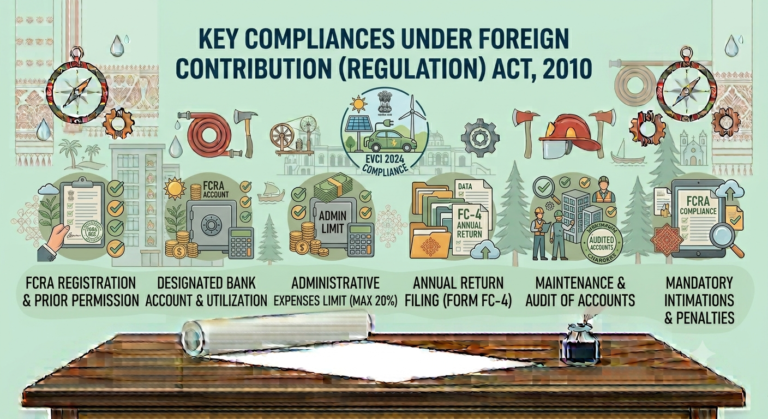
Foreign Contribution (Regulation) Act, 2010 (“FCRA”) and the Foreign Contribution (Regulation) Rules, 2011 constitute the principal Central legislative framework governing the acceptance and utilisation of foreign contributions and foreign hospitality by persons and organisations in India. The FCRA replaced the Foreign Contribution (Regulation) Act, 1976, and was enacted with the objective of consolidating the law relating to the acceptance and utilisation of foreign contribution and foreign hospitality by certain individuals and associations, to prohibit acceptance and utilisation of foreign contribution or foreign hospitality for activities detrimental to national interest, and for matters connected therewith. The Act is administered by the Ministry of Home Affairs, which maintains the FCRA online portal (fcraonline.nic.in) for all applications, filings, and intimations under the Act and the Rules. Persons with a definite cultural, economic, educational, religious, or social programme must obtain either a certificate of registration (Form FC-3A) for continuous receipt of foreign contribution from multiple sources, or prior permission (Form FC-3B) for receipt from a specific source for a specific purpose. All foreign contribution must be received exclusively through the designated FCRA Account at the notified branch of the State Bank of India, New Delhi, and may be utilised only for the purposes for which it was received, subject to the twenty percent cap on administrative expenses. The Foreign Contribution (Regulation) Amendment Rules, 2026 (S.O. 3272(E) dated 22nd June 2026) introduced Rule 17B and the new Form FC-6F, requiring registered associations to specify their purposes and areas of operation from a prescribed Schedule and mandating a one-time transitional intimation by existing registrants within one year.
Applicability
FCRA and the Rules apply to all persons and organisations in India — including individuals, associations, companies, trusts, and societies — that receive or seek to receive foreign contribution or foreign hospitality. Organisations with cultural, economic, educational, religious, or social programmes must obtain registration or prior permission before receiving any foreign contribution. Specified categories of persons — including election candidates, media persons and owners, public servants, Judges, Government servants, members of Legislatures, political parties and their office-bearers, politically-natured organisations, and news and current affairs broadcasters — are absolutely prohibited from accepting foreign contribution. Members of Legislatures, political office-bearers, Judges, Government servants, and employees of Government-owned or controlled corporations are prohibited from accepting foreign hospitality without prior permission. All registered organisations or prior-permission holders are subject to the prohibition on transfer of foreign contribution to others, the purpose-specific utilisation requirement, the twenty-percent administrative-expense cap, the mandatory FCRA Account and SBI New Delhi designation, the annual return obligation in Form FC-4, the separate accounts maintenance obligation, the six-year records preservation requirement, the website publication obligation, and the forty-five-day change-intimation obligations in Forms FC-6A through FC-6F. Banks are separately obligated to report all foreign contribution transactions within forty-eight hours. Existing registrants as of 22nd June 2026 must file a one-time Form FC-6F transitional intimation within one year.
Compliance Requirement Under the act in Accordance with the Rules & Regulations:
No person having a definite cultural, economic, educational, religious, or social programme shall accept any foreign contribution unless such person obtains a certificate of registration from the Central Government under Section 12. An application for a certificate of registration must be submitted electronically in Form FC-3A, accompanied by an affidavit executed by each key functionary in Proforma AA and such fee as may be prescribed. Any person making an application for registration must have an FCRA Account already opened at the designated branch of the State Bank of India, New Delhi, and must furnish its details before or at the time of filing the application.
A person who is not registered under Section 12 may accept foreign contribution only after obtaining the prior permission of the Central Government for a specific purpose and from a specific source. An application for prior permission must be submitted electronically in Form FC-3B, accompanied by an affidavit in Proforma AA, a specific commitment letter from the donor indicating the amount and purpose of the proposed contribution, and such fee as may be prescribed. Prior permission is valid for the specific purpose and source stated in the application and is not transferable to any other purpose or donor. Any applicant for prior permission must have an FCRA Account at the designated SBI New Delhi branch.
The following categories of persons and entities shall not accept any foreign contribution in any form or through any mode: (a) candidates for election; (b) correspondents, columnists, cartoonists, editors, owners, printers, or publishers of registered newspapers; (c) public servants, Judges, Government servants, and employees of any corporation or other body controlled or owned by the Government; (d) members of any Legislature; (e) political parties or office-bearers thereof; (f) organisations of a political nature as specified by the Central Government under Section 5(1); and (g) associations or companies engaged in the production or broadcast of audio news, audio-visual news, or current affairs programmes through any electronic mode, and their correspondents, columnists, cartoonists, or editors or owners. The acceptance of foreign contribution by any of these categories is absolutely prohibited regardless of the purpose, source, or quantum of the contribution.
No member of a Legislature, office-bearer of a political party, Judge, Government servant, or employee of any corporation or other body owned or controlled by the Government shall, while visiting any country or territory outside India, accept any foreign hospitality without the prior permission of the Central Government. Such persons who wish to accept foreign hospitality must apply electronically in Form FC-2 before availing such hospitality. The application must ordinarily reach the appropriate authority at least two weeks before the proposed date of the onward journey. Prior permission is not required for an emergent medical aid necessitated by sudden illness contracted during a visit abroad; however, the person receiving such emergency hospitality must give an intimation to the Central Government within one month of receipt.
Where a person specified under Section 6 accepts foreign hospitality for emergent medical aid on account of sudden illness contracted during a visit outside India, without prior permission, the person must give an intimation to the Central Government within one month from the date of receipt of such hospitality. The intimation must provide full details including the source of the hospitality, its approximate value in Indian rupees, and the purpose for which and manner in which it was received. No such intimation is required if the value of the emergent medical hospitality does not exceed one lakh rupees.
No person who is registered and granted a certificate, or has obtained prior permission, under the Act and who receives any foreign contribution, shall transfer such foreign contribution to any other person. This prohibition applies regardless of whether the recipient of such transfer is itself registered or holds prior permission under the Act. Any sub-grant, disbursal, or transfer of foreign contribution — including to implementing partners or sub-grantees — is prohibited unless expressly permitted by the Central Government.
Every person registered under the Act or holding prior permission who receives foreign contribution must utilise such contribution exclusively for the purposes for which it was received. Neither the foreign contribution nor any income arising from it may be used for speculative business. Speculative activities include: (a) any activity or investment involving risk of appreciation or depreciation of the original investment linked to market forces, including investment in mutual funds or shares; and (b) participation in schemes promising high returns such as investment in chits, land, or similar assets not directly linked to the declared aims and objectives of the organisation. Debt-based secure investments are not treated as speculative. Every association must maintain a separate register of investments, which must be submitted for audit.
No person registered under the Act shall incur administrative expenses exceeding twenty percent of the total foreign contribution received in that financial year, without prior approval of the Central Government. Administrative expenses include remuneration of key functionaries and management personnel, utilities, office administration, accounting and auditing costs, vehicles and travel costs of administrative personnel, reporting costs, legal and professional services, and rent. Expenditure directly incurred for achieving the stated welfare objectives — such as salaries of doctors, teachers, or research and training personnel — does not constitute administrative expense. Where unspent permissible administrative expenses are carried forward to the immediately succeeding financial year, the reasons must be disclosed in Form FC-4.
Any person who receives foreign contribution from a relative in excess of ten lakh rupees (or its equivalent in foreign currency) in a financial year must inform the Central Government electronically in Form FC-1 within three months from the date of receipt of such contribution, providing full details of the source, amount, and purpose of the contribution received.
Every person who has been granted a certificate of registration or prior permission under the Act must receive all foreign contribution exclusively in the FCRA Account designated by the State Bank of India, opened at the branch of SBI, New Delhi, as specified by the Central Government by notification. No funds other than foreign contribution shall be received or deposited in the designated FCRA Account. The account details must be furnished to the Central Government before or at the time of the registration or prior permission application.
Any person applying for registration or prior permission under the Act must open an FCRA Account at the designated branch of the State Bank of India, New Delhi, as specified by the Central Government by notification, before submitting the application. The account must be maintained as a dedicated account for receipt of foreign contribution, and its details must be furnished with the application for registration or prior permission.
Where a person registered under the Act opens a separate bank account for the purpose of utilising received foreign contribution, the person must intimate the Ministry of Home Affairs electronically in Form FC-6D within forty-five days of opening such account. Any changes in the bank or branch of the utilisation account must also be intimated in Form FC-6D within forty-five days.
Where a person granted registration or prior permission under the Act makes any change in the bank or branch used for the utilisation of foreign contribution, the person must intimate the Central Government electronically in Form FC-6D within forty-five days of the change. Such a change becomes effective only after approval of the Central Government.
No person whose certificate of registration has ceased to exist — whether because of expiry of the five-year validity period, non-renewal, or any other reason — shall either receive or utilise any foreign contribution until the certificate is renewed. Where no application for renewal of registration is received or where the application is not accompanied by the requisite fee before the expiry of the certificate’s validity, the certificate shall be deemed to have ceased from the date of completion of five years from the date of grant of the certificate.
During the period of suspension of a certificate of registration, the person concerned shall not receive any foreign contribution and shall utilise the foreign contribution already in its custody only with the prior approval of the Central Government. Up to twenty-five percent of the unutilised amount of foreign contribution may be spent, with the prior approval of the Central Government, exclusively for the declared aims and objects for which the contribution was received. The remaining seventy-five percent may be utilised only after the suspension is revoked.
A person granted a certificate of registration or prior permission under the Act must intimate the Central Government electronically in Form FC-6A within forty-five days of any change in the name of the association or its address within the State for which registration or prior permission was granted. Any such change takes effect only after final approval by the Central Government.
A person granted a certificate of registration or prior permission under the Act must intimate the Central Government electronically in Form FC-6B within forty-five days of any change in its nature, aims and objects, or registration with local or relevant authorities. Any such change takes effect only after final approval by the Central Government.
A person granted a certificate of registration or prior permission under the Act must intimate the Central Government electronically in Form FC-6C within forty-five days of any change in the bank, branch, or account number of the designated FCRA Account. Any such change takes effect only after final approval by the Central Government.
A person granted a certificate of registration or prior permission under the Act must intimate the Central Government electronically in Form FC-6E within forty-five days of any change in the key functionaries named in the application for registration, prior permission, or renewal of registration. Any such change takes effect only after final approval by the Central Government.
An association registered under the Act that intends to change its area of operation by including or deleting any purpose or any State or Union Territory specified in its certificate of registration must apply in Form FC-6F, accompanied by: (a) a resolution of the governing body approving the application; and (b) the prescribed fee payable in accordance with Rule 9(4) and the proviso thereto. This is a new obligation introduced by the Foreign Contribution (Regulation) Amendment Rules, 2026, notified vide S.O. 3272(E) dated 22nd June, 2026.
All associations registered under the Act before 22nd June, 2026 must submit a one-time intimation in Form FC-6F within one year from 22nd June 2026, specifying the purpose or purposes from the prescribed Schedule of Purposes and the State or States or Union Territories for which they wish to retain their existing FCRA registration. Failure to submit this transitional intimation within the prescribed period may affect the continued validity of the registration for the purposes and States not specified.
Where the foreign contribution for which prior permission has been granted exceeds one crore rupees and the Central Government has permitted its receipt in instalments, an association seeking the release of the second or any subsequent instalment must apply in Form FC-3BB. The second or any subsequent instalment shall be released by the Central Government only after: (a) the association has utilised at least seventy-five percent of the foreign contribution received in the previous instalment; and (b) a field inquiry has been conducted to verify such utilisation.
Every bank must report to the Central Government within forty-eight hours every transaction relating to the receipt or utilisation of foreign contribution by any person — irrespective of whether that person is registered under the Act or holds prior permission. This is an obligation imposed on banks as part of the FCRA compliance framework; all entities receiving foreign contribution through their FCRA Account should be aware that all transactions are automatically reported to the Central Government.
Every person registered under the Act or holding prior permission must publish the audited statement of accounts in respect of foreign contribution received and utilised — including the income and expenditure statement, the receipt and payment account, and the balance sheet — on the organisation’s official website or on such website as may be specified by the Central Government, within nine months from the close of each financial year.
Every person who has been granted registration or prior permission under the Act must file an annual return in Form FC-4 online within nine months from the close of each financial year. The return must include an activity report, the income and expenditure statement, the receipt and payment account, the balance sheet, and a certified copy of the FCRA Account bank statement. A NIL return in Form FC-4 is mandatory even if no foreign contribution was received during the financial year.
Every person who has been granted registration or prior permission under the Act must maintain a separate and exclusive set of accounts and records covering all foreign contribution received and its utilisation. These accounts and records must be entirely distinct from the organisation’s domestic or non-FCRA accounts and must cover: (a) an account of all foreign contribution received; and (b) a record of the manner in which such contribution has been utilised.
All accounting statements in respect of foreign contribution — including those filed with or accompanying the annual return in Form FC-4 — and the corresponding FCRA Account bank statements must be preserved by the person for a minimum period of six years from the date of their preparation or filing.
Every candidate for election who received any foreign contribution at any time within one hundred and eighty days immediately preceding the date on which they are duly nominated must give an intimation to the Central Government in Form FC-1 electronically within forty-five days from the date on which they are duly nominated as a candidate for election.
Any person aggrieved by an order passed by the competent authority under Section 32 of the Act may submit an application for revision of the order to the Secretary, Ministry of Home Affairs, Government of India, New Delhi, in such form and manner (including in electronic form) as may be specified by the Central Government. The application must be accompanied by a fee of ₹3,000 payable through the payment gateway specified by the Central Government, and must be submitted within one year from the date of communication of the order or from the date on which the person first came to know of such order.
A person who has been granted a certificate of registration under Section 12 and wishes to voluntarily surrender the certificate may make an application electronically in Form FC-7 to the Central Government. The Central Government may permit the surrender only if, after making such inquiry as it deems fit, it is satisfied that: (a) the person has not contravened any provision of the Act; and (b) the management of foreign contribution and any asset created out of such contribution has been vested in the prescribed authority under Section 15(1).
Any compoundable offence under the Act — being an offence not punishable with imprisonment only — may, before the institution of prosecution, be compounded by applying to the Secretary, Ministry of Home Affairs, New Delhi, electronically, accompanied by a fee of ₹3,000 payable through the Central Government’s specified payment gateway. Compounding is available only where prosecution has not yet been instituted. Compounding is not available to an individual or association where a similar offence was compounded within the preceding three years.
Penalty & Consequences
Section 35 — Criminal Penalty for Accepting or Assisting Acceptance of FC in Contravention
Whoever accepts, or assists any person, political party, or organisation in accepting, any foreign contribution or any currency or security from a foreign source in contravention of any provision of the Act or any rule or order made thereunder shall be punished with imprisonment for a term which may extend to five years, or with fine, or with both. This is the principal criminal penalty provision of the Act and applies to all substantive contraventions.
Section 10 — Freezing and Prohibition Order on Dealing with FC Accepted in Contravention
Where the Central Government is satisfied, after making such inquiry as it deems fit, that any person has in their custody or control any article, currency, or security (whether Indian or foreign) that has been accepted in contravention of any provision of the Act, it may by written order prohibit such person from paying, delivering, transferring, or otherwise dealing with such article, currency, or security in any manner, except in accordance with written orders of the Central Government. Such a prohibition order is served on the person concerned, after which the relevant provisions of the Unlawful Activities (Prevention) Act, 1967 regarding prohibition on dealings apply to the affected assets.
Section 14(d) — Cancellation of Certificate of Registration
The Central Government may cancel the certificate of registration of any person if the holder of the certificate has violated any of the provisions of the Act or the rules or orders made thereunder. Cancellation of the certificate has the effect of permanently disqualifying the organisation from receiving or utilising foreign contribution, and triggers the vesting of remaining foreign contribution and assets in the prescribed authority under Section 15.
Section 11(2) — Restriction on Utilisation of Unspent or Unreceived FC Following Violation
Where a person has been found guilty of violation of any provision of the Act or the Foreign Contribution (Regulation) Act, 1976, the unutilised or unreceived amount of foreign contribution shall not be utilised or received without the prior approval of the Central Government. This operates as a continuing restriction on the freedom to use or receive foreign funds, even where the registration has not been cancelled, and applies in addition to any prosecution or penalty under Section 35.
Section 41(2) — Compounding Not Available for Repeat Offenders within Three Years
Compounding of a compoundable offence under Section 41 is not available to any individual or association where a similar offence committed by that same individual or association was compounded under the Act within a period of three years from the date of the current contravention. In such cases, the offender remains subject to regular prosecution and the criminal penalties under Section 35.
Disclaimer: The information contained in this Article is intended solely for personal non-commercial use of the user who accepts full responsibility of its use. The information in the article is general in nature and should not be considered to be legal, tax, accounting, consulting or any other professional advice. We make no representation or warranty of any kind, express or implied regarding the accuracy, adequacy, reliability or completeness of any information on our page/article.