
Background
Poisons Act, 1919 is a Central legislation empowering the State Governments to regulate the possession and sale of poisons specified in its Schedule, and empowering the Central Government to restrict the importation of specified poisons across customs frontiers. The Act provides the foundational framework under which State Governments frame rules for licensing, inspection, and control of poison trade and use within their territories.
In Gujarat, the Gujarat Poisons (Regulation and Control of Sale and Use of Acid) Rules, 2014 (Gujarat Poisons Rules, 2014) have been framed under the Poisons Act, 1919, with a specific additional focus on the regulation and control of the sale and use of acid and corrosive substances — in response to rising incidents of acid attacks. The Rules establish a comprehensive licensing regime for persons possessing poisons and acids for sale, prescribe conditions of storage, labelling, sale verification, record-keeping in prescribed forms (Forms A through D), disposal of stock on termination/cancellation of licence, Standard Operating Procedures for acid users, quarterly usage reporting to the Sub-Divisional Magistrate, and emergency first-aid procedures under Schedule II for acid and poison incidents.
Applicability
Gujarat Poisons (Regulation and Control of Sale and Use of Acid) Rules, 2014 read with the Poisons Act, 1919 apply to all persons and entities in Gujarat engaged in the possession for sale, sale, import, or use of Schedule-I poisons and acid and corrosive substances. This includes: licensed dealers and distributors of Schedule-I poisons or acids (subject to Form A licensing, Form C sales register, Form D stock register, storage, labelling, and sales verification obligations); firms and companies dealing in poisons and acids (with licences in the name of the proprietor or responsible nominee); transferees of licensed businesses (required to apply for fresh licences within 14 days); importers of restricted poisons (requiring a licence under the Poisons Act, 1919); and all users of acid and corrosive substances — including industrial, commercial, educational, and institutional users — who are subject to SOP preparation, acid usage register maintenance, quarterly reporting to the Sub-Divisional Magistrate, and emergency first-aid compliance under Schedule II. Individuals using acid at home for purely personal purposes are exempted from the SOP, usage register, and quarterly reporting obligations.
Compliance Requirement Under the act in Accordance with the Rules & Regulations:
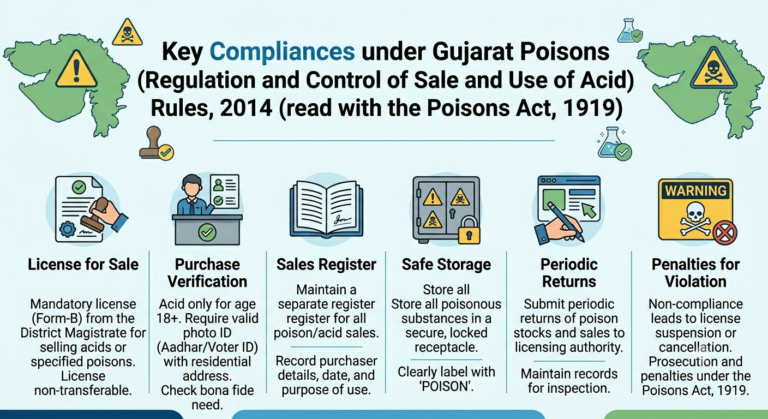
No person, unless specifically exempted under the Act, shall sell or possess for sale any poison specified in Schedule-I except under a licence in Form A granted or renewed by the Licensing Authority (District Magistrate or Commissioner of Police). Every person desiring the grant of a licence shall make an application in Form B to the Licensing Authority, bearing a ₹10 court-fee stamp. A licence shall be granted only to a person who, in the opinion of the Licensing Authority, is competent to conduct business in poisons. The licence issued to a firm or company shall always be in the name of the proprietor(s), a responsible person nominated by such proprietor(s), or in the case of a public company, in the name of its manager. The licence is valid for five years from the date of issue.
A copy of the licence in Form A shall always be displayed prominently at the place of business specified in the licence. In addition, a copy of the Rules may also be kept at the place of business by the licensee for reference.
Where the original licence is lost or destroyed, the licensee must apply in writing for a duplicate licence to the Licensing Authority, and such application shall bear a challan of ₹500.
Where a licensed dealer changes the place of business, a fresh licence application must be made to the Licensing Authority, and such application shall bear a challan of ₹500. The fresh licence application must be submitted before commencing operations at the new place of business.
Any applicant for a licence, or any licensee whose licence has been refused renewal, cancelled, or revoked, and who is aggrieved by an order of the Licensing Authority, may file an appeal with the Appellate Authority within 30 days from the receipt of the order. After the expiry of 30 days, the right to appeal lapses and the order of the Licensing Authority becomes final.
A licence shall automatically be terminated on the death of the licence-holder or on the transfer of their business. Where the licence is granted to a firm or company, it shall automatically terminate on the winding up or transfer of the business of such firm or company. The licence-holder or their legal representative must take note of this automatic termination and ensure that no further sale or possession for sale of poisons is carried out without a valid fresh licence.
Where the licensed business is transferred as a going concern, the transferee shall apply for a fresh licence within fourteen days of the transfer. The existing licence shall continue to remain in force until the fresh licence is granted or the application is rejected by the Licensing Authority, ensuring continuity of lawful business operations during the transition period.
No person shall import into India across any customs frontier defined by the Central Government any poison whose importation is for the time being restricted under Section 3 of the Poisons Act, 1919, except under and in accordance with the conditions of a valid licence. The Central Government may, by notification in the Official Gazette, prohibit the importation of any specified poison except under such a licence, and may by rule regulate the grant of licences for this purpose.
In the event of revocation or cancellation of the licence under Rule 9, or termination of the licence under Rule 10, the stock of poison may be sold to any other licence holder within three months from the date of such termination, revocation, or cancellation. After the expiry of three months, the remaining poison may be destroyed under the orders of the Licensing Authority. In the case of termination under Rule 10 (death, winding up, or transfer), the proceeds of any such sale shall be made over to the legal representative of the deceased licence holder, the transferee, the liquidator of the dissolved firm or company, or the transferee of the firm or company, as applicable.
Every sale of poisons shall, as far as practicable, be made by the licence-holder in person, or by a person duly recognised by the Licensing Authority in that behalf. The name of the authorised person or persons shall always be displayed prominently at the place of business. A person holding a licence for possession and sale of poisons shall store and sell only from the premises specified in the licence.
A licence holder shall not sell any poison to any person unless the purchaser, or a person authorised by the owner/proprietor/director of the firm or institution, is personally known to them or is satisfactorily identified by producing a photo identity card containing their address or a document substantiating their address. The licence holder shall also ascertain before the sale: the name, telephone number, and address of the purchaser; and the purpose for which the poison is being purchased. No poison shall be sold to any person who appears to be under the age of eighteen years, or to any person who does not appear to be in full possession of their faculties.
Every licence holder shall maintain a register of sales of poisons in Form C, recording all poison sales — except those dispensed or compounded by chemists, druggists, or compounders against valid medical or veterinary prescriptions. The daily quantities sold of each poison shall be entered separately and the register updated on a day-to-day basis. The signature in the register shall be that of the licence holder themselves, or, where the licence holder is a firm or company, that of an accredited representative, signed at the time of sale or dispatch to the purchaser. All letters or written orders shall be preserved in original for at least two years from the date of the sale. The licence holder shall also enter the daily balance of stock in the register.
All poisons possessed under a licence shall be stored securely in a locked box, almirah, room, or building, depending on the quantity stored. No substances other than poisons shall be kept in such secure storage. Each poison shall be stored separately in closed glass, metal, or earthenware containers within the secured storage area. Every such box, almirah, room, or building — and every such receptacle — shall be marked with the word ‘POISON’ in red letters, both in English and in Gujarati. Receptacles containing individual poisons shall also bear the name of the specific poison.
A licence holder shall maintain a stock register in Form D in respect of each poison and shall enter the daily balance of stock in the register, keeping the records current and up-to-date at all times.
When any poison is sold, it shall be securely packed in a closed receptacle or container appropriate to the quantity being sold. Every such receptacle or packet shall be labelled by the licensee with a red label bearing — in both English and Gujarati — the name of the poison and the name and address of the licensee. The applicable universal warning symbols as prescribed in Rule 18 shall also be prominently displayed on the receptacle or packet.
Every user of acid and corrosive substances — except individuals using them at home for personal purposes — must prepare a Standard Operating Procedure (SOP) covering security, storage, and incident management measures, and display it prominently in the premises. Under the SOP: a designated person shall be accountable for safe possession and storage of acids and poisons on the premises under supervision; storage shall follow a double-lock system; a usage register shall be maintained and submitted quarterly to the concerned Sub-Divisional Magistrate; and entry checks shall be conducted for persons leaving laboratories or storage areas. Storage requirements include: chemicals shall be kept in suitable plastic or other appropriate containers; all containers must be properly labelled indicating identity, hazards, and precautions; incompatible chemicals shall not be stored together; inventory shall be minimised; and appropriate PPE such as gloves, aprons, and eye protection shall be provided and used.
Every user of acid and corrosive substances — except individuals using them at home for personal purposes — shall maintain a register of usage of acid, recording all receipts, consumption, and current balance of acid and corrosive substances on a day-to-day basis. The register shall be kept at the premises and made available for inspection by the authorised Sub-Divisional Magistrate or designated officer on demand.
The register of usage of acid shall be filed with the concerned Sub-Divisional Magistrate authorised under Rule 6 of the Gujarat Poisons Rules, every quarter — i.e., once every three months. Timely quarterly filing is mandatory and failure to file constitutes an offence under the Rules.
Every incident involving contact with, or ingestion of, acid, corrosive, or poison substances shall be managed as per the emergency response procedures prescribed in Schedule II. The prescribed first aid procedures are: for skin contact — quickly remove contaminated clothing, blot or brush away excess chemical, flush with lukewarm water for at least 30 minutes without interruption, call a Poison Centre or doctor, and transport to hospital; for eye contact — avoid direct contact, wear protective gloves, flush contaminated eyes with lukewarm water for at least 30 minutes while holding eyelids open, do not delay flushing to remove contact lenses, call a Poison Centre or doctor, and transport to hospital; for ingestion — rinse mouth with water, if vomiting occurs lean forward to avoid aspiration, rinse mouth again, call a Poison Centre or doctor, and transport to hospital. Every premises using acid or corrosive substances shall maintain the necessary first aid materials and display the Schedule II emergency procedures prominently.
Penalty & Consequences
Section 6 of the Poisons Act, 1919 — Penalty for Contravention
Whoever contravenes any provision of the Poisons Act, 1919, or any rule made thereunder, shall be punishable: (a) on first conviction — with imprisonment for a term which may extend to three months, or with fine which may extend to five hundred rupees, or with both; and (b) on second or subsequent conviction — with imprisonment for a term which may extend to six months, or with fine which may extend to one thousand rupees, or with both. In addition, the poison in respect of which the offence was committed — together with the vessels, packages, or coverings in which it is found — shall be liable to confiscation.
Rule 9 of the Gujarat Poisons Rules, 2014 — Consequence of Failure to Appeal within 30 Days
Where an applicant or licensee who is aggrieved by an order of the Licensing Authority (refusing, cancelling, or revoking a licence) fails to file an appeal within 30 days of receipt of the order, the right to appeal shall lapse and the order of the Licensing Authority shall become final and binding.
Disclaimer: The information contained in this Article is intended solely for personal non-commercial use of the user who accepts full responsibility of its use. The information in the article is general in nature and should not be considered to be legal, tax, accounting, consulting or any other professional advice. We make no representation or warranty of any kind, express or implied regarding the accuracy, adequacy, reliability or completeness of any information on our page/article.