
Background
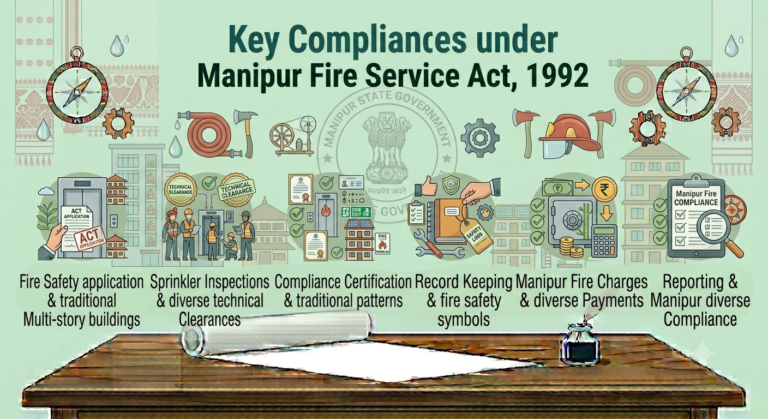
Manipur Fire Service Act, 1992 is the principal State legislation governing fire prevention, fire safety, and fire emergency response in Manipur. The Act regulates the licensing of buildings and premises used for purposes involving elevated fire risk — including warehouses and workshops for inflammable articles, places for manufacturing or dealing in fireworks, venues for public gatherings and entertainment, and temporary structures and pandals. It empowers the State Government to mandate fire precautionary measures for specified categories of premises by notification, and confers inspection and enforcement powers on the Director of Fire Services and authorised officers, including the power to seize and dispose of goods stored in contravention of the Act. The Act also establishes civil liability on property owners for fire damage caused by their own or their agent’s negligence, and criminalises the making of false reports of fire outbreaks. The Manipur Fire Service (Adoption of Fire Precautionary Measures) Rules, 1997, notified under Section 50(1)(2)(g) of the Act vide Notification No. 12/1(9)/93-H dated 4th November 1997, prescribe the framework for inspections and directions by the nominated authority and Director under Section 11(1), operationalising the general precautionary-measures obligation in the Act.
Applicability
Act and Rules apply to owners and occupiers of premises in Manipur that fall within the following regulated categories: buildings or places used or proposed to be used as warehouses or workshops for inflammable articles, which require a licence from the Licensing Authority before such use commences; premises of any class specified by State Government notification as being likely to cause a risk of fire, which must maintain the prescribed fire precautionary measures at all times and comply with directions issued following inspection under the 1997 Rules; buildings or places used for manufacturing, making, or dealing in fireworks, which require a separate licence; buildings or structures used for public gatherings for amusement, entertainment, or any purpose where the public may assemble, which require a licence granted on the Director’s recommendation; and temporary structures or pandals erected for public gathering, which require prior permission subject to Director-specified conditions and advance fee payment. All persons are additionally prohibited from making false reports of fire outbreaks. Property owners whose negligence or deliberate action causes a fire resulting in damage to others’ property are subject to civil compensation liability under Section 42.
Compliance Requirement Under the act in Accordance with the Rules & Regulations:
No building or place may be used as a warehouse or workshop for inflammable articles unless the owner or occupier has previously obtained a licence for such use from the Licensing Authority. No licence to use a building or place as a warehouse shall be granted unless the building or place conforms to such precautionary measures as may be directed by the Licensing Authority. A licence for use as a warehouse or workshop is a precondition to lawful use and must be obtained before operations commence.
The State Government may, by notification in the Official Gazette, require owners or occupiers of premises in any area — or of any class of premises used for purposes likely to cause a risk of fire — to take such precautions as are specified in the notification. Every such owner or occupier must maintain the fire precautions so specified at all times. The Manipur Fire Service (Adoption of Fire Precautionary Measures) Rules, 1997, made under the rule-making power in Section 50(1)(2)(g) of the Act, prescribe the framework for inspections and directions by the nominated authority or Director under Section 11(1). Following any such inspection, the owner or occupier must comply with all fire-safety measures directed by the nominated authority or the Director within the time specified.
Every owner or occupier of any building or place that was being used as a warehouse immediately before the date on which the Act came into force in the relevant area was required to apply for an operating licence from the appropriate Licensing Authority within thirty days from the date of commencement of the Act. [Note: This is a transitional obligation linked to the historical commencement of the Act. It applies only to warehouses that were already operating prior to the Act’s commencement in the relevant area of Manipur and is unlikely to have live applicability for establishments that commenced operations after the Act came into force.]
Whenever a change in the occupation of any licensed warehouse or workshop occurs, the person entering into occupation must give written notice of the change to the Licensing Authority within two weeks of entering into occupation, and must pay the prescribed fee. Upon receipt of the notice and fee, the name of the new occupier is substituted in the licence in place of the name of the last occupier. The obligation to notify falls on the incoming occupier.
No building or place may be used for the purpose of manufacturing, making, or otherwise dealing in any manner with fireworks, unless the owner or occupier has previously obtained a licence for such use from the Licensing Authority. The licence must be obtained before any such activity commences at the premises.
No building or structure of any kind may be used for public gathering for amusement, entertainment, or any other purposes where the public may assemble, unless the owner or occupier has previously obtained a licence from the Licensing Authority. The application for such a licence must be made to the Licensing Authority, who shall refer the matter to the Director of Fire Services. The Licensing Authority shall grant or refuse the licence as recommended by the Director.
No licence for use as a place of public gathering or entertainment under Section 16 shall be granted unless the building or structure conforms to such rules and conditions as may be prescribed for the purposes of public safety. Applicants must ensure that the building or structure satisfies all applicable prescribed safety conditions before a licence can be granted by the Licensing Authority on the Director’s recommendation.
A licence for use of a building or structure as a place of public gathering or entertainment under Section 16 shall not be granted unless the prescribed licence fee has been paid in advance by the applicant. Advance payment of the fee is a mandatory precondition to the grant of the licence.
No temporary structure or pandal intended for public gathering may be erected without first obtaining permission from the Licensing Authority. Permission shall be granted by the Authority subject to the following conditions: (i) the temporary structure conforms to such conditions as may be specified by the Director of Fire Services; (ii) advance payment of the prescribed fee has been made; and (iii) in the opinion of the Director, the structure is not unsafe for public gathering.
No person shall knowingly give, or cause to be given, a false report of the outbreak of a fire to any person authorised to receive such a report, whether by way of a statement, message, or by any other means. A person who commits this act is deemed to have committed an offence punishable under Section 177 of the Indian Penal Code.
Any person whose property catches fire on account of any action of their own — or of their agent — done deliberately or negligently is liable to pay compensation to any other person who suffers damage to their property as a result of any action taken under Section 22 of the Act by any fire officer or any person acting under the authority of such officer. All claims under this section must be preferred to the District Magistrate within thirty days from the date on which the damage was caused. The District Magistrate shall, after giving all parties an opportunity of being heard, determine the amount of compensation due and pass an order specifying the amount and the person liable, and such order shall have the force of a decree of a civil court.
Penalty & Consequences
The following penalty provisions and financial consequences apply across the compliance obligations covered in this blog.
Section 32(1) — Penalty for Violation of Sections 11, 15, 16, and 17
Any person who violates any provision of Sections 11 (fire precautionary measures and warehouse/workshop licensing), 15 (licence to deal in fireworks), 16 (licence for public gathering venues), or 17 (permission for temporary structures) of the Act shall be punishable, on conviction before a Magistrate, with imprisonment which may extend to two years, or with a fine which may extend to ₹5,000, or with both.
Section 32(2) — Penalty for Operating a Warehouse or Workshop after Refusal, Withdrawal, or Suspension of Licence
Any person who uses any warehouse or workshop in respect of which a licence has been refused, or after the licence in respect thereof has been withdrawn, or during the time for which such licence has been suspended, shall be punishable, on conviction before a Magistrate, with imprisonment which may extend to one year, or with a fine which may extend to ₹1,000, or with both.
Section 13 — Seizure, Detention, Removal, and Disposal of Goods
Where goods or objects are stored or dealt with in contravention of the licensing requirements under the Act, the Director or any officer authorised in this behalf may seize, detain, remove, dispose of, or destroy such objects or goods in such manner as may be prescribed by the State Government. Neither the Director nor any authorised officer shall be liable to pay any compensation in any manner to any person in respect of any such action taken.
Section 35 read with Section 177 of the Indian Penal Code — Penalty for False Report of Fire Outbreak
Any person who knowingly gives or causes to be given a false report of the outbreak of a fire to any person authorised to receive such a report is deemed to have committed an offence punishable under Section 177 of the Indian Penal Code. Section 177 IPC provides for punishment with simple imprisonment for a term which may extend to six months, or with a fine which may extend to ₹1,000, or with both.
Section 42 — Civil Liability for Compensation for Fire Caused by Negligence
Any person whose property catches fire due to their own deliberate or negligent act — or that of their agent — is civilly liable to compensate any other person who suffers property damage as a result of firefighting action taken under Section 22 of the Act. Claims must be filed before the District Magistrate within thirty days of the date of damage. The District Magistrate’s compensation order has the force of a decree of a civil court and is enforceable accordingly.
Disclaimer: The information contained in this Article is intended solely for personal non-commercial use of the user who accepts full responsibility of its use. The information in the article is general in nature and should not be considered to be legal, tax, accounting, consulting or any other professional advice. We make no representation or warranty of any kind, express or implied regarding the accuracy, adequacy, reliability or completeness of any information on our page/article.