
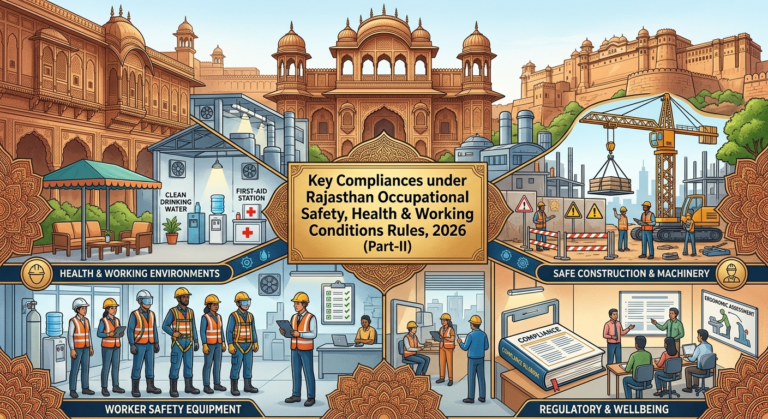
Background
Occupational Safety, Health and Working Conditions Code, 2020 (OSH Code) consolidates thirteen central labour laws into a single framework governing workplace safety, health and working conditions across establishments such as factories, mines, plantations, docks, motor transport undertakings, construction establishments, and contract labour. It prescribes employer and worker duties, registration and licensing requirements, and empowers Governments to frame detailed implementation rules.
Rajasthan Occupational Safety, Health and Working Conditions Rules, 2026 implement the Code within the State by prescribing procedures for electronic registration and licensing, factory plan approvals, statutory notices and returns, maintenance of registers and records, constitution of Safety Committees, appointment of Safety and Welfare Officers, medical examination of workers engaged in hazardous processes, and submission of the unified annual return. The Rules operate in conjunction with the Occupational Safety, Health and Working Conditions (Central) Rules, 2026.
Applicability
The Rajasthan Occupational Safety, Health and Working Conditions Rules, 2026 apply to factories, commercial establishments, contractors, and other establishments covered under the OSH Code, 2020. They cover factories, construction establishments, motor transport undertakings, plantations, mines, docks, beedi and cigar establishments, and establishments engaging contract labour. Employers and principal employers must obtain registrations and licences (where applicable), maintain statutory records, ensure workplace safety, health and welfare, comply with working-hour and leave provisions, and file prescribed returns. Contractors must obtain licences and fulfil wage, record-keeping and welfare obligations. The Rules also impose safety-related responsibilities on architects, designers, engineers, and manufacturers, importers and suppliers of plant and machinery used in covered establishments.
Compliance Requirement Under the act in Accordance with the Rules & Regulations:
If contract worker of contractor is working at the premises of the principal employer, then it shall be responsibility of principal employer to provide facilities or amenities such as toilet, washroom, drinking water, bathing facilities if required, changing room, first aid box, Canteen and Crèche
Where the contractor fails to pay minimum wages to contract workers, the Labour Commissioner or an authorised representative may cause payment of unpaid wages from the security deposit maintained under Rule 70, including by invoking the bank guarantee.
Every contractor shall apply for a contract labour licence electronically in Form-25, with the principal employer’s certificate (Form-26), work order, bank guarantee and fee.
Contractor not intending to renew the licence shall apply electronically to the Licensing Authority for refund of the security deposit, along with the licence copy, notice of completion of work and bank details.
Where the security deposit is appropriated towards payment of unpaid wages of contract labour, the contractor shall re-furnish the security deposit within 15 days, failing which the licence is liable to be suspended.
Every contractor shall intimate Licensing Authority electronically on Official Portal or e-mail, of details of work order including principal employer’s name, work-site address, commencement date, number of contract labour & duration of work order.
Contractor shall fix wage periods not exceeding one month and pay wages of every contract labour before expiry of the seventh day after the last day of the wage period, through bank transfer or electronic mode only.
Contractor shall display at the place of work a notice showing the wage period and the date and time of disbursement of wages of contract labour, with a copy sent to the principal employer. 68. Payment of Unpaid Wages of Contract Labour by Principal Employer (Section 55, Rule 75(7) of Rajasthan Occupational Safety, Health and Working Conditions Rules, 2026). Where the contractor fails to pay wages within 7 days of the end of the wage period, the principal employer shall pay the wages within 15 days and recover the amount from the contractor.
Every contractor, including those employing fewer than 50 contract labour, shall send a half-yearly return in Form-23 to the concerned licensing authority electronically, not later than 30 days from the close of each half-year (January-June and July-December).
Every contractor shall issue, on demand, an experience certificate in Form-28 to the contract labour, giving details of the period, work performed and experience gained in various fields.
Employer shall pay a lump sum amount for to-and-fro journey from place of employment to place of residence, to an inter-State migrant worker who has worked for not less than 180 days in preceding twelve months, once every twelve months.
The agreement between an audio-visual worker and the producer shall be executed in Form-29 and registered with the competent authority notified by the State Government.
Every factory shall be kept clean and free from effluvia arising from any drain, privy or other nuisance, and in particular-
Internal surfaces shall be repainted/re-varnished every 5 years; washable water-painted surfaces repainted every 3 years and washed every 6 months; painted, varnished or smooth impervious surfaces cleaned every 14 months; other surfaces whitewashed/colour-washed every 14 months; and doors, window frames, frameworks and shutters painted/varnished every 5 years.
Effective arrangements shall be made in every factory for the treatment of wastes and effluents due to the manufacturing process carried on therein, so as to render them innocuous. Effective and suitable provision shall be made in every factory for securing and maintaining in every workroom adequate ventilation by circulation of fresh air, and such a temperature as will secure to workers reasonable conditions of comfort and prevent injury to health.
Effective and suitable provision shall be made in every factory for securing and maintaining in every workroom,- (a) adequate ventilation by the circulation of fresh air, and (b) such a temperature as will secure to workers therein reasonable conditions of comfort and prevent injury to health; and in particular, — (i) walls and roofs shall be of such material and so designed that such temperature shall not be exceeded but kept as low as practicable; (ii) where the nature of the work carried on in the factory involves, or is likely to involve the production of excessively high temperatures, such adequate measures as are practicable shall be taken to protect the workers therefrom, by separating the process which produces such temperatures from the workroom, by insulating the hot parts or by other effective means.
Where the manufacturing process gives off dust, fume or other impurity likely to be injurious or offensive to workers, effective measures including exhaust appliances applied as near as possible to the point of origin shall be taken to prevent its inhalation and accumulation. In any factory no stationary internal combustion engine shall be operated unless the exhaust is conducted into the open air.
No stationary internal combustion engine shall be operated in a factory unless its exhaust is conducted into the open air.
No room in any factory shall be overcrowded to an extent injurious to the health of the workers employed therein. There shall be in every workroom of a factory in existence on the date of the commencement of these rules at least 9.9 cubic metres and of a factory built after the commencement of these rules at least 14.2 cubic metres of space for every worker employed therein.
Provide and maintain sufficient and suitable natural or artificial lighting in all areas where workers work or pass. Keep glazed windows and skylights clean and unobstructed, and prevent glare and shadows causing eye strain or accident risks.
Provide sufficient wholesome drinking water at convenient points, mark them as “Drinking Water”, maintain the required distance from contamination sources and provide cool drinking water during hot weather where more than 250 workers are employed.
Every factory shall provide sufficient, conveniently situated latrine and urinal accommodation, separate for male and female workers, adequately lit and ventilated, maintained in a clean & sanitary condition, with sanitary napkins and lidded disposal bins provided and maintained in women’s toilets.
In every factory, the following shall be securely fenced with substantial safeguards, continuously maintained and kept in position while in motion or use:
Exceptions: (I) Necessary examination, lubrication or adjustment may be carried out while machinery is in motion where required to be performed during operation. (II) In continuous processes where stopping transmission machinery may substantially interfere with operations, necessary examination, mounting or shipping of belts, lubrication or adjustment may be carried out while the machinery is in motion.
Examination or adjustment of machinery in motion shall be carried out only by a specially trained worker wearing tight-fitting clothing supplied by the occupier; no adolescent shall clean, lubricate or adjust any prime mover or transmission machinery while in motion.
In every factory- (a) suitable striking gear or other efficient mechanical appliance shall be provided and maintained and used to move driving belts to and from fast and loose pulleys which form part of the transmission machinery, and such gear or appliances shall be so constructed, placed and maintained as to prevent the belt from creeping back on the fast pulley; (b) driving belts when not in use shall not be allowed to rest or ride upon shafting in motion. (c) In every factory suitable devices for cutting off power in emergencies from running machinery shall be provided and maintained in every workroom. (d) When a device, which can inadvertently shift from “off” to “on” position, is provided in a factory to cut off power, arrangements shall be provided for locking the device in safe position to prevent accidental starting of the transmission machinery or other machines to which the device is fitted
No traversing part of a self-acting machine and no material carried thereon shall, if the space over which it runs is a space over which any person is liable to pass, be allowed to run within a distance of forty-five centimetres from any fixed structure which is not part of the machine.
Every set screw, bolt or key on any revolving shaft, spindle, wheel or pinion of power-driven machinery shall be sunk, encased or effectively guarded, and toothed/friction gearing not requiring frequent adjustment shall be completely encased.
In every factory- (a) every hoist and lift shall be- (i) of good mechanical construction, sound material and adequate strength; (ii) properly maintained, and shall be thoroughly examined by a competent person at least once in every period of six months; (b) every hoist way and lift way shall be sufficiently protected by an enclosure fitted with gates, and the hoist or lift and every such enclosure shall be so constructed as to prevent any person or thing from being trapped between any part of the hoist or lift and any fixed structure or moving part; (c) the maximum safe working load shall be plainly marked on every hoist or lift, and no load greater than such load shall be carried thereon; (d) the cage of every hoist or lift used for carrying persons shall be fitted with a gate on each side from which access is afforded to a landing; (e) every gate referred to in clause (b) or clause (d) shall be fitted with interlocking or other efficient device to secure that the gate cannot be opened except when the cage is at the landing and that the cage cannot be moved unless the gate is closed.
In any factory the following provisions shall be complied with in respect of every lifting machine, other than a hoist and lift, and every chain, rope and lifting tackle- (a) all parts shall be of good construction, sound material and adequate strength, properly maintained, and thoroughly examined by a competent person at least once in every period of twelve months, and a register shall be kept containing the particulars of every such examination; (b) no lifting machine and no chain, rope or lifting tackle shall be loaded beyond the safe working load which shall be plainly marked thereon.
Maintain a register containing the particulars of every examination of lifting machines, chains, ropes and lifting tackles carried out by a competent person. The register shall be produced whenever required by the Inspector-cum-Facilitator.
Ensure no lifting machine, chain, rope or lifting tackle is loaded beyond its safe working load, except for the purpose of testing.
Clearly mark the safe working load and identification mark on every lifting machine, chain, rope and lifting tackle, or prominently display a table of safe working loads where marking is not practicable, and record the details in the prescribed register.
Where any person is employed on or near the wheel track of a travelling crane, effective measures shall be taken to ensure that the crane does not approach within 6 metres of that place to prevent workers from being struck by the crane.
Display the prescribed safe operating speed of grinding machines and ensure grindstones, abrasive wheels and all power-driven revolving equipment are operated within the specified safe working peripheral speed.
Effective measures shall be taken to ensure that the safe working pressure of every pressure plant, machinery or part operated above atmospheric pressure is not exceeded.
Every pressure plant shall be of good construction with proper safety devices, properly maintained, and thoroughly examined by a competent person at least once in every 12 months, with a register of examinations kept.
Maintain a register recording the particulars of every examination of pressure plants conducted by a competent person. The register shall be produced before the Inspector-cum-Facilitator whenever required.
All floors, steps, stairs, passages and gangways shall be of sound construction, properly maintained, kept free from obstructions and slip hazards, with handrails where necessary, and safe means of access shall be provided to every place of work.
Every fixed vessel, sump, tank, pit or opening in the ground or floor which is or may be a source of danger shall be securely covered or securely fenced.
No person shall be employed to lift, carry or move any load so heavy as to be likely to cause injury; no person, unaided by another person or mechanical aid, shall be required to lift/carry/move a load exceeding 25 kg (adult male) or 15 kg (adult female).
For any manufacturing process involving risk of eye injury from particles/fragments or excessive light exposure, effective screens or suitable goggles shall be provided for the protection of persons employed on or in the immediate vicinity of the process.
Ensure no person enters a confined space unless adequate means of egress are provided, hazardous gases, fumes, vapours or dust are reduced to permissible limits, and a safety certificate or suitable breathing apparatus is provided. No person shall enter such confined space until all practicable measures have been taken to remove the gas/fume/vapour/dust and unless a certificate by a competent person is given or the person is wearing suitable breathing apparatus and a secured belt/rope. (a) a certificate in writing has been given by a competent person, based on a test carried out by himself that the space is reasonably free from dangerous gas, fume, vapour or dust; or (b) such person is wearing suitable breathing apparatus and a belt securely attached to a rope the free end of which is held by a person outside the confined space.
Use only portable electric lights or electrical appliances not exceeding 24 volts inside confined spaces unless adequate safety devices are provided. Where inflammable gas, fumes or dust may be present, use only flame-proof lamps or lights.
Where a manufacturing process generates combustible dust, gas, fumes or vapours likely to explode on ignition, effectively enclose the plant or machinery, prevent accumulation of hazardous substances and eliminate or effectively enclose all possible sources of ignition.
Provide suitable devices such as chokes, baffles, vents or other effective appliances to restrict the spread and effects of explosions where plant or machinery cannot withstand probable explosion pressure.
Before opening, welding, brazing, soldering or cutting any plant, machinery, tank or vessel containing or having contained explosive or inflammable substances, follow the prescribed safety measures to prevent fire or explosion. Where any plant or machinery contains explosive or inflammable gas or vapour above atmospheric pressure, it shall not be opened except as follows: (a) Stop the flow of gas or vapour into the part or connected pipe using a stop-valve or other effective means before loosening any joint or cover. (b) Before removing any fastening, reduce the gas or vapour pressure to atmospheric pressure as far as practicable. (c) After loosening or removing any fastening, prevent entry of explosive or inflammable gas or vapour until the fastening is securely replaced.
Provided that these provisions do not apply to plant or machinery installed in the open air.
No plant, tank or vessel containing or having contained explosive or inflammable substances shall undergo welding, brazing, soldering or cutting involving heat unless such substances and fumes are removed or rendered non-explosive/non-inflammable. No such substance shall re-enter until the metal has cooled sufficiently to eliminate ignition risk.
Provide and maintain adequate fire prevention measures, safe means of escape, fire-fighting equipment and facilities, and ensure workers are trained in fire emergency and evacuation procedures.
Where the Inspector-cum-Facilitator considers the existing fire safety or escape measures inadequate, having regard to the nature of work, factory construction, risks to life or safety, or other circumstances, he may, by written order, require the factory to implement such additional reasonable and necessary measures within the specified time.
Provide and use suitable and securely supported ladders or crawling boards where persons are required to stand, pass or work on or near fragile roofs or ceilings with a fall risk exceeding 3 metres.
Every person working at a place from which he may fall more than ten feet shall be provided a safety belt with leather shoulder straps and a D-ring, tested and examined by a competent person at least once in six months, with a certificate obtained and entered in a register.
Penalty and Consequences
The following penalty provisions apply across the compliance obligations covered in this blog. These have been consolidated and de-duplicated for ease of reference:
Section 94 of the Occupational Safety, Health and Working Conditions Code, 2020 — General Penalty for Contravention
Save as otherwise expressly provided in the Code, if in or in respect of any establishment there is any contravention of the provisions of the Code or regulations, rules, bye-laws or any of the standards made thereunder, or of any order in writing given under the Code or such regulations, rules, bye-laws or standards, the employer or the principal employer of the establishment, as the case may be, shall be liable to a penalty which shall not be less than two lakh rupees but which may extend to three lakh rupees. Where the contravention is continued after conviction, a further penalty of up to two thousand rupees for each day during which such contravention continues shall apply.
Section 96 of the Occupational Safety, Health and Working Conditions Code, 2020 — Penalty for Failure to Maintain Registers or File Returns
Any person who is required under the Code or the rules, regulations, bye-laws or orders made thereunder to: (i) maintain any register or other document or to file returns, and who omits or fails to maintain such register or document or to file such returns; or (ii) produce any register, plan, record, report or any other document, and who omits or fails to produce such register, plan, record, report or other document, shall be liable to a penalty which shall not be less than fifty thousand rupees but which may extend to one lakh rupees. Where any person convicted of an offence punishable under sub-section (1) is again convicted of an offence under the same provision, he shall be liable to a penalty which shall not be less than fifty thousand rupees but which may extend to two lakh rupees.
Section 97 of the Occupational Safety, Health and Working Conditions Code, 2020 — Penalty for Contravention of Provisions Relating to Employment of Certain Categories of Workers
Any person who, save as permitted by or under the Code, contravenes any: (i) provision of the Code or of any rule, regulation or bye-law; or (ii) order made under the Code prohibiting, restricting or regulating the employment of workers including women, audio-visual workers and contract labour, and employees below eighteen years of age in the case of mines, shall be liable to a penalty which shall not be less than fifty thousand rupees but which may extend to one lakh rupees. Where any person convicted of an offence punishable under sub-section (1) is again convicted of an offence under the same provision, he shall be punishable with imprisonment for a term which may extend to three months, or with a fine which may extend to two lakh rupees, or with both.
Disclaimer: The information contained in this Article is intended solely for personal non-commercial use of the user who accepts full responsibility of its use. The information in the article is general in nature and should not be considered to be legal, tax, accounting, consulting or any other professional advice. We make no representation or warranty of any kind, express or implied regarding the accuracy, adequacy, reliability or completeness of any information on our page/article.