
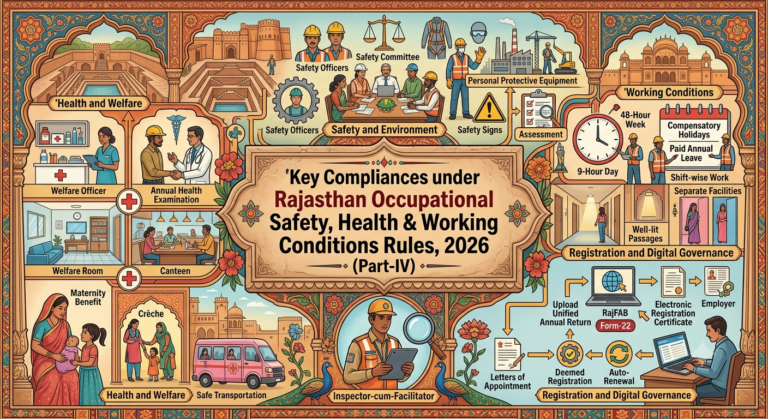
Background
Occupational Safety, Health and Working Conditions Code, 2020 (OSH Code) consolidates thirteen central labour laws into a single framework governing workplace safety, health and working conditions across establishments such as factories, mines, plantations, docks, motor transport undertakings, construction establishments, and contract labour. It prescribes employer and worker duties, registration and licensing requirements, and empowers Governments to frame detailed implementation rules.
Rajasthan Occupational Safety, Health and Working Conditions Rules, 2026 implement the Code within the State by prescribing procedures for electronic registration and licensing, factory plan approvals, statutory notices and returns, maintenance of registers and records, constitution of Safety Committees, appointment of Safety and Welfare Officers, medical examination of workers engaged in hazardous processes, and submission of the unified annual return. The Rules operate in conjunction with the Occupational Safety, Health and Working Conditions (Central) Rules, 2026.
Applicability
The Rajasthan Occupational Safety, Health and Working Conditions Rules, 2026 apply to factories, commercial establishments, contractors, and other establishments covered under the OSH Code, 2020. They cover factories, construction establishments, motor transport undertakings, plantations, mines, docks, beedi and cigar establishments, and establishments engaging contract labour. Employers and principal employers must obtain registrations and licences (where applicable), maintain statutory records, ensure workplace safety, health and welfare, comply with working-hour and leave provisions, and file prescribed returns. Contractors must obtain licences and fulfil wage, record-keeping and welfare obligations. The Rules also impose safety-related responsibilities on architects, designers, engineers, and manufacturers, importers and suppliers of plant and machinery used in covered establishments.
Compliance Requirement Under the act in Accordance with the Rules & Regulations:
Provide and maintain first-aid boxes or cupboards in adequate numbers with prescribed contents at readily accessible locations during working hours.
Display at a conspicuous place the details of first-aid facilities, name and contact details of the person in charge, and the nearest hospital in English or Hindi and the local language.
Every first-aid box or cupboard shall be under the charge of a worker or supervisor holding a valid first-aid certificate. At least one fully equipped first-aid box shall be maintained in every department or section, with additional boxes where required.
At least 33% of workers shall be trained in first-aid procedures, with refresher training every three years. Where women workers are employed, at least one woman worker shall be trained. Training shall be conducted by a qualified trainer as prescribed.
Every factory, mine and building or other construction work ordinarily employing 500 or more workers shall provide and maintain an ambulance room or dispensary in good order.
Ensure the ambulance room is conveniently located, adequately equipped with equipments as mentioned in illustrative list Annexure-II, provides privacy and examination facilities, and is provided with emergency lighting, communication facilities and drenching showers, where required. Contents of First Aid
Full-time qualified medical practitioner to manage the ambulance room shall be appointed directly by the employer and is assisted by adequate number of paramedical staffs (at least one nurse and one General Duty Assistant-Healthcare or Nursing Assistant) Medical practitioner required to be appointed under sub-rule (iii) has a medical qualification included in the I or II schedule or part II of the Third schedule of the Indian Medical Council Act, 1956 (102 of 1956). Persons possessing qualifications included in part II of Third schedule should also fulfil the condition specified in sub-section (3) of section 13 of the Act or as per the National Medical Commission Act, 2019 (30 of 2019) or Diploma or Degree in Industrial or Occupational Health, Associate Fellow in Industrial Health or equivalent. The Qualified Medical Practitioner shall acquire a Diploma or Degree in Industrial or Occupational Health or the Associate Fellow in Industrial Health, within one year from the date of appointment;
The ambulance room shall be assisted by adequate paramedical staff, including at least one qualified nurse registered with the State Nursing Council having Basic Life Support (BLS) training and the prescribed emergency experience of not less than six months, and one General Duty Assistant-Healthcare or Nursing Assistant.
Every factory & mine employing >50 workers & motor transport undertaking where employees are required to halt at night shall provide suitable shelters, rest rooms or lunch rooms with drinking water & washing facilities.
Shelters, rest rooms and lunch rooms shall be sufficiently lighted and ventilated, maintained in a clean and hygienic condition, constructed with suitable heat-resistant materials, have adequate roof height and floor area, and be furnished with suitable seating and eating arrangements.
Every employer of a motor transport undertaking shall provide uniforms, raincoats and other prescribed amenities to motor transport workers free of charge.
Every factory, mine and plantation ordinarily employing 250–500 workers shall appoint at least one Welfare Officer. Where the number of workers exceeds 500, appoint one additional Welfare Officer for every additional 500 workers or part thereof. Appoint women Welfare Officers in proportion to women workers, including an additional woman Welfare Officer where more than 100 women workers (up to 1,000) are employed. Where more than one Welfare Officer is appointed, designate one as the Chief Welfare Officer. Welfare Officers shall possess the prescribed postgraduate qualification or diploma and have knowledge of the language spoken by the majority of workers. Person appointed as Welfare Officer has obtained a post graduate degree or diploma in social work or human resources management or labour welfare from any institution recognised by the Central or State Government in this behalf; and has knowledge of the language spoken by the majority of the workers in every establishment mentioned above.
(1) Welfare Officers shall promote harmonious industrial relations, assist in grievance redressal, advise management on statutory compliances, welfare measures, social security, training and employee welfare.
(2)Welfare officers shall not deal with disciplinary cases or appear on behalf of the management against workers or appear before a conciliation officer or tribunal on behalf of every establishment mentioned above management.
Inform the Inspector-cum-Facilitator electronically or otherwise about the appointment of every Welfare Officer, including details of qualifications and conditions of service.
Every establishment employing more than 50 workers shall provide and maintain a crèche facility for children below six years of age. Where required, a mobile crèche may be provided. Ensure the crèche facility is provided free of cost and is easily accessible to all employees. Provided that an establishment can avail common crèche facility of the Central Government, State Government, municipality or private entity or provided by non-governmental organisation or by any other organisation or group of establishments may pool their resources for setting up of common crèche in the manner as they may agree for such purpose.
Ensure the crèche is suitably located and maintained with prescribed infrastructure, sanitation, feeding room, washroom, resting arrangements and other required amenities.
Appoint a suitable person in charge of the crèche and ensure police verification of the caretaker, support staff and security personnel. The employer shall ensure that: 1. Crèche is under the charge preferably woman for the care of children and infants; 2. Police verification of in charge of creche, support staff and guard are mandatory.
Maintain records of each child, including identity and address details, authorised pick-up and drop-off persons, and daily attendance. Children shall be handed over only to authorised persons.
Keep sharp objects, chemicals and electrical installations out of children’s reach, ensure no child is left unattended, prohibit verbal, physical and sexual abuse, restrict unauthorised entry and comply with applicable child protection laws.
Equip the crèche with CCTV monitoring during working hours, display emergency contact numbers, maintain an evacuation plan and ensure medical support is available on call.
Ensure every child receives nutritious, wholesome and healthy food according to dietary requirements and that the child’s personal hygiene and cleanliness are properly maintained.
The employer of every factory, building or other construction work, industrial premise for manufacture of beedi and cigar, and motor transport undertaking shall conduct quarterly mock drills to check emergency preparedness to deal with various emergencies.
Provide suitable temporary living accommodation free of charge to workers at remote construction sites where adequate transportation or other suitable accommodation is unavailable.
The employer of every motor transport undertaking shall provide medical facilities at the operating centres and halting stations, and uniforms, raincoats and other like amenities for protection from rain or cold, for motor transport workers, as prescribed under Rule 63 of the Central OSH Rules, 2026 The employer shall ensure that:
The employer shall furnish to the Central Government detailed statistics of inter-State migrant workers and of their occupational safety and health, electronically on the web portal designated for the purpose, as specified through general or special orders issued from time to time.
Work shall not be carried on in any establishment by means of a system of shifts so arranged that more than one relay of workers is engaged in work of the same kind at the same time, except where exempted by written order of the appropriate Government or the Chief Inspector-cum-Facilitator.
Every worker employed in an establishment shall be entitled for leave in a calendar year with wages subject to the following conditions, namely:— (i) that he has worked one hundred and eighty days or more in such calendar year; (ii) that he shall be entitled for one-day leave for every twenty days of his work, in the case of adolescent worker for fifteen days of his work, and in case of worker employed below ground mine, at the rate of one day for every fifteen days of his work, in such calendar year; (iii) any period of layoff, maternity leave or annual leave availed by such worker in such calendar year shall be counted for calculating the period of one hundred and eighty days or more under clause (i), but he shall not earn leave for the period so counted; (iv) any holidays falling between the leave availed by such worker (in a calendar year or prefixed or suffixed holiday) shall be excluded from the period of leave so availed; (v) in case of such worker whose service commences otherwise than on the first day of January shall be entitled to leave with wages at the rate specified in clause (ii), if he has worked for one-fourth of the total number of days in the remainder of the calendar year.
Where a worker does not avail the entire annual leave, unavailed leave may be carried forward to the next calendar year up to a maximum of 30 days. However, where leave applied for is refused by the employer, the refused leave may be carried forward without any ceiling.
A worker is entitled to encash annual leave on demand at the end of the calendar year. Where accumulated leave exceeds 30 days, the excess leave shall be encashed in accordance with the Code.
In case such worker is discharged or dismissed from service or quits employment or is superannuated or dies while in service, during the course of the calendar year, such worker or his heir or nominee, shall be entitled to wages in lieu of the quantum of leave to which such worker was entitled immediately before his discharge, dismissal, quitting of employment, superannuation or death, calculated as specified in preceding clauses, even if such worker has not worked for the required period under this sub-section making such worker eligible to avail such leave, and such payment shall be made— (a) where such worker is discharged or dismissed or quits employment before the expiry of the second working day from the date of such discharge, dismissal or quitting; and (b) where such worker is superannuated or dies while in service, before the expiry of two months from the date of such superannuation or death
The working hours of an adolescent worker shall be regulated in accordance with the provisions of the Child and Adolescent Labour (Prohibition and Regulation) Act, 1986. Notwithstanding
The contractor shall not charge, directly or indirectly, in whole or in part, any fee or commission from the contract labour.
Employment of contract labour in core activities of any establishment is prohibited. Provided that the principal employer may engage contract labour through a contractor to any core activity, if— (a) the normal functioning of the establishment is such that the activity is ordinarily done through contractor; or (b) the activities are such that they do not require full time workers for the major portion of the working hours in a day or for longer periods, as the case may be; (c) any sudden increase of volume of work in the core activity which needs to be accomplished in a specified time.
Every contractor or employer engaging inter-State migrant workers shall provide suitable working conditions having regard to the fact that such workers are employed in a State other than their home State.
It shall be the duty of every contractor or the employer, of an establishment employing inter-State migrant workers in connection with the work of that establishment—
No person shall be employed as an audio-visual worker in or in connection with production of any audio-visual programme unless a written agreement has been entered into with such person by producer and such agreement is registered with competent authority notified by appropriate Government.
An employer shall not require or permit any person who is known or reasonably believed to be deaf, have defective vision or have a tendency to giddiness to perform any building or other construction work that is likely to involve a risk of accident to the person or to any other individual.
Provide and maintain suitable housing accommodation, including drinking water, kitchen and toilet facilities, for every worker employed in the plantation and their family, as prescribed by the State Government.
In every plantation, arrangement shall be made by the employer to provide for the safety of a worker in connection with the use, handling, storage and transport of insecticides, pesticides and chemicals and toxic substances
Every employer of a plantation shall display in the plantation, a list of permissible concentrations of insecticides, pesticides, chemicals and toxic substances in breathing zone of workers engaged in handling and application of insecticides, pesticides, chemicals and toxic substances in plantation
No person shall in respect of the establishment, disclose any information relating to any manufacturing or commercial business or any working process which may come to his knowledge in the course of his official duties
Ensure working journalists do not work beyond 144 hours in any four consecutive weeks and provide a weekly rest of at least 24 consecutive hours. Grant earned leave, medical leave and related accumulation, encashment and cash compensation benefits as prescribed.
The employer shall be responsible to maintain in his establishment such health, safety and working conditions for the employees as may be prescribed by the Central Government.
Every factory employer artificially increasing humidity shall assess and control risks from extreme heat and humidity, considering worker safety, protective clothing, hazardous substances and discomfort caused by respiratory protectors in hot environments. Employers shall provide work-rest cycles in shaded, cooler or air-conditioned spaces where employees are exposed to heat from work, sunlight or high temperatures. Adequate drinking water with electrolytes shall be made available. Employees shall be supervised and withdrawn from hot conditions if heat stress symptoms occur, with trained first-aid support available. Workers shall be trained to recognize heat stress symptoms and emergency actions. Humidity tests shall be conducted and recorded, and harmful humidity levels regulated using purified water. Instruments for measuring and recording temperature and humidity shall be provided and maintained at appropriate locations.
Every construction employer shall prevent exposure to dangerous chemical, physical and biological hazards through safer substitutes, technical controls or free PPE and protective clothing, and ensure adequate safeguards where toxic substances, oxygen deficiency or flammable atmosphere may exist. Employers shall take measures against heat, cold and wet conditions through proper workload design, training, PPE, medical surveillance, drinking water and electrolytes. Adequate ventilation shall remove fumes, dust and harmful gases and maintain safe temperature and humidity. High-temperature processes shall be isolated or insulated. Work-rest cycles in shaded or cool areas shall be provided where required. Air quantity, temperature and humidity shall be regularly monitored. In tunnelling works, ventilation systems shall control pollutants, maintain suitable climate and provide fresh air. Instruments for measuring oxygen, flammable gases, temperature, dust and toxic gases shall be maintained, and compressor air intakes kept free from contamination.
Every construction employer shall take necessary steps to minimize emissions of gas, fumes, vapours and dust at workplaces and ensure employee exposure to respirable dust, gas, fumes or vapours remains within safe and non-harmful limits.
Every employer shall provide accessible clean and safe drinking water at workplaces. Non-piped drinking water shall be stored in suitable vessels marked in Hindi, English and local language, replenished daily and protected from contamination.
Employer except BOCW/Beedi & cigar workers shall ensure that workplaces, dock areas, wharfs, jetties are not overcrowded with machinery, materials or products & sufficient space is maintained around machines, process units for safe operation, repairs, material handling (Excluding Motor Transport Undertaking)
Every employer except Plantations shall ensure adequate natural or artificial lighting at all workplaces, utility areas and passages, including emergency access areas, suitable to the operations and type of work performed, with natural lighting arranged wherever possible.
Every employer shall provide sufficient, accessible and separate latrine and urinal facilities for male, female, transgender and disabled employees, ensure proper lighting, ventilation and sanitation, and maintain floors of sanitary blocks in a clean and non-slippery condition. Internal walls of latrines, urinals, sanitary blocks shall have glazed tiles/smooth impervious surfaces for hygiene & easy cleaning. Sanitary pans to be kept clean at all times. Min.1 latrine shall be provided for every 25 male & 15 female employees, along with 1 separate facility each for transgenders & persons with disabilities & one urinal for every 15 male emp, with adequate water supply. “Cleaning in progress” sign in Hindi, English and local language shall be displayed during cleaning. Washbasins with tap water shall be provided. Free sanitary napkins, replenished daily & covered disposal bins shall be provided in women’s toilets, with disposal bins also provided for men, transgenders, persons with disabilities. Latrines shall ensure privacy, ventilation and proper signage (Men/women/trans). Wastewater shall be safely treated and disposed of. Water taps shall be available within or near latrines. Mobile toilets shall be provided where required in construction, plantation and dock work
Employers except beedi/cigar works shall ensure proper disposal of liquid effluents, gaseous emissions, solid waste & effective waste treatment compliant with safety and health requirements. Plantations must safely dispose pesticide and chemical containers to prevent reuse and pollution.
No worker shall be allowed to work in an establishment for more than six days in any one week: Provided that in any motor transport undertaking, an employer may, in order to prevent any dislocation of a motor transport service, require a worker to work on any day of weekly holiday which is not a holiday so arranged that the worker does not work for more than ten days consecutively without a holiday for a whole day intervening.
Where the appropriate Government considers the employment of women dangerous for their health and safety in an establishment or in particular hazardous or dangerous processes, the employer shall provide adequate safeguards prior to the employment of women for such operation, per the standards declared for safeguarding women employed in hazardous processes specified in the First Schedule to the Code.
Constitute a Grievance Redressal Committee for contract labour to address grievances relating to health, working conditions and wages. Ensure grievances are disposed of within prescribed timelines and escalated to the Inspector-cum-Facilitator where required. Grievance redressal mechanism for contract labour-
(1) The contract labour may submit grievance relating to health, working conditions and wages, at the level of principal employer, who shall look into the matter and redress grievance.
(2) A committee shall be constituted by the principal employer in whose establishment contract labour is employed and the committee shall comprise of a chairman, who shall be the authorised representative of the principal employer and shall have representative of principal employer and contractor.
(3) The committee shall hear and dispose of the grievance of the contract labour within a period of thirty days.
(4) In event the grievance is not redressed within thirty days, the principal employer shall forward the grievance to the concerned Inspector-cum-Facilitator electronically.
A worker regularly employed by the contractor for any activity, whose employment is governed by mutually accepted standards of conditions of employment, shall get an annual increment of not less than two percent of his wages.
No pregnant woman shall be employed in any part of a factory wherein, or near which, a dangerous manufacturing process or operation is carried out.
Penalty and Consequences
The following penalty provisions apply across the compliance obligations covered in this blog. These have been consolidated and de-duplicated for ease of reference:
Section 94 of the Occupational Safety, Health and Working Conditions Code, 2020 — General Penalty for Contravention
Save as otherwise expressly provided in the Code, if in or in respect of any establishment there is any contravention of the provisions of the Code or regulations, rules, bye-laws or any of the standards made thereunder, or of any order in writing given under the Code or such regulations, rules, bye-laws or standards, the employer or the principal employer of the establishment, as the case may be, shall be liable to a penalty which shall not be less than two lakh rupees but which may extend to three lakh rupees. Where the contravention is continued after conviction, a further penalty of up to two thousand rupees for each day during which such contravention continues shall apply.
Section 97 of the Occupational Safety, Health and Working Conditions Code, 2020 — Penalty for Contravention of Provisions Relating to Employment of Certain Categories of Workers
Any person who, save as permitted by or under the Code, contravenes any: (i) provision of the Code or of any rule, regulation or bye-law; or (ii) order made under the Code prohibiting, restricting or regulating the employment of workers including women, audio-visual workers and contract labour, and employees below eighteen years of age in the case of mines, shall be liable to a penalty which shall not be less than fifty thousand rupees but which may extend to one lakh rupees. Where any person convicted of an offence punishable under sub-section (1) is again convicted of an offence under the same provision, he shall be punishable with imprisonment for a term which may extend to three months, or with a fine which may extend to two lakh rupees, or with both.
Disclaimer: The information contained in this Article is intended solely for personal non-commercial use of the user who accepts full responsibility of its use. The information in the article is general in nature and should not be considered to be legal, tax, accounting, consulting or any other professional advice. We make no representation or warranty of any kind, express or implied regarding the accuracy, adequacy, reliability or completeness of any information on our page/article.