
Background
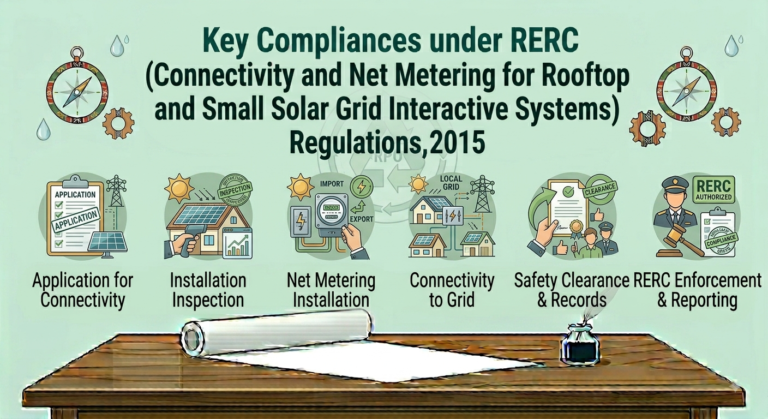
RERC (Connectivity and Net Metering for Rooftop and Small Solar Grid Interactive Systems) Regulations, 2015 establish the framework for connecting rooftop solar PV systems to Rajasthan’s distribution network and implementing net metering. The Regulations prescribe requirements relating to eligibility, application and approval, interconnection, technical and safety standards, metering, energy settlement and billing. They apply to rooftop solar systems of 1 kWp to 1,000 kWp and require compliance with applicable CEA connectivity standards.
The First Amendment, 2019 revised the energy settlement mechanism for domestic and non-domestic consumers. For installations commissioned on or before 15 September 2021, these Regulations continue to apply, while installations commissioned thereafter are generally governed by the RERC DREGS Regulations, 2021.
Applicability
Regulations apply to residential, commercial, industrial and institutional consumers installing eligible grid-connected rooftop solar systems of 1 kWp to 1,000 kWp under net metering, where the installation was commissioned on or before 15 September 2021.
Consumers are required to comply with prescribed technical, safety, metering, protection, anti-islanding, application and energy-settlement requirements. Distribution licensees are responsible for processing applications, providing connectivity, executing agreements, installing/maintaining bi-directional meters, and undertaking billing and energy settlement in accordance with the Regulations.
Compliance Requirement Under the act in Accordance with the Rules & Regulations:
The distribution licensee must offer the net metering arrangement to every consumer who intends to install a grid-connected Rooftop PV Solar Power Plant in its area of supply, on a non-discriminatory and first-come-first-serve basis. Every eligible consumer is entitled to install a grid-connected Rooftop PV Solar Power Plant of the rated capacity specified under these Regulations. The interconnection of such system with the grid must be undertaken as specified under these Regulations and in compliance with the Central Electricity Authority (Technical Standards for Connectivity of the Distributed Generation Resources) Regulations, 2013.
The cumulative capacity of Rooftop PV Solar Power Plants to be connected under net metering at any particular distribution transformer must not exceed 30% of the capacity of that distribution transformer. The distribution licensee must update the distribution transformer-level capacity available for connecting Rooftop PV Solar Power Plants under the net metering arrangement on a yearly basis, and must make this information available on its website as well as to the Commission.
The distribution licensee must execute the standard interconnection agreement in Annexure IV within thirty days of receipt of a completed application from the eligible consumer. Where the distribution licensee determines that an interconnection study is necessary before executing the agreement, it must carry out such study within sixty days of the completed application, and thereafter execute the interconnection agreement within ninety days of the completed application.
Upon receipt of the standard interconnection agreement from the distribution licensee, the eligible consumer must execute the agreement and return it to the distribution licensee within thirty days from the date of receipt. Failure to return the executed agreement within this period may result in the lapse of the interconnection approval.
An eligible consumer who proposes to install a rooftop solar energy system must apply in the prescribed form along with the applicable fee, available for download on the DISCOM’s website and in physical form at the relevant subdivisional office. The distribution licensee must acknowledge, register, and process applications in order of receipt. Within ten working days of receipt, it must confirm all required documents have been received or notify the applicant of any deficiencies. The distribution licensee must assess feasibility and intimate the consumer within fifteen days of a completed application; this feasibility determination remains valid for one month unless extended. Where an interconnection study is required, feasibility must be communicated within sixty days. The feasibility intimation must specify required documents, identified deficiencies, interconnection study requirements, and the applicable security deposit. After receipt of the security deposit, supporting documents, and rectification of deficiencies, the distribution licensee must issue approval within ten working days. If deficiencies are not rectified within thirty days of notification, the application shall stand cancelled and the application fee shall be forfeited.
The installed capacity of the Rooftop PV Solar Power Plant must not exceed 80% of the sanctioned connected load or contract demand of the eligible consumer. The capacity must be in conformity with the provisions relating to connected load or contract demand permissible under the RERC (Electricity Supply Code and Connected Matters) Regulations, 2004 and subsequent amendments thereto. The eligible capacity range under these Regulations is between 1 kWp and 1,000 kWp.
The Solar Power Generator (SPG) and all associated equipment installed at the eligible consumer’s premises must conform to: (a) the CEA (Technical Standards for Connectivity of Distributed Generation Resources) Regulations, 2013; (b) the CEA (Installation and Operation of Meters) Regulations, 2006; and (c) the RERC (Electricity Supply Code and Connected Matters) Regulations, 2004. All equipment must be pre-tested; the supplier’s representative must install the equipment at the consumer’s premises to confirm satisfactory working, and test certificates must be provided to the consumer.
Rooftop PV Solar Power Plants must interconnect with the distribution licensee’s network in accordance with the CEA (Technical Standards for Connectivity of Distributed Generation Resources) Regulations, 2013, as amended, and the connectivity levels specified under Regulation 9(2) of these Regulations. EHT and HT consumers may install solar generators at LT or HT voltage and connect to their LT or HT system as appropriate. Interconnection must comply with CEA (Safety and Electric Supply) Regulations, 2010, as amended. The solar power generator is responsible for safe operation, maintenance, and any defects up to the interconnection point; from the interconnection point onwards — including the net meter — the distribution licensee is responsible.
The consumer bears sole responsibility for any accident to human beings or animals — whether fatal or non-fatal — that may occur due to back-feeding from the Solar Power Generator when the grid supply is off. The distribution licensee reserves the right to disconnect the consumer’s installation at any time in such emergencies to prevent accident or damage to persons and property.
Tests as per EN 50160 and in accordance with the distribution licensee’s standards must be carried out to ensure the quality of power generated from the Solar PV system before and during grid connection. Compliance with EN 50160 power quality standards is the responsibility of the solar power generator.
Any alternate source of supply — including battery power, diesel generator power, or other backup power — must be restricted to the consumer’s own network. The consumer must take adequate safety measures to ensure that battery power, diesel generator power, or any backup power does not extend to the distribution licensee’s LT grid upon failure of the distribution licensee’s grid supply.
The distribution licensee has the right to disconnect the rooftop PV solar energy generator from its system at any time in the following conditions: (i) emergencies or maintenance requirements on the distribution licensee’s electric system; (ii) a hazardous condition on the distribution licensee’s system arising from the operation of the solar energy generator or its protective equipment, as determined by the Distribution Licensee, Transmission Licensee, or SLDC; and (iii) adverse electrical effects, such as power quality problems, on the electrical equipment of other consumers caused by the solar energy generator, as determined by the distribution licensee.
The distribution licensee may call upon the rooftop PV solar energy generator to rectify any defect in the solar system within a reasonable time. On receiving such a call, the solar energy generator must carry out the rectification within the reasonable time specified by the distribution licensee.
Every Rooftop PV Solar Power Plant must be capable of detecting an unintended islanding condition and must be equipped with anti-islanding protection to prevent unfavourable conditions — including failure of supply — arising from such islanding. IEC-62116 shall be followed to test islanding prevention measures for grid-connected photovoltaic inverters.
Every Rooftop PV Solar Power Plant must be equipped with an automatic synchronisation device. Where the system uses an inverter, a separate synchronising device is not required if the same functionality is inherently built into the inverter.
Every Rooftop PV Solar Power Plant operating in parallel with the electricity system must be equipped with the following protective functions: (i) over and under voltage trip — if voltage reaches above 110% or below 80% of nominal, with a clearing time of up to two seconds; (ii) over and under frequency trip — if frequency reaches 50.5 Hz or below 47.5 Hz, with a clearing time of up to 0.2 seconds; (iii) cessation of energising the circuit in the event of any fault in the connected circuit; (iv) a voltage and frequency sensing and time-delay function preventing reconnection unless the system has been stable for at least sixty seconds; and (v) a function to detect and prevent unintended island formation, ceasing to energise the electricity system within two seconds of the formation of an unintended island.
The equipment of the Rooftop PV Solar Power Plant must meet the following requirements: (i) circuit breakers or other interrupting equipment must be capable of interrupting the maximum available fault current expected at their location; (ii) the plant and associated equipment must be designed such that the failure of any single device or component does not compromise the safety and reliability of the electricity system; and (iii) the paralleling device must be capable of withstanding 220% of the nominal voltage at the interconnection point.
Every time the Rooftop PV Solar Power Plant of an eligible consumer is synchronised to the electricity system, it must not cause voltage fluctuation greater than plus or minus 5% at the point of interconnection.
Where the distribution licensee determines it is necessary for maintenance and safety purposes, it may require the rooftop PV solar power plant to provide a manually operated isolating switch between the plant and the electricity system. Where such a requirement is imposed, the isolating switch must: (i) allow visible verification that electrical separation has been accomplished; (ii) include clear indications of open and closed positions; (iii) be accessible at any time — twenty-four hours a day — by the licensee’s personnel without requiring clearance from the applicant; (iv) be capable of being locked in the open position; (v) not be rated for load-break nor have overcurrent protection features; and (vi) be installed at a height of at least 2.44 metres above ground level.
Prior to the first synchronisation of the Rooftop PV Solar Power Plant with the electricity system, the applicant and the distribution licensee must agree on the protection features and control diagrams for the installation. No first synchronisation may take place until this mutual agreement is established and documented.
The power conditioning unit must be equipped with features to filter out harmonics and other distortions before injecting energy into the distribution utility’s system. Technical, power quality, and inverter standards must comply with Annexure V of the Regulations or any other standards specified by the CEA from time to time. As per Annexure V and IEEE 519, the permissible level for individual harmonics — both voltage and current — must be less than 3%, and the Total Harmonic Distortion (THD) for both voltage and current harmonics must be less than 5%.
Before connecting the photovoltaic system to the distribution system, the eligible consumer must obtain all necessary approvals and clearances — including environmental clearances and grid connection-related approvals — as required under the interconnection agreement. Connection to the distribution system may not proceed until all such approvals and clearances are in place.
The distribution licensee must install suitable metering at the interconnection point to measure both imported and exported energy, along with a separate solar meter to measure solar generation. Meter readings are taken on a monthly or billing cycle basis, with bills showing solar injection, grid supply, net energy billed, and total solar generation. For domestic consumers, surplus energy injected above 100 units shall be paid at Rs. 3.14 per unit, subject to a generation cap of 4.8 units per kW per day; energy credits below 100 units carry forward until the 100-unit threshold is reached. For non-domestic consumers, the same 4.8 units per kW per day cap applies and surplus energy credits that remain after the billing cycle lapse without payment. Where grid supply exceeds solar generation, the consumer is billed for net consumption after adjusting previous credits. Under the Time-of-Day tariff, solar generation first offsets consumption in the same time block, with excess treated as off-peak energy. Energy credits may offset only kWh consumption and not other charges; applicable State Government duties and levies remain payable in full. Unused energy credits lapse when the consumer exits the net metering arrangement.
Regardless of whether surplus energy is delivered to the distribution licensee’s grid, the eligible consumer must continue to pay all applicable charges, including fixed or demand charges and Government levies. The distribution licensee shall charge for electricity consumed by the consumer in excess of solar generation at the otherwise applicable tariff rate schedule.
A Rooftop PV Solar Power Plant under a net metering arrangement — whether self-owned or third-party owned — installed on the premises of an eligible consumer is exempt from banking charges, wheeling charges, and cross-subsidy surcharge. This exemption applies regardless of the ownership model of the solar installation.
A bi-directional net meter must be installed at the interconnection point between the eligible consumer and the distribution licensee’s network; for existing consumers, the existing meter must be replaced with the bi-directional or net meter. Consumers already equipped with ABT-compliant meters are not required to install an additional net meter. A solar meter must be installed after the inverter to measure solar generation, and all meters must support MRI downloading. Check meters are mandatory for rooftop solar systems above 250 kWp and optional for systems of 250 kWp and below. The cost of new or additional meters is borne by the eligible consumer, while meters are installed and owned by the distribution licensee. Consumers may obtain meter-reading records from the distribution licensee.
All meters installed under the net metering arrangement must be jointly inspected and sealed by representatives of both the eligible consumer and the distribution licensee. Meters may be interfered with or tested only in the presence of representatives of both parties, or in the manner specified under the Supply Code as determined by the Commission. Where the eligible consumer is subject to the Time-of-Day tariff, meters capable of recording ToD consumption and generation must be installed.
The technical standards for all meters installed under the net metering arrangement must comply with the specifications set out in Annexure VIII of these Regulations, as well as any standards specified by the Central Electricity Authority (CEA) from time to time. The eligible consumer must follow the metering specifications and provisions for placement of meters as developed by the distribution licensee and as per the applicable Supply Code.
For Rooftop PV Solar Power Plants with a capacity above 250 kWp, the meters installed must be equipped with a communication port for exchanging real-time information with the distribution licensee. This enables the distribution licensee to monitor generation and energy flows from larger rooftop solar installations on a real-time basis.
Upon termination of the interconnection agreement — whether initiated by the eligible consumer on ninety days’ notice or by the distribution licensee on thirty days’ written notice for breach — the eligible consumer must disconnect the photovoltaic system from the distribution licensee’s distribution system in a timely manner and to the satisfaction of the distribution licensee.
Penalty & Consequences
The following penalty provisions apply across the compliance obligations covered in this blog.
Regulation 17 — Penalty for Non-Compliance with Net Metering Requirements
In case of failure to meet any of the requirements under these Regulations in respect of net metering, the solar power generator shall be liable to pay a penalty as decided by the Commission from time to time. The specific quantum of penalty is not fixed in the Regulations themselves but is determined by the Rajasthan Electricity Regulatory Commission through separate orders. Regulated entities are advised to refer to current RERC penalty orders available at rerc.rajasthan.gov.in for the applicable penalty amount.
Section 142 of the Electricity Act, 2003 (as amended by the Jan Vishwas (Amendment of Provisions) Act, 2026, with effect from 1st June 2026) — Penalty for Contravention of the Act, Rules, Regulations, or Directions
Any person who contravenes any provision of the Electricity Act, 2003, or any rule, regulation, or direction or order issued thereunder — including contraventions of the RERC (Connectivity and Net Metering) Regulations, 2015 — shall be liable to: (a) a penalty of not less than Rs. 10,000 but which may extend to Rs. 5,00,000 for each contravention; and (b) in the case of a continuing failure, an additional penalty of not less than Rs. 1,000 but which may extend to Rs. 10,000 per day during the period of such failure. Proceedings under Section 142 may be initiated by the Commission suo motu or upon a complaint before the Appropriate Commission.
Disclaimer: The information contained in this Article is intended solely for personal non-commercial use of the user who accepts full responsibility of its use. The information in the article is general in nature and should not be considered to be legal, tax, accounting, consulting or any other professional advice. We make no representation or warranty of any kind, express or implied regarding the accuracy, adequacy, reliability or completeness of any information on our page/article.