
Background
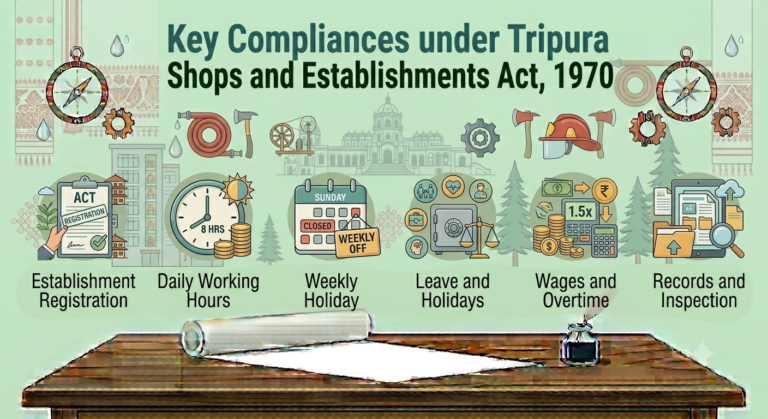
Tripura Shops and Establishments Act, 1970 and the Tripura Shops and Establishments Rules, 1970 constitute the principal legislative framework regulating conditions of employment in shops and establishments in the State of Tripura. The Act and Rules govern weekly rest entitlements, hours of work and overtime limits for shops and establishments, special protections for young persons and women, prohibition on child employment, annual and sick and casual leave entitlements, payment of wages and deductions, notice requirements for termination of service, maintenance of employment registers and records, and the issuance of letters of appointment. The Act has been amended six times up to and including the 6th Amendment of 2019, which introduced important changes including protections for women working in night shifts — requiring written consent and a suite of welfare facilities — and provisions relating to the employment of young persons. The Inspector appointed under the Act is empowered to inspect premises, examine records, and initiate prosecution proceedings for contraventions.
Applicability
Act and Rules apply to all shopkeepers and employers of shops and commercial establishments in Tripura. Every such employer is required to comply with weekly rest obligations, display Form G weekly holiday notices and Form H shift notices, observe the prescribed opening and closing hours and working-hour limits for shops (Section 6) and establishments (Section 7), ensure young persons do not exceed seven-hour daily limits or work beyond 8:00 PM, prohibit employment of children under twelve, obtain written consent from women working between 8:00 PM and 6:00 AM with the required welfare facilities in place, grant the prescribed annual, sick, and casual leave entitlements, pay accrued privilege leave wages on termination, issue Form R overtime notices, pay wages by the 10th of the succeeding month, give one month’s notice or wages in lieu before terminating employees with one or more years of service, maintain employee registers and all prescribed records, furnish letters of appointment to every employee, and maintain Form J leave registers, Form K pay registers, and leave passes for all leave other than casual leave.
Compliance Requirement Under the act in Accordance with the Rules & Regulations:
Every employer must allow every person employed in the shop or establishment at least one full day and one additional half day of weekly rest. Where a person is denied the weekly holiday, compensatory leave in lieu thereof must be given within two months of the scheduled holiday. Where a person employed is required to work on a rest day, the employer must pay wages at twice the ordinary rate of wages for that day. A notice in Form G specifying the weekly holiday must be displayed prominently at the shop or establishment.
The employer must display a notice in Form H specifying the weekly full and half holidays applicable to employees, before the cessation of work on the Saturday immediately preceding the first week in which the notice is to take effect. The notice must be preserved for at least one year. A copy of the notice must be sent to the Chief Inspector or concerned Inspector, as applicable. Departments or sections of a shop or establishment may work in more than one shift at the discretion of the employer, and an employee may be required to work in any shift so determined.
No shop may open earlier than 8:00 AM or close later than 9:00 PM, subject to any change notified by the Administration in the public interest. No person employed in a shop may be required or permitted to work for more than eight and a half hours in any one day or more than forty-eight hours in any one week. Total working hours including overtime shall not exceed ten hours in any one day, and overtime shall not exceed one hundred and twenty hours in any calendar year. A rest interval is mandatory after every six hours of continuous work.
Establishments such as hotels, restaurants, and cafes shall not close after 11:00 PM. No person employed in an establishment may be required or permitted to work for more than ten hours in any one day or more than forty-eight hours in any one week. Total working hours including overtime shall not exceed twelve hours in any one day, and overtime shall not exceed one hundred and forty-four hours in any one quarter. Where an employer requires or permits a lactating mother or pregnant woman to work overtime, written consent must be obtained from such woman before requiring her to do so.
No young person — being a person between 12 and 15 years of age — may be required or permitted to work in any shop or establishment for more than seven hours in any one day or more than forty hours in any one week. Work periods must be arranged so that no young person works for more than four continuous hours without a rest interval of at least one hour. Benefits admissible to a young person under any other law in force apply in addition to, and not in derogation of, the benefits provided under the Act.
No child who has not completed the age of twelve years shall be employed in any shop or establishment in any capacity whatsoever. The employer must ensure at all times that no child below twelve years of age is engaged or employed in the establishment.
No young person between the age of twelve and fifteen years may be allowed or required to work after 8:00 PM in any shop or establishment. Women may work in any shift on any day of the week; however, no woman shall be required or permitted to work between 8:00 PM and 6:00 AM without first obtaining her written consent. Where a woman is required to work during these hours, the employer must ensure: adequate provision of shelter, rest room, night creche, and ladies’ toilet; adequate protection of the woman’s dignity, honour, and safety; protection from sexual harassment; and transportation from the shop or establishment to the door step of her residence.
Every person employed in a shop or establishment is entitled to: (a) for every completed year of continuous service, privilege leave on full pay for fifteen days; (b) in every year, sick leave on half pay for fourteen days on production of a medical certificate; and (c) in every year, casual leave on full pay for twelve days. Privilege leave may be accumulated up to a maximum of fifty-six days. Sick leave may be accumulated up to a maximum of one hundred and twelve days. Casual leave shall not be accumulated and lapses if not availed during the year.
Where a person employed in a shop or establishment has their services terminated by or under the orders of the shopkeeper or employer, the employee is entitled to receive wages for the entire period of privilege leave standing to their credit at the time of termination. These wages must be paid in addition to all other dues payable to the employee on termination.
The employer must issue a notice in Form R to every employee before requiring them to work overtime, at least twenty-four hours in advance. The notice must also be submitted to the Chief Inspector or concerned Inspector before the overtime work commences. In cases of urgency where advance notice is not practicable, the notice in Form R must be posted within twenty-four hours after the completion of the overtime work.
All overtime work must be compensated at twice the ordinary rate of wages. Overtime work includes work done on any day declared by the Administration by notification to be a National holiday. Where any agreement or award provides for a higher rate of overtime wages, that higher rate shall prevail and must be paid.
All wages payable to a person employed in a shop or establishment must be paid not later than the 10th day of the following month. Deductions from wages are permissible only as authorised under the Payment of Wages Act, 1936. Where any deduction has been made or wages have not been paid within the prescribed date, the affected person — or a legal practitioner, Inspector, or authorised trade union official acting on their behalf — may apply to the competent authority within one year from the date of the deduction or default for a direction under sub-section (3) of Section 14.
No employer may terminate the services of any employee who has completed not less than one year of continuous service without: (a) giving the employee one month’s written notice with reasons for the termination; or (b) paying wages in lieu of such notice. Continuous service for this purpose includes any holiday, authorised leave, any period of a non-illegal strike, or any lockout. The computation of one completed year of continuous service is governed mutatis mutandis by Section 25B of the Industrial Disputes Act, 1947. Where an employee is wrongfully terminated, the Magistrate may order payment of up to two months’ wages as compensation.
Every shopkeeper or employer must maintain and keep an up-to-date register of employees in the prescribed form, together with all other registers, records, and documents as may be prescribed, and must display all prescribed notices at the establishment. All registers, records, and documents must be produced on demand by the Inspector. The register of employees may from time to time be inspected and signed by the employees themselves.
Every shopkeeper or employer must furnish a letter of appointment in the prescribed form to every person employed in the shop or establishment at or before the commencement of their employment. No person may be allowed to commence employment without receipt of a letter of appointment.
Where an employee is absent from duty without leave, the employer must issue a written notice to the employee requiring a written explanation of the absence within fifteen days of the notice. Based on the explanation received, the employer must take an appropriate decision: the absence may be regularised as leave, treated as leave without wages, or the lien on appointment may be terminated where the explanation is not satisfactory.
Every employer must maintain a Leave Register in Form J. Every leave application received — whether granted or refused — must be recorded in the Leave Register immediately after the decision is taken. The Leave Register must be kept up-to-date at all times.
Every employer must maintain a Pay Register in Form K. All payment entries must be duly certified by the shopkeeper or employer in the presence of two witnesses, as prescribed in the form. The Pay Register must be maintained accurately and made available for inspection on demand.
Where any leave — other than casual leave — is granted to an employee, the employer must issue a Leave Pass to the employee showing the nature and period of leave granted. The employee must intimate the employer of their address during the period of leave, and must inform the employer of any change in address within three days of such change.
Penalty & Consequences
Section 21(1A) — Contravention of Sections 5 to 13, 15, and 18
Whoever contravenes any of the provisions of Sections 5 to 13 (weekly rest, hours of work, young persons, children, night work, leave, accrued leave wages, overtime notice, and overtime wages), Section 15 (notice of termination), or Section 18 (letter of appointment) shall, on conviction, be punishable with a fine of not less than ₹200 and not more than ₹700 for the first offence. In case of any subsequent contravention after the first conviction, the offender shall be punishable with imprisonment for a term which may extend to three months, or with a fine of not less than ₹300 and not more than ₹1,000, or with both.
Section 21 — Contravention of Section 17
Whoever contravenes any provision of Section 17 (maintenance of employee register, records, and display of notices) shall, on conviction, be punishable with a fine of not less than ₹100 and not more than ₹500 for the first offence, and with a fine which may extend to ₹1,000 for any subsequent offence.
Section 14(3) — Compensation for Unlawful Deduction or Delayed Payment of Wages
Where the competent authority finds that an unlawful deduction has been made from an employee’s wages, it may direct the employer to refund the deducted amount along with compensation of up to ten times the deducted amount. In cases of unjustified delay in payment of wages, compensation of up to ₹10 may be imposed, subject to prescribed exceptions.
Rule 43 — Contravention of Rules
Whoever contravenes any provision — including obligations relating to Form G notice, Form H shift communication, Form R overtime notice, Form J leave register, Form K pay register, leave pass issuance, and unauthorised absence procedure — shall, on conviction, be punishable with a fine which may extend to ₹200. Where the contravention is a continuing one, an additional fine of up to ₹50 for every day after the first during which the breach continues shall also be imposed.
Disclaimer: The information contained in this Article is intended solely for personal non-commercial use of the user who accepts full responsibility of its use. The information in the article is general in nature and should not be considered to be legal, tax, accounting, consulting or any other professional advice. We make no representation or warranty of any kind, express or implied regarding the accuracy, adequacy, reliability or completeness of any information on our page/article.