
Background
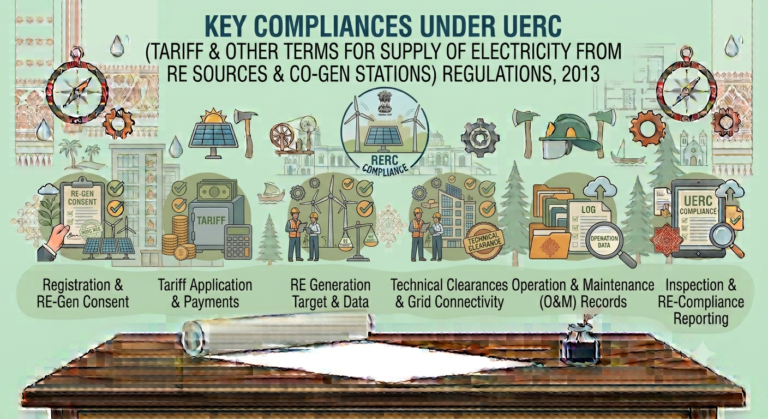
UERC (Tariff and Other Terms for Supply of Electricity from Renewable Energy Sources and Non-Fossil Fuel Based Co-generating Stations) Regulations, 2013 (“the Regulations”) were notified by the Uttarakhand Electricity Regulatory Commission (UERC) under the Electricity Act, 2003 to establish a comprehensive framework governing the terms, conditions, and tariff for the supply of electricity from renewable energy-based generating stations and non-fossil fuel based co-generating stations in Uttarakhand. The Regulations cover the full spectrum of compliance obligations for RE generators — from pre-commissioning clearances and PPA execution through to ongoing operational, reporting, grid code, and SLDC coordination obligations. They also govern the tariff determination framework (generic tariff for common project categories, and project-specific tariff for eligible generators), the RPO and Energy Storage Obligation trajectory for all Obligated Entities in the State, connectivity and evacuation infrastructure obligations, metering requirements, open access charges, and the framework for Grid-Interactive Rooftop PV (GRPV) and Grid-Interactive Small PV (GSPV) systems. The Regulations have been amended over the years to reflect evolving national and State policy, including the Second Amendment Regulations, 2025, which introduced the BESS utilisation procedure obligation under Regulation 39A(5) and established the Energy Storage Obligation trajectory for Uttarakhand.
Applicability
Regulations apply to five broad categories of entities in Uttarakhand. RE-based Generating Stations and Co-generating Stations — including solar, wind, small hydro, biomass, biogas, bagasse, and other RE technologies — must obtain all pre-commissioning clearances, exercise tariff options, execute and amend PPAs, comply with all ongoing operational obligations (reporting, grid code, IEGC, SLDC directions, payment of SLDC charges), establish SLDC communication systems, install protection equipment, maintain generating infrastructure per CEA standards, and provide CEA-compliant metering. Distribution licensees must sign or reject PPAs within prescribed timelines, apply for PPA approval within one month of signing, maintain monthly accounting of renewable energy, settle deemed generation and net energy on a monthly and annual basis, pay out VNM credits on disconnection of participating consumers, maintain prescribed voltage at interconnection points, procure green energy as requisitioned by consumers, complete GRPV or GSPV commissioning within 15 days of installation certificate submission, and prepare the BESS utilisation procedure per the Second Amendment Regulations, 2025. Obligated Entities — being distribution licensees, captive users, and open access consumers — must meet the prescribed RPO trajectory (Wind, HPO, Distributed, Other) and the Energy Storage Obligation trajectory for each financial year. GRPV and GSPV consumers and third-party solar owners are subject to back-feeding liability, safety obligations, metering and switch gear cost-sharing, load enhancement charges, and tripartite agreement requirements. Captive power plants must comply with the banking of power framework and pay parallel operation charges for grid support.
Compliance Requirement Under the act in Accordance with the Rules & Regulations:
Every RE-based Generating Station and Co-generating Station must abide by the emission standards and environmental norms set by the Union or State Government, and must obtain all required environmental and pollution clearances from the Central or State Pollution Control authorities — wherever applicable — before commissioning.
Every RE-based Generating Station and Co-generating Station must obtain all necessary clearances from the State Government and the Uttarakhand Renewable Energy Development Agency (UREDA), wherever necessary, before commissioning.
RE-based Generating Stations and Co-generating Stations may opt either for the generic tariff determined under these Regulations or for a Project Specific Tariff by filing a petition before the Commission. The option must be communicated to the distribution licensee at least three months before the anticipated commissioning date of the project or, in the case of multiple units, three months before commissioning of the first unit. Once exercised, the option cannot be changed during the validity period of the PPA. Project Specific Tariff is not available to: (i) any type of solar power plant; (ii) Wind Energy Power Plants; (iii) Battery Energy Storage Systems; or (iv) other RE-based power projects with installed capacity up to 1 MW.
All Power Purchase Agreements signed by RE-based Generating Stations and Co-generating Stations that were in existence on the date of notification of these Regulations must be amended — where inconsistent with these Regulations — to bring them into conformity. As amended, such PPAs shall be valid for the entire life of the RE-based Generating Station or Co-generating Station.
Where a distribution licensee intends to purchase power offered by an RE-based Generating Station or Co-generating Station, it must sign the Power Purchase Agreement within two months of the offer made by the generating company, in conformity with these Regulations and the relevant provisions of other applicable Regulations and the Electricity Act, 2003.
Where the distribution licensee is not willing to purchase power from an RE-based Generating Station or Co-generating Station, it must intimate this decision to the generating company within one month of the offer made by the generating company.
The distribution licensee must make an application for Commission approval of the PPA entered into with the generating company, in the form and manner specified under these Regulations and the UERC (Conduct of Business) Regulations, 2014 as amended, within one month of the date of signing the PPA. The application for approval must be accompanied by an unconditional Technical Feasibility Report, and the connectivity agreement signed with the Transmission or Distribution Licensee must form part of the PPA.
An RE-based Generating Station or Co-generating Station opting for Project Specific Tariff must file a petition before the Commission in such formats and with such information as the Commission may require, including: information in Forms 1.1, 1.2, 2.1, and 2.2 (as applicable); a Detailed Project Report outlining technical and operational details, site-specific aspects, capital cost premise, and financing plan; a statement of applicable terms and conditions and expected expenditure; a statement of any subsidy or incentive received or due, with tariff calculated with and without such subsidy; an auditor’s certificate of year-wise and component-wise expenditure with audited annual accounts; details of loans including a lender’s certificate confirming the project is not classified as a Non-Performing Asset; and the fee specified in the UERC (Fee and Fines) Regulations, 2002, as amended.
A Generating Station operating under a provisional tariff — whether at the generic rate or at a provisionally determined project-specific rate — must file a fresh application for determination of final tariff based on actual capital expenditure incurred up to the date of commercial operation or commissioning of the generating station, within eighteen months from the actual Commercial Operation Date (CoD).
A RE-based generating company seeking to extend the useful life of its plant through Renovation, Modernisation and Up-gradation (RMU) must apply to the Commission for in-principle approval of its RMU proposal before undertaking works, along with a Detailed Project Report providing the complete scope, cost-benefit analysis, estimated life extension from a reference date, financial package, phasing of expenditure, schedule of completion, and other details as required by the Commission.
Every RE-based Generating Station and Co-generating Station must submit to the Commission, on an annual basis or as otherwise directed, information in respect of generation, demand met, capacity availability, capacity utilisation factor, auxiliary consumption, specific heat rate, specific oil consumption, and any other parameters as may be directed by the Commission from time to time.
Every RE-based Generating Station and Co-generating Station must submit its audited annual accounts — along with a copy of the income tax returns filed — to the Commission on an annual basis. Where the generator operates more than one generating station, it must maintain and submit plant-wise details of Operation and Maintenance expenses along with the audited accounts on a yearly basis.
Every RE-based Generating Station and Co-generating Station must ensure that all Government and other statutory dues are paid within the stipulated time.
Every RE-based Generating Station and Co-generating Station must submit to the Authority or Commission such technical details concerning generation or transmission as may be specified for the purpose of carrying out cost and efficiency studies.
Every RE-based Generating Station and Co-generating Station must establish and maintain a communication and data transfer system with the State Load Dispatch Centre (SLDC) for coordination in respect of: (a) scheduling; (b) exchange of data on the quantity of electricity transmitted through the grid; and (c) real-time grid operation and dispatch of electricity in accordance with the Indian Electricity Grid Code (IEGC) and the State Grid Code.
Every RE-based Generating Station and Co-generating Station must abide by grid discipline and install adequate protection equipment for the safety of its system and of human life. The generating station shall not be entitled to any compensation in the event of grid failure or any interruption or damage to the plant or its associated substation and transmission line on account of any occurrence in the grid.
Every RE-based Generating Station and Co-generating Station must establish, operate, and maintain its generating station, associated substation, and dedicated transmission lines (where it exercises the option to construct such lines) in accordance with: (a) the technical standards for construction of electrical plants, electric lines, and connectivity with the grid as specified by the Authority under Section 73(b) of the Electricity Act, 2003; (b) safety requirements for construction, operation, and maintenance of electrical plants and electric lines as specified by the Authority under Section 73(c); (c) grid standards for operation and maintenance of transmission lines as specified by CERC, CEA, or the State Transmission Utility under Section 73(d); and (d) the conditions for installation of meters as specified by the Authority or STU under Section 73(e).
Every RE-based Generating Station and Co-generating Station must ensure compliance with the Indian Electricity Grid Code (IEGC), the State Grid Code, and the Distribution Code, as amended from time to time.
Every RE-based Generating Station and Co-generating Station must ensure compliance with all general and specific directions issued and all regulations made by the Commission for generating companies.
Every RE-based Generating Station and Co-generating Station must coordinate with the State Transmission Utility and the Distribution Licensee for the purpose of planning and coordination relating to the intra-State transmission and distribution system as provided under the Electricity Act, 2003.
Every RE-based Generating Station and Co-generating Station must comply with all directions issued by the State Load Dispatch Centre. Failure to comply renders the generating station liable to appropriate action under the Electricity Act, 2003.
Every RE-based Generating Station and Co-generating Station must pay the fees and charges to the SLDC as may be specified or directed by the Commission from time to time.
Every Obligated Entity — being a distribution licensee, captive user, or open access customer in Uttarakhand — must procure a minimum percentage of its total electricity requirement from eligible renewable energy sources in each financial year, in four sub-categories: Wind RPO (met exclusively from Wind Power Projects commissioned after 31st March 2022); Hydro Purchase Obligation (HPO, met from Hydro Power Projects commissioned after 8th March 2019); Distributed RPO (met from RE projects below 10 MW, including net metering configurations); and Other RPO (met from any remaining eligible RE source). The RPO trajectory, effective from 1st April 2024, is as follows: FY 2024-25 — Wind 1.97%, HPO 0.87%, Distributed 0.38%, Other 29.55%, Total 32.77%; FY 2025-26 — Total 33.01%; FY 2026-27 — Wind 1.97%, HPO approximately 1.34%, Distributed 1.35%, Other 31.29%, Total 35.95%; FY 2027-28 — Total 38.81%; FY 2028-29 — Wind 2.95%, HPO 1.42%, Distributed 1.95%, Other 35.05%, Total 41.36%; FY 2029-30 — Wind 3.48%, Other 36.27%, Total 43.33%.
Every Obligated Entity must also meet a prescribed Energy Storage Obligation (ESO) for each financial year, representing a percentage of total electricity consumption that must be met through solar or wind energy stored through Energy Storage Systems. The ESO is calculated in energy terms as a percentage of total electricity consumption and is treated as fulfilled only when at least 85% of the total energy stored in the Energy Storage System, on an annual basis, has been procured from renewable energy sources. The quantum of energy stored from renewable sources that counts towards ESO fulfilment is also counted towards the overall RPO compliance to that extent. The ESO trajectory for FY 2025-26 onwards has been prescribed under the Second Amendment Regulations, 2025 (for example, 3.0% for FY 2027-28, escalating in subsequent years).
The distribution licensee, in consultation with the SLDC, must prepare a detailed procedure for the optimal utilisation of Battery Energy Storage Systems (BESS) — covering charging power costs, scheduling, charge and discharge protocols, and location considerations — and submit this procedure to the Commission for approval within three months of the notification of the Second Amendment Regulations, 2025.
The distribution licensee must account for renewable energy supplied at the distribution level on a monthly basis.
The distribution licensee must pay for saleable deemed generation, on an annual basis, for eligible Small Hydro, Solar PV, and Solar Thermal projects, calculated at the applicable generic or project-specific tariff rate. Settlement of payment towards deemed generation charges must be carried out within three months of the completion of the financial year. Such charges paid by the distribution licensee towards deemed generation are not allowed as a pass-through in tariffs; the distribution licensee must bear such charges. This obligation applies only to projects that have signed a long-term PPA and are connected to an 11 kV or higher voltage grid substation.
Where electricity generated from a plant is being exclusively sold to the State distribution licensee, the electricity (in kWh) procured by the Generating Station from the distribution licensee for its own use or for start-up power must be adjusted from the electricity sold to the distribution licensee on a month-to-month basis. The distribution licensee must make payment for the net energy sold — being the difference between the total energy injected into the grid and energy drawn from the grid by the Generating Company.
Where the service connection of any participating consumer under Virtual Net Metering is disconnected due to any reason under any law in force, the unadjusted units or remaining credits of that consumer must be paid by the distribution licensee at the end of the financial year.
The distribution licensee must apply the prescribed Group Net Metering and Virtual Net Metering billing and energy accounting procedure. Where the export of units during any billing period exceeds the import of units at the connection where the solar power plant is located, surplus units must be adjusted against the energy consumed in the monthly bill of the service connection or connections as per the priority list provided by the consumer. Electricity consumption in any time block must first be compensated with generation in the same time block; any remaining surplus units are billed to the licensee at the generic tariff or the bid-discovered rate, whichever is lower. Under Virtual Net Metering, energy generated must be credited in the monthly bill of each participating consumer per the procurement ratio indicated in the agreement or Memorandum of Understanding.
The distribution licensee must maintain voltage at the point of interconnection with eligible RE projects within the following limits with reference to the declared voltage: at 11 kV voltage level, +6% and -9%; and at 33 kV and above, as per the State Grid Code.
Any consumer may elect to purchase green energy up to a specified percentage of their consumption — including up to 100% of their entire consumption — by placing a requisition with the distribution licensee. The distribution licensee must procure such quantity of green energy and supply it to the consumer. Consumers may voluntarily purchase more renewable energy than obligated, in steps of twenty-five percent up to one hundred percent. Any requisition for green energy from a distribution licensee must be for a minimum period of one year.
The distribution licensee must install the energy meter for a Solar PV generating plant or Battery Energy Storage System within seven days from the receipt of a complete application from the generator. The date of commissioning of a Solar PV plant is the date of first injection of power into the licensee’s grid after completion of the project in all respects, subsequent to: (i) installation of the energy meter by the distribution licensee within seven days of a complete application; and (ii) issuance of a Clearance Certificate by the Electrical Inspector. For BESS, commissioning requires completion of all contractual obligations related to interconnection, grid synchronisation, and metering, including meter installation within seven days of a complete application.
A Solar PV Generating Station must demonstrate a minimum Performance Ratio of 75% — based on the rated installed capacity in kW or MW — within ten days from the date of first injection of power into the licensee’s grid, following compliance with the metering and Electrical Inspector clearance prerequisites. The distribution licensee must issue a certificate to this effect upon verification.
After installation of the Grid-Interactive Rooftop PV (GRPV) or Grid-Interactive Small PV (GSPV) system, the consumer must submit the installation certificate to the distribution licensee.
After receiving the consumer’s installation certificate for the GRPV or GSPV system, the distribution licensee must complete the signing of the Connection Agreement, installation of the meter, and successful commissioning of the rooftop solar photovoltaic system within fifteen days from the date of submission of the installation certificate.
Where installation of a GRPV or GSPV system requires enhancement of the consumer’s sanctioned load, the Prosumer must pay charges towards load enhancement and the security deposit for the enhanced load in accordance with the UERC (The Electricity Supply Code, Release of New Connections and Related Matters) Regulations, 2020, as amended. Applications for GRPV or GSPV of up to 10 kW — where complete in all respects — are deemed accepted without requiring a technical feasibility study.
Where any augmentation is required to connect a GRPV or GSPV plant, the distribution licensee must facilitate and bear the capital expenditure for system strengthening or augmentation up to the interconnection point from the nearest substation.
The eligible consumer is solely responsible for any incident or accident — fatal, non-fatal, departmental, non-departmental, or involving damage to the licensee’s material — that may occur due to back-feeding from the solar plant when the grid supply is off. The consumer must not only bear the cost of any material damage to the licensee’s assets but must also provide compensation for any loss of human or animal life in case of such incidents. The distribution licensee reserves the right to disconnect the consumer’s installation at any time in such emergencies to prevent accident or damage to persons and property.
The owner of a Grid Interactive Rooftop or Small Solar PV plant is responsible for the safe operation, maintenance, and rectification of defects of the system up to the interconnection point. Beyond the interconnection point — including the meters — responsibility for safe operation, maintenance, and defect rectification rests with the distribution licensee.
The owner of a GRPV or GSPV solar generator must bear the cost of switch gear, metering, and protection arrangement at the generator end. The distribution licensee must provide a Check Meter of the same specification as the Main Meter. The plant owner has the option to procure the Check Meter directly; in such a case, the cost of the Check Meter must be refunded by the licensee, being the lower of: (a) the actual cost of the meter; or (b) the highest rate discovered through the licensee’s Competitive Bidding Process, escalated by 25%.
Where a GRPV or GSPV plant is installed in the consumer’s premises by a third party who intends to sell net energy (after adjustment of the entire consumption of the premises owner) to the distribution licensee, a tripartite agreement must be executed among the third party, the Eligible Consumer, and the distribution licensee before commencing such third-party net energy sale.
The distribution licensee must provide connectivity to RE-based Generating Stations with capacity up to 25 MW at its nearest distribution substation — preferably within a range of 10 kilometres from the location of such generating station. The transmission licensee must provide connectivity to RE-based Generating Stations with installed capacity of more than 25 MW at its nearest transmission substation — preferably within 10 kilometres — subject to technical feasibility and the technical standards specified by the CEA.
Where an RE-based Generating Station exercises the option to construct the evacuation system — including the line up to the nearest substation of the Transmission or Distribution Licensee — the generating station must bear the cost of the required bay, terminal equipment, associated synchronisation equipment, pooling switching station (if any), and all other evacuation infrastructure. The generating station may alternatively get this work carried out by the State Transmission or Distribution Licensee. Land for extending the bay at the transmission or distribution substation must be provided free of cost by the owner of the substation.
The Generating Station is responsible for maintenance of terminal equipment at the generating end and of dedicated transmission lines — including the pooling switching station, if any — owned by such generating station. The Transmission or Distribution Licensee or the STU, as applicable, is responsible for maintenance of the terminal equipment at its own substation. Transmission and distribution licensees may carry out maintenance of the generating station’s terminal equipment and dedicated lines at mutually agreed charges, where desired by the generating company.
Every RE-based Generating Station must provide meters at the point of interconnection — as defined under these Regulations — complying with the regulations on installation of meters specified by the Central Electricity Authority (CEA), whether the electricity is sold to distribution licensees, local rural grids, or third parties.
Where an RE generator or consumer avails of non-discriminatory open access to the intra-State transmission system, the RE generator or the consumer (as applicable) must pay transmission charges and wheeling charges for use of the intra-State transmission system and distribution system, calculated in accordance with the UERC (Terms and Conditions of Intra-State Open Access) Regulations, 2015, and amendments thereto, along with applicable losses. No transmission or wheeling charges are payable for sale of electricity to the distribution licensee or to a local rural grid within the State.
For sale of electricity to a person other than a distribution licensee or a local rural grid, the RE-based Generating Station must comply with the principles of optimum scheduling and dispatch as per the IEGC and State Grid Code, and must pay such SLDC fee as specified under the UERC (Terms and Conditions of Intra-State Open Access) Regulations, 2015.
For the purpose of applicability of tariff and wind-zone classification, the generating company operating a Wind Energy Generating Station must provide duly validated information on annual mean wind power density measured at 100-metre hub height. Wind masts erected either by the National Institute of Wind Energy (NIWE) or by a private developer — duly validated by NIWE — are normally extended 10 kilometres from the mast-point in all directions for uniform terrain. Based on NIWE validation, the State Nodal Agency must certify the zoning of the proposed wind farm complex.
Captive and Co-generation plants availing power banking must comply with the following conditions: energy may be banked up to 100% during declared peak hours; banked power may only be withdrawn during non-peak hours; ABT-compliant Special Energy Meters must be provided, with monthly settlement based on Special Energy Meter readings — power banked during peak hours may be withdrawn during non-peak hours; upon introduction of intra-state ABT, banking and withdrawal are subject to day-ahead scheduling; power withdrawn that cannot be treated as banked-power withdrawal is charged as power purchased per Regulation 49; banked power must be withdrawn within the same financial year; unutilised banked power at year-end is treated as a sale to the licensee, settled at the tariff for the year of banking without deduction of banking charges; and banking charges are adjusted in kind at 8% of the energy banked, with additional charges for drawal patterns that deviate from the peak-to-non-peak norms.
Captive power plants availing open access must pay Parallel Operation Charges to the Distribution Licensee and/or Transmission Licensee, as applicable, for utilisation of grid support. The Commission specifies the Parallel Operation Charges in its annual Tariff Orders for the distribution or transmission licensee.
Penalty & Consequences
Section 142 of the Electricity Act, 2003 (as amended by the Jan Vishwas (Amendment of Provisions) Act, 2026, with effect from 1st June 2026) — Penalty for Contravention
Where the Appropriate Commission, on receipt of a complaint or on its own motion, is satisfied that any person has contravened any provision of the Electricity Act, 2003, or any rule, regulation, or direction issued thereunder — including contraventions of the UERC (Tariff and Other Terms for Supply of Electricity from Renewable Energy Sources and Non-Fossil Fuel Based Co-generating Stations) Regulations, 2013 and its amendments — that person may be directed to pay a penalty. The penalty shall not be less than ₹10,000 but may extend to ₹5,00,000 for each contravention. In the case of a continuing failure, an additional penalty of not less than ₹1,000 but which may extend to ₹10,000 per day during the period of such failure shall also be imposed.
Regulation 6(9) — Failure to Comply with SLDC Directions
A RE-based Generating Station or Co-generating Station that fails to comply with directions issued by the State Load Dispatch Centre is liable to appropriate action under the Electricity Act, 2003. This includes, but is not limited to, proceedings under Section 142 of the Act and any other enforcement mechanism available to the SLDC or the Commission.
Regulation 51(3) — Deemed Generation Charges Not a Pass-Through
Where the distribution licensee fails to settle deemed generation charges within three months of the close of the relevant financial year, the obligation to pay remains enforceable against the distribution licensee. Such charges are not allowable as a pass-through in tariffs and must be borne entirely by the distribution licensee; they may not be recovered from consumers through the Annual Revenue Requirement.
Disclaimer: The information contained in this Article is intended solely for personal non-commercial use of the user who accepts full responsibility of its use. The information in the article is general in nature and should not be considered to be legal, tax, accounting, consulting or any other professional advice. We make no representation or warranty of any kind, express or implied regarding the accuracy, adequacy, reliability or completeness of any information on our page/article.