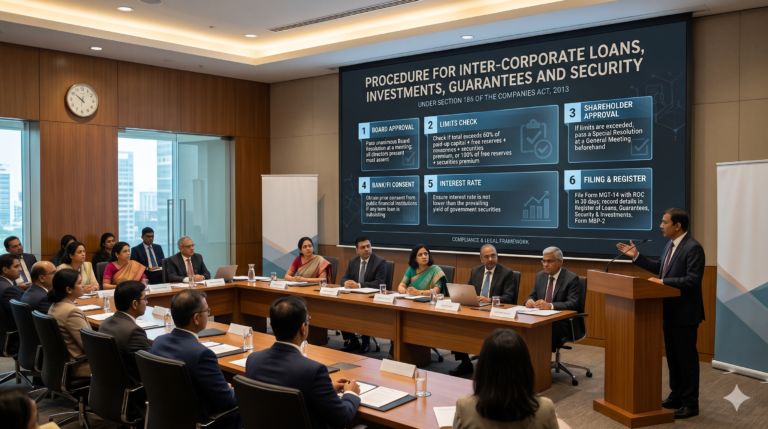
Section 186 governs every loan a company gives to any person or body corporate, every guarantee or security it provides for another’s loan, and every acquisition of securities of another body corporate. It sets a ceiling on these transactions, beyond which shareholder approval is needed, and requires the Board to approve each one unanimously at a meeting.
This article walks through the procedure, from checking the limits to maintaining the register, with the timeline for each step.
Governing law: Sections 179(3), 186 and 117 of the Companies Act, 2013; Rules 11, 12 and 13 of the Companies (Meetings of Board and its Powers) Rules, 2014; Regulations 30 and 44 of the SEBI (LODR) Regulations, 2015 Applies to: All Companies (subject to exemptions in Section 186(11)) Approval required: Unanimous Board resolution at a meeting; special resolution of members where limits are exceeded Key ROC form: e-Form MGT-14; Register in Form MBP-2 |
Limits and Conditions
Condition | Requirement | Provision |
Overall limit | Loans, guarantees, security and investments in aggregate up to the higher of 60% of paid-up capital, free reserves and securities premium, or 100% of free reserves and securities premium | Section 186(2) |
Beyond the limit | Prior special resolution of members | Section 186(3) |
WOS and JV exemption | No special resolution is required for loans, guarantees or security to a wholly owned subsidiary or joint venture, or for acquiring securities of a wholly owned subsidiary; these are excluded from the limit computation | Proviso to Section 186(3) |
Board approval | Resolution at a meeting with the consent of all directors present; no resolution by circulation | Section 186(5); Section 179(3) |
Public financial institution | Prior approval of the PFI where a term loan is subsisting, unless within limits and there is no default | Section 186(5) |
Deposit default | No loan, guarantee, security or investment while a default in repaying deposits or interest is subsisting | Section 186(6) |
Rate of interest | Not lower than the yield of the government security closest to the tenor of the loan (1, 3, 5 or 10 years) | Section 186(7) |
Layers of investment companies | Investment through not more than two layers of investment companies | Section 186(1) |
Section 186 does not apply to loans, guarantees or security given in the ordinary course of business by a banking company, insurance company, housing finance company, NBFC or a company providing infrastructural facilities, nor to certain acquisitions by NBFCs and investment companies (Section 186(11)). Loans to directors and to entities in which directors are interested are separately governed by Section 185.
Step-by-Step Procedure
Step 1: Computation of Limits and Pre-checks – before the Board Meeting
(Applicable to All Companies)
Section 186(2), (6) and (7) of the Companies Act, 2013
- The proposed transaction is required to be added to existing loans, guarantees, security and investments and tested against the limit, based on the latest audited financial statements.
- There is required to be no subsisting default in deposits, and the consent of any PFI lender is required to be checked.
- For a loan, the interest rate is required to be fixed at or above the applicable government security yield.
Step 2: Notice and Agenda for the Board Meeting – at least 7 days before the meeting
(Applicable to All Companies)
Section 173(3) of the Companies Act, 2013 read with SS-1
- Notice of the Board Meeting is required to be given in writing to every director at the address registered with the company, by hand, post or electronic means.
- The notice is required to be accompanied by the agenda, notes on agenda, draft resolutions and supporting papers for the proposed loan, guarantee, security or investment.
- The notes are required to set out the recipient, the amount, the purpose, the rate of interest and tenure, the limits computation, and whether a special resolution is required.
- A meeting to transact urgent business may be called at shorter notice, provided at least one independent director (if any) is present. If none is present, the decisions are final only on ratification by at least one independent director.
Step 3: Board Meeting to Approve the Transaction – on the date fixed
(Applicable to All Companies)
Sections 179(3) and 186(5) of the Companies Act, 2013 read with Rule 11
- The Board is required to pass the resolution at a meeting with the consent of all directors present.
- Where the limit is exceeded, the Board is required to approve the notice of the general meeting seeking a special resolution. The resolution may specify the total amount up to which the Board is authorised.
- Directors interested in the recipient are required to disclose their interest and abstain where Section 184 applies.
Step 4: Disclosure of Outcome to Stock Exchanges and Website – within 30 minutes of conclusion of the meeting
(Applicable in case of Listed Company)
Regulation 30(6) and 30(8) read with Schedule III of the SEBI (LODR) Regulations, 2015
- The outcome of the meeting, including any material loan, guarantee or investment, is required to be disclosed to the stock exchanges within 30 minutes of the conclusion of the meeting, along with the time of commencement and conclusion of the meeting.
- If the meeting ends after trading hours but more than 3 hours before the next trading session starts, the disclosure is required within 3 hours of its conclusion.
- The same disclosure is required to be hosted on the company’s website simultaneously and retained there for at least 5 years (Regulation 30(8)).
Step 5: Filing of Board Resolution with ROC – within 30 days of the meeting
(Applicable to Public Companies)
Section 117 read with Section 179(3) of the Companies Act, 2013
The Board resolution for loans, investments, guarantees or security falls under Section 179(3) and is required to be filed with the Registrar of Companies in e-Form MGT-14. Private companies are exempt from filing resolutions passed under Section 179(3).
Step 6: Minutes of the Board Meeting – draft within 15 days, signed within 30 days
(Applicable to All Companies)
Section 118 of the Companies Act, 2013 read with Paragraph 7 of SS-1
- Draft minutes are required to be circulated to all members of the Board within 15 days of the meeting. Members may give their comments within 7 days of receipt.
- Minutes are required to be entered in the Minutes Book within 30 days of the meeting and signed by the Chairman.
- A copy of the signed minutes is required to be circulated to all members within 15 days of signing.
Step 7: Notice of General Meeting to Members – at least 21 clear days before the meeting
(Applicable to All Companies)
Sections 101 and 102 of the Companies Act, 2013 read with Rule 18 of the Companies (Management and Administration) Rules, 2014 and SS-2
- Notice is required to be sent to every member, the legal representative of a deceased member, the assignee of an insolvent member, every director and the statutory auditors (and the secretarial auditor and debenture trustee, where applicable), by hand, post, courier or e-mail.
- Notice is required to be given at least 21 clear days before the meeting, excluding the day of sending and the day of the meeting, and placed on the company’s website, if any.
- An explanatory statement under Section 102 is required to be annexed, setting out the material facts, including the nature of concern or interest of directors, KMP and their relatives.
- The explanatory statement is required to state the particulars of the transaction, its purpose and the limits computation.
- The meeting may be called at shorter notice with the consent of a majority in number of members entitled to vote who represent at least 95% of the paid-up share capital carrying voting rights.
Step 8: Submission of Notice to Stock Exchanges – within 12 hours of dispatch of notice
(Applicable in case of Listed Company)
Regulation 30 read with Para A, Part A of Schedule III of the SEBI (LODR) Regulations, 2015
The notice of the general meeting is required to be submitted to the stock exchanges and hosted on the company’s website simultaneously.
Step 9: Cut-off Date and Remote E-Voting – e-voting open for at least 3 days, closing at 5:00 p.m. on the day before the meeting
(Applicable to Listed Companies and Companies having 1,000 or more members)
Section 108 of the Companies Act, 2013 read with Rule 20 of the Companies (Management and Administration) Rules, 2014
- The cut-off date for determining voting eligibility is required to be not earlier than 7 days before the meeting.
- A scrutiniser is required to be appointed, after obtaining his or her consent, to scrutinise the e-voting and the voting at the meeting.
- Remote e-voting is required to remain open for at least 3 days and to close at 5:00 p.m. on the date preceding the meeting.
Step 10: Holding the General Meeting – on the date fixed
(Applicable to All Companies)
Sections 100, 103 and 108 of the Companies Act, 2013 read with SS-2
- The meeting is required to have the prescribed quorum present: for a public company, 5, 15 or 30 members personally present depending on whether the membership is up to 1,000, between 1,000 and 5,000, or more than 5,000; for a private company, 2 members.
- Members are required to approve the transaction, or an overall limit for such transactions, by a special resolution before it is made.
Step 11: Proceedings, Scrutiniser’s Report and Voting Results – proceedings within 12 hours; voting results within 2 working days
(Applicable in case of Listed Company)
Regulations 30 and 44(3) of the SEBI (LODR) Regulations, 2015 read with Rule 20(4) of the Companies (Management and Administration) Rules, 2014
- A summary of the proceedings of the meeting is required to be submitted to the stock exchanges within 12 hours of its conclusion.
- The scrutiniser is required to submit a consolidated report of the votes cast to the Chairman, who declares the result.
- Voting results, along with the scrutiniser’s report, are required to be submitted to the stock exchanges within 2 working days of the conclusion of the meeting and hosted on the company’s website.
Step 12: Filing of Resolution with ROC – within 30 days of passing the resolution
(Applicable to All Companies)
Section 117 of the Companies Act, 2013
The special resolution under Section 186(3) is required to be filed in e-Form MGT-14, with the notice and explanatory statement.
Step 13: Register of Loans, Guarantees, Security and Investments – within 7 days of making the transaction
(Applicable to All Companies)
Section 186(9) of the Companies Act, 2013 read with Rule 12
Particulars of each transaction are required to be entered chronologically in the register in Form MBP-2 within 7 days. The register is kept at the registered office, authenticated by the Company Secretary or an authorised director, and open to inspection by members.
Step 14: Disclosure in Financial Statements and Board’s Report – annually
(Applicable to All Companies)
Sections 134(3)(g) and 186(4) of the Companies Act, 2013
The full particulars of loans, guarantees, security and investments, and the purpose for which the recipient proposes to use them, are required to be disclosed in the financial statements, and referred to in the Board’s report.
Post-Meeting Filings and Disclosures
Filing / Disclosure | Authority | Due Date | Applies to |
e-Form MGT-14 (Board resolution) | Registrar of Companies | Within 30 days of meeting | Public Companies |
e-Form MGT-14 (special resolution) | Registrar of Companies | Within 30 days of passing | All Companies |
Entry in Register MBP-2 | Company | Within 7 days of the transaction | All Companies |
Voting results | Stock Exchanges | Within 2 working days of meeting | Listed Company |
Penalties for Non-Compliance
Default | Provision | Penalty |
Contravention of Section 186 | Section 186(13) | Company: fine of ₹25,000 to ₹5 lakh; every officer in default: imprisonment up to 2 years and fine of ₹25,000 to ₹1 lakh |
Non-filing or late filing of MGT-14 | Section 117(2) | ₹10,000 on company and every officer in default, plus ₹100 per day (maximum ₹2 lakh for company, ₹50,000 for officers) |
Failure to give notice of Board Meeting | Section 173(4) | ₹25,000 on every officer whose duty it was to give notice |
Default in minutes / Secretarial Standards | Section 118(11) | ₹25,000 on company and ₹5,000 on every officer in default, per meeting |
Delay in disclosures under the SEBI (LODR) Regulations | Section 15A(b), SEBI Act, 1992 | ₹1 lakh, up to ₹1 lakh per day of default (maximum ₹1 crore) |
Section 186 at a Glance
Day 0 = Date the loan, guarantee, security or investment is made
Timeline | Action | Applies to |
Before Board Meeting | Limits computation and pre-checks | All Companies |
Board Meeting − 7 days | Notice and agenda to directors | All Companies |
Board Meeting | Unanimous approval of directors present | All Companies |
Before Day 0 | Special resolution (if limit exceeded) | All Companies |
Day 0 + 7 days | Entry in Register MBP-2 | All Companies |
Resolution + 30 days | MGT-14 filed | Public / All Companies |
Annually | Disclosure in financial statements | All Companies |